Worm Castings for Cannabis: Mix Ratios, Top Dress, and Tea


Worm castings for cannabis are worm manure. That is the whole product. Red wigglers eat bedding and scraps, and what comes out the other end is dark, damp, and already finished. The old page on this URL had the right instinct: mix them in, top-dress them, make tea, feed the bin on purpose. It also said you could dump as much as you want and never burn a plant, and that 35% of the mix was the house rate. Those lines need a grower’s correction, not a slogan. Castings are gentle. They are not magic dirt. Too much of a fine, wet amendment still turns a pot into mud.
This rewrite keeps that backbone — what they are, how to get them, what to feed the worms, how to supercharge a bin, how to use them, how much — and teaches what people actually search now: mix ratios, top dress, worm casting tea versus leachate, seedling rates, and why the NPK on the bag looks like a joke next to a bottle of 10-10-10. You are building a cannabis soil, not decorating a houseplant. The job is biology plus a slow trickle of nutrients, in a mix that still drains.
What Worm Castings for Cannabis Actually Are

Worm castings are the digested, excreted remains of organic matter that passed through a composting worm, usually Eisenia fetida, the red wiggler. Gardeners also call them vermicompost, worm poop, and gardener’s gold. Strictly, vermicompost is the bin harvest: castings plus leftover bedding that the worms have not finished. A bag labeled worm castings is often that mix. For a cannabis pot, the difference is small if the material is finished, dark, and smells like a forest floor after rain. If it smells like a dumpster or ammonia, it is not finished. Do not put that in a tent.
They look like moist coffee grounds. Crumbly, dark brown to black, a little greasy between fingers, not dusty. Good castings hold a squeeze and break apart. Bone-dry pellets from a hot warehouse are a different product. Heat and time kill most of the biology you paid for. You still get some organic matter and a little nitrogen. You do not get a living inoculant. Buy moist when you can. Store cool, dark, and barely damp, like you would seed. Dry them out and you own dirt with a story.
Worm castings vs compost vs fertilizer
Hot compost is bulk organic matter cooked by bacteria in a pile. It is cheaper by the yard and coarser. Worm castings are cooler, finer, and denser in microbes and plant-available bits per pound. A bottle of synthetic 10-10-10 is a salt. It feeds the plant this week and does nothing for the food web. Castings sit in the middle: low guaranteed analysis, high biology, slow release. That is why the bag often reads something like 1-0-0 or 0.5–1.5 nitrogen, 0.2–0.8 phosphorus, 0.8–1.5 potassium, plus calcium, magnesium, iron, zinc, and a pile of humic material. The number looks weak because most of the nutrient is tied up in organic form. Microbes have to chew it first. That is the feature, not the bug.
If you want a complete organic program, castings are the biology and the buffer. Meals, rock dust, and a decent base mix do the rest: organic growing amendments, organic marijuana fertilizer, and cannabis soils.
Why Worm Castings Work in a Cannabis Pot
Cannabis roots want air, water, and a cafeteria that does not dump salt on them at noon. Castings help all three if you do not overdo the volume. The particles are small and full of humus. Humus holds water and still leaves pore space if the rest of the mix has perlite, pumice, or bark. Cation exchange capacity goes up, which is a fancy way of saying the mix can hang onto calcium, magnesium, potassium, and ammonium instead of flushing them out the drain hole. CEC explainer: cannabis and cation exchange capacity.
The biology is the part bottles cannot fake. A gram of decent vermicompost can carry huge counts of bacteria, fungi, protozoa, and the enzymes they leave behind. Those organisms mineralize the kelp, the bone meal, the alfalfa you mixed last month. They also compete with the pathogens that love wet, dead mix. Research on vermicompost is real on germination, some root diseases, and seedling vigor. It is not a spray that deletes spider mites. If a sales page promises pest-proof plants because of chitinase in worm guts, treat that as a bonus maybe, not a IPM program. Mites still show up under a dry canopy. Castings will not save a swamp: cannabis plants are dying.
Watering changes when you add them. A peat-perlite mix without organics dries from the top and you learn the lift. A 20% castings mix stays heavy a day longer. That is the water-holding you wanted outdoors in July. Indoors under a strong LED it is how beginners water on Monday, Wednesday, and Friday and drown the root zone. Lift the pot. If it is still heavy, wait. Fabric pots forgive more than plastic. Plastic plus a high-castings mix plus a saucer of standing water is a gnat hatchery. The amendment did not fail. The schedule did.
pH is quieter in a castings mix than in salt coco. Humus buffers. You still should not water with 8.2 well water and hope. Aim the input around 6.2–6.8 in soil. You will see fewer wild swings than a bottled coco run, which is the point of living soil. If leaves go pale with locked tips, check runoff and the rest of the amendments before you dump another cup of castings on top. More biology will not unstick a calcium problem if the water is the problem.
The “will not burn” claim
Fresh, finished castings are hard to burn a plant with. Seeds sprout in bins. That is true. Two caveats. First, a pot that is 60% fine, wet castings holds water like clay. Roots drown. That looks like burn, lockout, and damping off. Second, some bagged products are dried, screened, and sitting on a saltier lab test than homemade. Read the guaranteed analysis. If you already run a hot super soil plus bottles plus tea every watering, the castings are not the innocent party. They added more N and more water-holding to a mix that was already loud. The plant does not care which bag did it.
What they will not do
They will not replace a bloom booster if your mix has no phosphorus source and you vegged a hungry sativa for two months. They will not fix a 5.2 pH coco disaster by themselves. They will not make a 2×2 with a 100-watt bulb yield like a 4×4. Light still writes the grams: grow lighting for cannabis. Water still kills more plants than genetics: water cannabis plants. Castings make a decent organic mix work. They do not make a bad room honest.
How to Get Worm Castings for Cannabis

Three sources, in order of how much you can trust them. Homemade is first. You know the bedding, the food, and that nobody cooked the bag in a truck. A local worm farm that sells moist, screened castings is second. Garden-center bags are third. They work as organic matter. They are often drier and older. Smell the bag. Earth is good. Sour, fishy, or nothing at all is a skip. If the only option is a dusty brick, hydrate it, mix it, and do not pretend you bought a living soil starter. You bought a slow amendment.
The old page was going to write a farm-start article. That piece exists now: worm bin composting for cannabis. If you only need a few gallons a year, buy. If you run a lot of living soil, a bin pays for itself in a season and you can feed it cannabis trim: cannabis trimmings. Do not dump fresh, wet, salty trim in a tiny bin and wonder why the worms climbed the walls. Mix it with dry cardboard.
How to judge a bag
- Color: dark brown to black, not orange or gray.
- Smell: soil, not garbage, not chlorine, not perfume.
- Feel: moist crumb, not powder, not sludge.
- Debris: a little cardboard or eggshell is fine. Whole food scraps and fruit flies mean it is not finished.
- Label: NPK listed, feedstock listed if they will tell you. “Organic” with no analysis is a shrug.
- Price: the cheapest pallet of dust is not a steal if you wanted microbes.
Bedding and Food Sources for Worms

Worms live in bedding and eat both the bedding and the food. Bedding is the brown: shredded cardboard, newspaper without glossy junk, dried leaves, aged sawdust in moderation. Commercial farms often use sawdust because it is cheap. Home bins do well on cardboard and leaves. Keep it damp like a wrung-out sponge. A swamp bin makes leachate and unhappy worms. A bone-dry bin goes dormant.
Food is the green and the kitchen. Banana peels, melon, cucumber, coffee grounds in thin layers, vegetable scraps, crushed eggshells for grit. Worms have a gizzard. They need grit to grind. The old page was right that whatever you feed shows up in the castings. Banana-heavy bins lean potassium. That does not mean you can skip a real K source in flower if the rest of the mix is peat and perlite. It means homemade castings are not a generic brown powder. They are a record of the diet.
Do not feed: meat, dairy, oily leftovers, spicy piles of onion and citrus in bulk, pet feces, glossy color-print junk, and anything that heats a pocket of the bin. Onions and citrus in small amounts are fine for many bins. A bucket of citrus is a bet. Overfeeding is the usual kill. Uneaten food goes anaerobic, mites explode, and the worms flee. Bury small amounts under bedding. Wait until they work it before you add more.
Supercharge Your Worm Castings

This is the part of the old page worth keeping. You can run a plain cardboard-and-peel bin and get decent castings. You can also dust the bedding with slow amendments the worms will process or leave behind in the harvest. We mix a tablespoon each of ground oyster shell, kelp meal, insect frass, and fish bone meal into a home bin’s bedding. Then a cup of alfalfa meal goes on top, not stirred in. Alfalfa heats as it breaks down. Buried in a small bin it can cook worms. On top it mellows and they work it.
Oyster shell is calcium and a pH buffer. Kelp is micros and hormones. Insect frass is chitin and a microbial kick. Fish bone is phosphorus on a slow clock. Alfalfa is nitrogen and triacontanol. None of that turns the bin into a complete super soil. It makes the harvest more useful in a cannabis mix so you are not buying five bags of dust and then adding the same meals anyway. Alfalfa as a tea is a different tool: alfalfa for cannabis. Rock dust can ride along in the soil mix, not necessarily in the worm bin: rock dust in cannabis cultivation.
Harvest when the bin is mostly dark crumb and the worms have migrated to a new feeding zone, or screen them out. Leave a little moisture. Bag what you will not use this month. Do not bake it in a closed car. Finished castings are already composted. You do not hot-compost them again unless you want to kill the biology on purpose.
A simple harvest: stop feeding one side for a couple of weeks, feed the other side. Worms follow food. Scoop the finished side. Screen if you are picky. A little bedding left in the harvest is not failure. Big chunks of cardboard mean you pulled too early. Put those back. Winter bins slow down. Do not panic and overfeed because the pile “isn’t making castings fast enough.” Cold worms eat less. Insulate the bin or wait for spring rather than dumping a week of scraps on a sleepy herd.
How Much Worm Casting to Mix Into Cannabis Soil

This is the ranking question, and the old 35% answer needs context. Most cannabis living-soil recipes land at 10–20% worm castings by volume. That is one part castings in four to nine parts of everything else. If the rest of the mix is already loaded with compost, meals, and guano, stay closer to 10%. If the base is peat or coco plus aeration and you want castings to carry a lot of the biology, 20–25% is a working range. The old house mix at about 35% is a high-castings recipe. It can work in a well-aerated pot. It gets heavy if you skip perlite. 100% castings will grow a plant. It is a waste of an expensive amendment and it stays wet. Use them where they earn their keep.
| Use | Castings by volume | Notes |
|---|---|---|
| Seed starting | 2–5% | More invites gnats and high EC on a baby root. |
| General cannabis mix with other amendments | 10–15% | Default indoor fabric pot. |
| Castings as the main organic in a simple mix | 20–25% | Peat or coco, plenty of aeration. |
| High-castings house mix | ~30–35% | Only if the rest is chunky and you water by weight. |
| Top dress, established plant | 0.5–1 cup, or ¼–½ inch | Water in. Keep off the stem. |
A simple indoor mix
By volume, for a 5-gallon fabric pot: 40% quality peat or coco, 30% aeration (perlite, pumice, or rice hulls), 20% worm castings, 10% compost or more aeration if the compost is heavy. Lime the peat. Optional: a small measured dose of kelp, fish bone, and gypsum, not a handful of each “for luck.” Mix dry-ish, then wet to a wrung sponge. Let it sit a few days if you added meals so the biology can wake up. Full soil builds: organic cannabis soil and best soil for growing cannabis seeds. Medium choice if you are still on the fence: best medium to grow cannabis.
Reuse last run’s mix by screening roots, adding a fresh charge of castings (same amount as the first mix, the old page had that right), and half of the meals. Castings are the inoculant you put back at full rate because the biology took a beating in flower. Water, wait a week if you can, then plant. Dead, salty, gnat-infested swamp goes in the compost, not back in the tent.
Worked pot and tent numbers
A 5-gallon fabric pot holds about 18–20 liters of mix. At 15% that is roughly 3 liters of castings, a bit over three quarts. At 20% you are near a gallon of castings per pot. Four of those in a 4×4 is four gallons of castings for the run, not a sprinkle from a quart bag. Buy enough before you start mixing or you will stretch a quart across four pots and wonder why nothing happened.
A 2×2 with two 3-gallon pots: about 12 liters each, 15% is under two liters of castings per pot. Keep aeration high. Small tents stay humid. Heavy mix plus a closed tent is the gnat-and-fungus special. A 30-gallon outdoor smart pot can take the higher 25–30% if you also throw in bark and pumice so rain does not make soup. In-ground beds: fork a half inch to an inch into the top four inches before planting, not a two-inch pancake sitting on crusted clay. Clay needs aeration first or the castings sit on top and wash off.
Do the squeeze test after you mix. Grab a handful, squeeze, open. It should hold a shape and crack. If it smears like brownie batter, add perlite until it does not. If it falls apart like dry sand, you went too light on castings and compost, or you never wet it. Mix the day before you pot when you can. Dry peat steals water from the castings and then the whole tub looks dusty even though you measured right.
Top Dressing Cannabis with Worm Castings

Top dress is how you feed a plant that is already in the pot without ripping the root ball. Sprinkle a thin layer on the surface, out from the stem, then water. The old page said a 1–2 inch mulch. That is a lot of fine material on a small indoor pot. It crusts, stays wet, and invites fungus gnats. Outdoors in a bed, an inch as mulch can make sense. In a 5-gallon fabric pot, think a handful to a cup, about a quarter inch once it is spread, every two to four weeks in veg if the plant is hungry. Early flower, one top dress is enough for many mixes. Late flower, stop adding nitrogen-heavy organics unless the plant is fading too fast on purpose.
Keep castings off the stem. A wet collar against the stalk is a rot invitation. Water the top dress in so it does not sit as dust and blow into the tent filter. If you use a mulch of straw or leaves over the castings, even better. Darkness and moisture keep the biology working. Bare, bone-dry peat on top of a dusting of castings does almost nothing until you water.
The old page mentioned a handful a week plus alfalfa teas. That is a heavy program. It can work on a big, hungry photoperiod in a large pot. On a seedling or a small auto it is how you get dark, clawed leaves and then lockout. Watch the plant. Dark green and shiny is enough. Clawed tips means you already fed. Autos do not wait while you correct a hot top dress. First-crop pacing: planning your first cannabis crop.
Worm Casting Tea vs Worm Bin Leachate

This is the mix-up that ranks, and it is worth getting cold. Worm casting tea is finished castings steeped or bubbled in clean water on purpose. Leachate is the liquid that drips out of a wet worm bin. Leachate can be anaerobic, sour, and full of whatever was still rotting in the tray. It is not tea. Do not spray it on cannabis. If you must use dilute leachate, put it on a lawn or pour it back into a dry bin, not on a flowering cola.
A working tea for a home tent
Dechlorinate the water. Tap sitting overnight, or bubble it empty for a few hours, or use rain/RO. Chlorine is not a friend of the microbes you are trying to multiply. A 5-gallon bucket, an aquarium pump, a stone, a paint-strainer bag. About 2–4 cups of finished castings in the bag for 4–5 gallons of water is a home rate. Optional: a teaspoon to a tablespoon of unsulfured molasses as microbe food, not a cup. More molasses makes a stink brew and a gnat party. Bubble 12–24 hours at room temp, about 65–75°F. It should smell earthy and look like weak tea with foam. Rotten, sulfur, or a slimy film means dump it on the compost and start over.
Use it the day you turn the pump off. Aerated tea is a living soup. It goes anaerobic in a closed jug on the shelf. Dilute about 1:4 to 1:10 as a soil drench if the brew looks strong, or use it as part of a normal watering if it is already weak. Do not drench a wet pot. Lift first. Seedlings get a weaker splash or none. Veg every 10–14 days is plenty. Flower: maybe twice in early bloom, then stop the foliar idea entirely. Never mist developing flowers. Extra moisture and organic film on a cola is botrytis looking for a room.
Strain if you will foliar in veg. A paint strainer or old T-shirt. Clogged sprayers are how people give up on tea. Spray at lights-off so the leaf stays wet without UV cooking the microbes. Undersides of leaves, not a flood that drips into the crown. If the brew smells even a little off, it is a soil drench or it is trash. Foliar is for clean, fresh, earthy tea only. Once pistils show in number, keep liquids off the flowers. Soil drench only, and only if the pot is due for water anyway.
Spent castings from the bag go on the garden or back in the next mix. They still have body. They are not empty. Do not pour the sludge from the bottom of a four-day bucket onto a keeper. That sludge is the anaerobic leftover. If you must pause a brew, leave the pump on. A tea with the stone running can wait a few extra hours. A tea with the stone pulled cannot.
Extract if you do not want a pump
A non-aerated extract is a bag of castings in a bucket for a few hours, stir, squeeze, use. You get soluble nutrients and some microbes. You do not get the exponential brew. For most home growers that is enough. The pump is for people who like the ritual. It is not required to make castings useful. Aeration does not turn a bad bag of dust into a lab inoculant.
Other homemade liquids exist. Fermented plant juice is a different brew with different rules: FPJ for cannabis. Do not stack tea, FPJ, bottles, and a hot top dress in the same week and then blame the seed.
Worm Castings for Seedlings and Clones
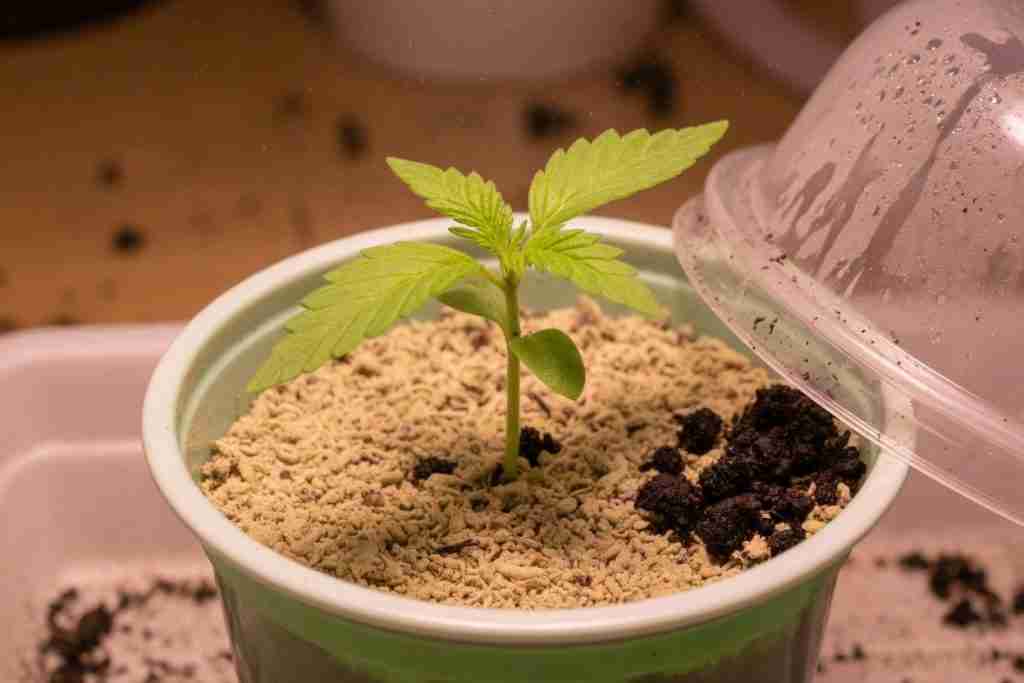
Babies want a light mix. A pinch of castings in a starter, 2–5% by volume, is a microbial bump without a salt slap. The old line that you can start seeds in straight castings is technically true and practically messy. Straight castings stay wet. Wet plus cool plus a seed is damping off. If you germ in a plug, you do not need castings in the plug at all. After the transplant, the 10–20% mix does the work. Germination: cannabis seed germination. Starter recipes: seed-starting mix recipes. Seedling weeks: seedling stage of growth and cannabis seedlings day by day. If the stem pinches at the soil line: damping off.
Clones root in a sterile-ish plug faster than in a living swamp. Once they are potted up, a castings mix helps the root system colonize. Dusting the transplant hole with a pinch of castings plus mycorrhizae is a habit, not a religion. Do not pack wet castings against a fresh cut stem.
Veg, Flower, Indoor, and Outdoor

In veg, castings shine because the nitrogen trickle matches leaf growth and the biology keeps the rest of the meals moving. A photoperiod in a 5-gallon pot with a 15–20% mix can often veg on water, maybe a top dress, maybe a tea. Watch color, not the calendar. Pale lower leaves on a fast vegger can mean it is time to top-dress, or it can mean the pot is too small. Stage guide: cannabis vegetative stage.
In flower, the plant still wants that biology. It also wants more P and K than a 1-0-0 bag can invent. If you built the mix with bone, kelp, and a decent compost, water through bloom and stop dumping nitrogen top dresses after stretch. If you built a light mix and expected castings to be the bloom bottle, the plant will tell you around week three with pale new growth and small flowers. Flower stage: flowering stage of growth. Roots should stay white and smell like soil: healthy cannabis roots.
Indoor tents dry from the light and the fan. Castings help the mix hold a drink without turning into a brick if aeration is there. Outdoors, they help sandy ground hold moisture and help clay crumble if you fork them into the top inches, not just sprinkle on a hardpan. Outdoor: growing cannabis outdoors. Indoor rooms: indoor cannabis growers guide. Climate around the pot still matters: best growing environment for cannabis.
Coco, soilless, and hydro
Coco is not soil. A 10% castings cut in coco is a hybrid: some biology, still a coco watering rhythm, still Cal-Mag demand. Do not treat it like a no-till bed. Straight hydro and rockwool do not want a handful of castings in the reservoir. You will clog, rot, and feed a biofilm. If you want biology in hydro, that is a different tea and a different sanitation job, and most hydro growers skip it. Castings belong in a pot with a solid medium.
Fungus gnats in a castings mix
Organic mix plus a wet top is gnat food. Castings did not import a plague from another planet. Adults lay in damp organic surface. Larvae chew root hairs. The plant looks hungry, you water more, they multiply. Let the top inch dry. Yellow sticky cards. A 1-inch layer of coarse sand or clay pebbles on the surface after the top dress has been watered in once. Beneficial nematodes in a moist mix, not in a desert and not in a swamp. Do not answer gnats by stripping all the castings out and going back to sterile peat if the real issue is a saucer of water. Dry the surface. Then decide.
Reading the plant instead of the bag
Pale new growth, even color, slow: the mix may be too cold, too wet, or actually hungry. Check temperature and weight before you top-dress. Dark, clawed, shiny leaves that taco: you already have enough nitrogen. Stop the weekly handful. Burnt tips with a wet pot: not a castings deficiency. Back off water. Purple stems on a seedling under a strong LED can be genetics or phosphorus, not a reason to pour bone-meal tea on day five. Give a castings mix two weeks in veg before you decide it is empty. Biology is slower than a bottle. That is why you mixed it before you needed it.
If a plant stalls after a transplant into a high-castings mix, the usual cause is a waterlogged root ball, not “the worms stole the nitrogen.” Fresh high-carbon bedding mixed in by mistake can immobilize nitrogen for a bit. Finished dark castings should not. If you mixed in half-finished bin material with visible cardboard chunks, wait, keep it barely moist, and do not add more food. The pile is still composting in the pot. Next time harvest darker.
Mistakes That Waste a Bag
- Using bin leachate as “tea.”
- Filling a small pot with 100% wet castings and watering on a coco schedule.
- Buying heat-dried dust and expecting a living soil.
- Top-dressing against the stem every week on an auto.
- Foliar-spraying tea on flowers.
- Stacking tea, bottles, and a hot super soil until the leaf claws, then adding more castings “because they cannot burn.”
- Leaving an aerated brew for four days and pouring the swamp on a keeper.
- Mixing alfalfa into a small worm bin until it composts hot.
- Storing an open bag in a hot garage until it is a brick.
- Blaming the seed when the mix never drained: how to pick cannabis seeds is a different problem.
FAQ: Worm Castings for Cannabis
What is the NPK of worm castings?
There is no single number. A common lab range is roughly 0.5–1.5 nitrogen, low phosphorus, modest potassium, plus calcium and micros. Feedstock changes it. Banana-heavy homemade can test different from a manure-fed commercial bag. Read the label on the bag you bought. Treat it as a slow organic, not as 10-10-10.
How much worm castings for weed plants?
Ten to twenty percent of the mix by volume is the usual indoor answer. Seed starting stays at 2–5%. Top dress a cup or less on an established plant, watered in. The old 35% mix is a high-castings recipe for a chunky, well-aerated pot, not a rule for every bag of peat.
Can you grow cannabis in 100% worm castings?
You can. You should not, as a plan. It is expensive, it holds too much water in a small pot, and you get more out of blending them with aeration and a base. Save the bag.
Do worm castings burn cannabis?
Fresh finished castings almost never salt-burn. Overwatering a heavy mix, stacking other hot organics, and using a salty dried product will still hurt a plant. The burn story is about the whole program.
How do I make worm casting tea?
Finished castings in a mesh bag, dechlorinated water, optional tiny molasses, bubble 12–24 hours, use that day as a drench. Do not confuse it with the tap on the bottom of the bin. Do not spray flowers.
Worm castings vs compost: which is better?
Compost is bulk and cheap. Castings are denser biology per pound. Use both. Compost to build volume in a bed. Castings to inoculate a pot. They are not rivals.
Will worm castings keep pests off my plants?
They can help soil-borne disease pressure and they will not replace a canopy IPM. Gnats love wet organic mix. If you top-dress thick and keep the surface swampy, you invited them. Let the top dry. Use a sticky card. Do not drown the biology you just added.
How should I store them?
Cool, dark, barely moist, air in the bag. A sealed wet bag in the sun becomes a science experiment. A wide-open bag in a dry room becomes dust. Use within months for biology. The organic matter lasts longer than the live count.
If you are mixing this week, start with 15% castings, plenty of aeration, and one top dress in veg. Brew tea after you have a feel for the soil, not on day one of a seedling. The worms already did the composting. Your job is not to drown their work. Seeds that belong in that mix: cannabis seeds store. Questions on a specific bag or bin: contact us.
How often should I add worm castings?
In the mix, once, at build. Then top-dress in veg every two to four weeks if the plant is eating. Recycle the soil between runs with a full castings charge. Tea is extra, not a daily watering. A well-built living soil can finish a photoperiod on water plus one or two top dresses. If you need tea every other day, the mix was thin or the pot is too small, and more liquid will not fix gallons.
Are store-bought worm castings as good as homemade?
A moist farm bag from a place that feeds a known diet can beat a neglected home bin. A dusty garden-center brick will not beat either. Homemade wins when you actually finish the material and you know there is no mystery manure. It loses when the bin is a wet trash can. Buy while you learn the bin. Do not wait a year to grow because the farm is not “pure” enough.
Can I use worm castings in late flower?
A light top dress at flip or week two is fine in most mixes. Late flower is a bad time to add a nitrogen-heavy handful if you want the plant to fade and ripen. Tea in week seven is usually theater. Water, watch trichomes, dry slow. The biology already did its job in veg and early bloom.