Node Enhancement in Cannabis


Node Enhancement in Cannabis is the joint on the stem, and whether that joint becomes a branch you can use. A marijuana plant can carry the same leaf count as the one beside it and still be a lanky weed, because the bare stem between the joints ate the height. You do not buy that structure in a bottle. You read the joints, then you stop wasting them.
Node Enhancement in Cannabis

A node is the joint. A leaf stalk meets the stem there, and tucked in that crotch is a small shoot. That shoot can stay a speck, or it can become a branch. Later a flower can form at the same joint. The bare stem between two joints is the internode. Growers stare at that gap more than at the joint itself, because the gap is what runs you out of tent.
The plant builds those joints on its own clock. You cannot talk a cultivar into a joint it was not going to make. You can keep the gaps from getting silly, and you can turn side shoots into tops instead of leaving one spear in the middle of the light. Training and lamp height are how. The joint is what those jobs are about.
Once the plant is past the seedling leaves, a joint usually offers two shoots, one on each side. Early on, the first true leaves can be single blades, and the joints can sit alternate, one then the other up the stem. Later they sit as opposite pairs, and the leaves pick up more fingers. Count the joint, not the finger count. A three-finger leaf and a seven-finger leaf can mark the same kind of joint. If you wait for a “perfect” fan before you count, you will mis-time the first cut.
The two round leaves at the soil line are cotyledons. They were the packed lunch inside the seed. They yellow and fall off. They are not joint number one. Start the count at the first serrated true leaves. People who count the seed leaves cut a plant that is still a baby, then spend two weeks asking why it sat still. The baby did not have the roots or the leaf yet. The cut was early. The stall was the bill.
Count the true joints
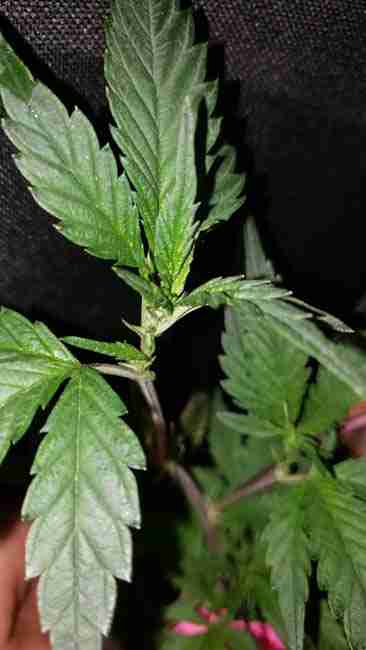
Run a finger up the main stem from the medium. Every place a leaf stalk meets the stalk is a joint you can count, once it has a leaf you can name and a shoot you can see in the crotch. The newest growth is a tight pale cluster at the tip. That tip is the growing point. It is not a finished joint. If you count the tip, and your friend counts only the open fans, you will argue about a number on the same plant. Write the rule down and use it every time: seed leaves no, open true joints yes, the pale tip no.
Four true joints means four of those meetings above the seed leaves. Six means six. Do not average a guess because the plant “looks about a month old.” Age is a rotten counter. A plant under a close lamp can stack six joints while it is still short. A plant reaching for a far lamp can show three joints and already be too tall for the shelf. The number and the gap are two different facts. You need both before you cut or flip.
Sex shows at the joint later, not in the seed leaves and not in the first week. A female throws a small teardrop with a hair or two. A male throws a smooth sac on a short stalk, with no hair. Check a couple of upper joints, not only the lowest scrap. If the joint is not clear, wait two or three days and look again. Do not pull a plant because it stretched. Stretch is not a sex. The picture version of that check is the male or female page. A feminized pack skips most of the boys. It does not skip the look. Do that look before you give a regular-seed plant the whole floor.
The same joint is where a cutting can throw roots, which is why people take the piece just under one. That is a different job from shaping the plant you already have in the pot. Do not turn a spacing decision into a propagation afternoon. Finish the count on the plant in front of you.
The gap is the diagnosis

Short gaps mean the joints are stacked. The plant stays shorter for the number of fans it carries, and the side shoots sit close enough to fatten if they get light. Long gaps mean the plant spent the week building stem. You get height, a thinner stalk, and less leaf in the brightest part of the lamp. Neither gap is a moral score. Read it as a report from the room and from the seed.
Genetics set the ceiling. A short, broad cultivar tends to stack joints even when the room is ordinary. A tall cultivar opens the gaps, especially in the first weeks after the flip, even under a lamp you would swear is perfect. A hybrid can go either way. The words on the packet are a height hint, not a law. Two seeds from one pack can still disagree, because a pack is a family, not a photocopy. You buy the menu. The room decides whether the plant hits that menu or stretches past the tent zipper.
If you need a plant that finishes under a low ceiling, start with a plant that wants to stay short. Training a stretchy cultivar helps. It does not rewrite the seed. Bending a tall plant into a table keeps more joints in the light. It does not turn the gaps into the gaps of a squat cultivar. People lose weeks trying to “fix” a plant that was always going to be tall. Next pack, pick the height on purpose.
Very tight gaps are not automatically a trophy. A lamp parked on the leaves can stack the joints and also canoe the fans or wash the color out of the top. That is too much light, not a better architecture. Back the lamp off until the top is green and the leaves sit flat or only slightly raised. A lamp that burns the crown and throws thin spears off the cola is a heat problem. The spear page is foxtailing. Chasing tighter joints until the top bleaches is how people ruin a plant that was already stacked enough.
Outdoors, a long gap in full sun is usually the cultivar, or a cloudy stretch, not a lamp you can lower. Wind thickens the stem that has to carry it. A foliar bottle still does not add joints. Pick a finish that beats your frost, and give the plant the sun.
Light and heat open it
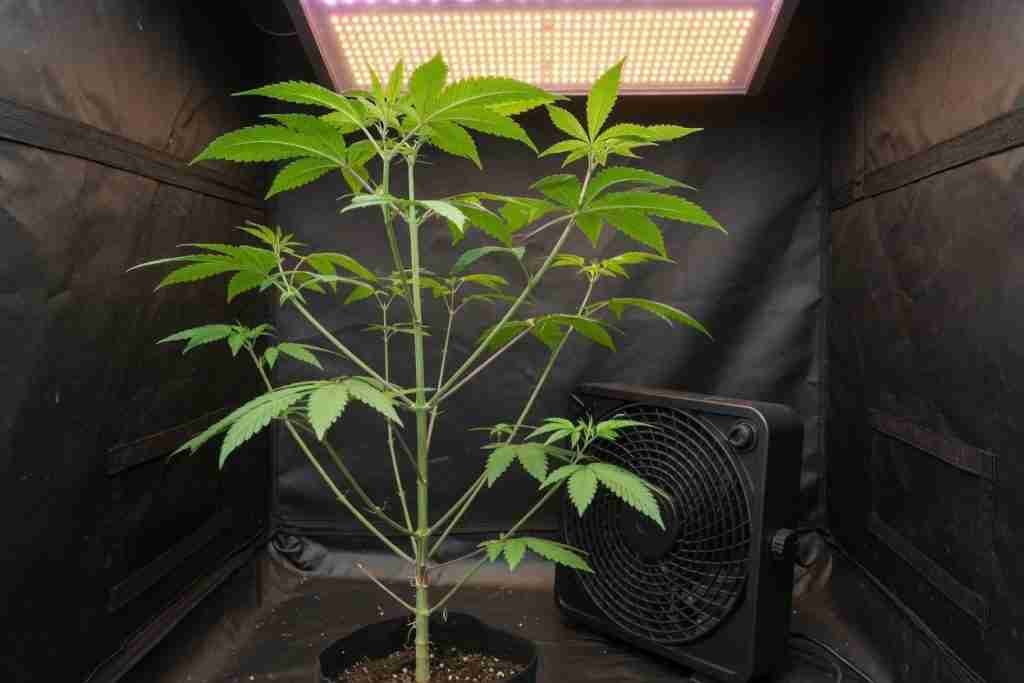
Indoors, the usual reason for a silly gap is the lamp. Too far, or too dim for the footprint, and the plant reaches the way a shaded plant reaches. The stem between joints gets long and pale. You can see it inside a week if you actually look, instead of waiting until the top is in the fixture. Bring the lamp closer until the crown is properly lit and the leaves are not crying. A hand held at the canopy for a few seconds should feel warm, not like a heater. If the top goes pale, or you smell hot plastic, you overshot. Raise it. Tight joints that come with bleached sugar leaves are a loss.
A bright, even canopy builds more useful joints than a special hour of one color. Blue-weighted white light in early veg tends to keep plants shorter. Far-red, and a weak lamp, tell the plant it is under a neighbor, and shade plants stretch. That chart lives on the LED color spectrum page. Do not invent a blue-hour protocol on top of a lamp that is simply too far away. Fix distance and coverage first. A diode recipe will not shorten a plant that is hunting a dim corner.
Extra carbon dioxide is a yield conversation for a canopy that is already bright. It is not a way to add joints, and it is not a way to shorten the ones you have. Ultraviolet is not a node switch. Drought is not one either. A wilted plant is not stacking a better map. It is stalling. Water when the pot needs it, on a rhythm you can repeat. A plant that droops every afternoon, then gets a flood, spends its week recovering. The joints still appear. They appear on a weaker stem.
Heat opens gaps when the day runs hot and the night drops hard. The plant chases the warm part of the cycle and lays down longer stem. A day that sits in the mid 20s C, with a night only a little cooler, keeps the report honest. A day that climbs toward 30 C while the lights-off period falls hard will show up as stretch, even if the lamp distance was fine. Do not crash the night to “tighten” anything. A cold tent stalls the plant, claws the leaves, and invites a wet medium. Veg can run warmer than the last weeks of flower. Steady beats clever.
Humidity does not manufacture joints. A wet, still tent sets up rot once those sites become flowers. Move air through the canopy. A fan blasted at one cola does not shorten the stem under it. A normal complete feed in veg is enough for joints to form. Extra nitrogen late grows more leaf. It does not draw the map tighter. Ease off as you approach the flip. That feed change belongs on the phosphorus page. If the plant is green and reaching, the cause is the lamp or the seed, not a missing supplement.
The count before you cut

Topping takes the growing tip off so the two shoots at the joint below become the new leaders. The plant was pouring its growth hormone into that one tip. After the cut, the side shoots stop waiting. You get two mains instead of one spear. That is the enhancement people are actually shopping for, and it is a cut, not a product.
Wait until you can count about four to six true joints and the plant is growing, not yellow, not drooping, and not fresh from a move into a new pot. A cut on a two-joint seedling stalls it. The first cut on a home photoperiod is usually just above the fourth true joint, once those four to six are actually there. Leave the structure under the cut. Take the tip above it. Cutting lower on a plant that barely has four joints is how seedlings get stunted. Waiting until the stem is woody and the crown is already at the lamp wastes the veg the new tops needed.
Use clean, sharp scissors. One horizontal cut through the soft stem. Leave a short stub above the joint you are keeping. A flush cut nicks the two shoots you wanted. A long leftover stem dies back and gives rot a place to start. Do not saw. Do not pinch the stalk flat with dirty nails and call it the same thing. Then leave the plant alone for a few days. The new tips need that time. Do not bend them the same afternoon, and do not strip half the fans the same day. Stacking stress is how a simple cut becomes a two-week pause. The week-by-week room is the vegetative stage.
A second cut, after each new top has joints of its own, turns two mains into four. Four mains is enough for a first tent. Eight and sixteen is extra veg on purpose, for a grower who wants matched branches from one hub. That longer schedule is mainlining. It still starts with the same honest count. It does not start with a calendar that says “top every Tuesday.” If the plant has not resumed strong growth, you wait. A cut on a stalled plant buys you less plant, not more tops.
FIM is a messy pinch of that same tip, leaving a scrap of the growing point. It can throw three or four shoots, or one, or a knot of twisted leaves. Less predictable than a clean top. Still veg only. If you want two even mains, top.
Bending is the other half, and it is not a cut. You tie the main tip out toward the rim of the pot so the side joints rise and become tops. On a photoperiod, start when the stem is still green and you have about four to six true joints. Soft ties. Not fishing line into the bark, and not a zip tie you forget until it girdles the stem. Anchor the pot so you do not lever the root ball out. Several small pulls beat one hero bend. If the stem creases white and stays creased, you went too far. Tape it. Do not cut the plant down in a panic. The tie method, step by step, is low stress training. Give a fresh top a few days before you bend those new shoots hard.
Do not top in flower. The plant has switched to building flowers. A cut then steals time you do not get back, and it can push a stressed plant to throw male parts on a female flower. Train the shape in veg. In flower you tuck, you support, and you stop playing surgeon. A screen is just the same bending with a net. Weave while you are still in veg. Stop weaving new flower into the mesh.
Flower adds joints fast
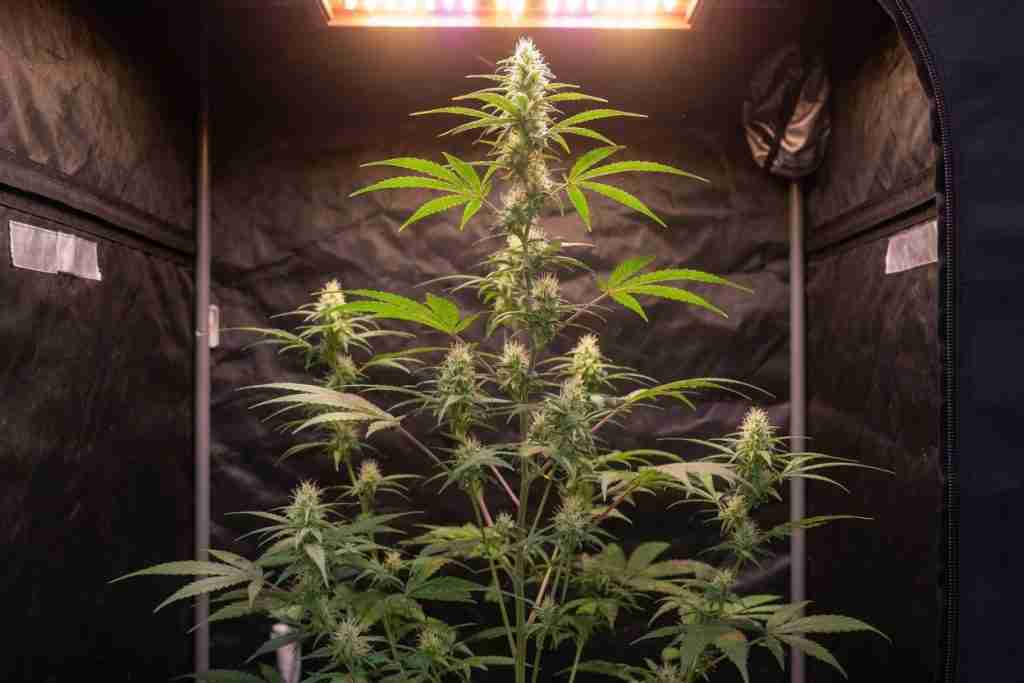
The flip is not “wait until joint number six and turn the timer.” A plant with four to six joints and no training is one spear. Flip that and you get a taller spear. In the first two or three weeks of flower the plant opens new joints quickly while the hormones change. Many plants put on about as much height again as they had on flip day. Short cultivars move less. Tall ones can pass that and still be climbing in week three. A younger plant often stretches longer than an older one that has already filled the footprint, because it takes longer to settle into flower. The week-by-week of that change is the flowering stage.
Decide the flip from the height you can finish, not from a number you saw on a forum. If the plant is about half the height you can afford, and the tops are even, you have room for the stretch. If the crown is already in the lamp, flipping makes the gap problem worse, and you will spend flower week two tie-yanking a plant that should have been bent in veg. Sea of green is the plan people mix into this rule. That plan is many small plants, one top each, a short veg, and an early flip. It is a different layout. One plant in a tent should fill the floor first. Four or more mains sitting in the light is a better cue than a date on tape.
Autos do not pause for your count. They flower by age, on a clock that started at the seed. A topping recovery can eat the only veg they have. Bend them gently, and a little earlier than a photoperiod, once you can see three to five true joints and the stem will take a soft tie. Stop hard bends once white hairs show. If you top an auto, do it once, early, on a plant that is already growing hard, and then do not stack a bend, a defoliation, and a feed change on the same day. Skipping the cut is a sane choice. You cannot veg an auto for an extra month to “catch up” the joints you cut off.
If you cannot see light at a joint, it will not become a cola you keep. Cleaning shaded sites is a flower job, and the line is the light, not a ruler that says the bottom third must go. A short plant under a close lamp may only lose the lowest joint or two. A tall untrained plant may be dark halfway up. Train the height first if you still can. Do not bare a four-joint plant and then veg for a month. New lower growth comes back. When the shape is almost the shape you will flower, those shaded sites are the lollipop decision. Leave the mains.
Read the gaps in the morning, before the tent is at its hottest. If week two of flower is outrunning the ties, you flipped a tall plant too late, or the lamp is still far enough that the plant is hunting. Support it. Do not start a new round of topping to save it.
A bottle does not add joints
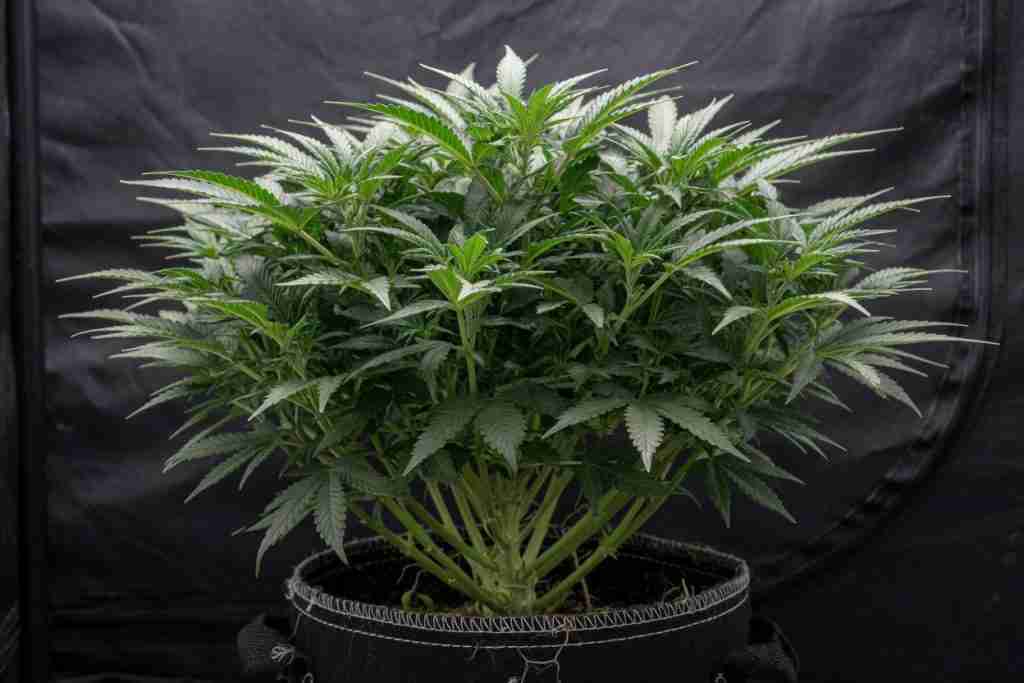
Nobody sells a bottle that inserts a joint the seed cannot make. A kelp pour, a bloom booster, and any jug with “node” on the label is perfume for the feed chart. If the plant is pale or stalled, fix water, light, and a normal complete feed. If it is green and reaching, move the lamp or accept the cultivar. If the gaps are tight and the top is burnt, move the lamp the other way. The map is already in the plant. Your job is to stop wrecking it.
Living soil can help the plant express the menu it already has. It does not add a joint the genetics skipped, and it does not shorten a stretch the lamp and the heat are causing. A dry seed does not show you the spacing. You see it after the true leaves stack, under your light. If every plant in the tent has long gaps, suspect the lamp before you suspect four different packs. If one plant is stacked and its neighbor is a ladder, those are two phenotypes. Training the ladder is fair. Feeding it harder so it will “tighten up” is how ladders hit the ceiling.
Buy the structure you want, then keep the room from undoing it. A short pack under a close, even lamp, topped once it has four to six true joints and bent so the new tops share the light, shows you more useful joints than any additive. A tall pack can still be a good plant. Give it floor and veg time, or do not buy it for a short tent.
One plant stays one plant
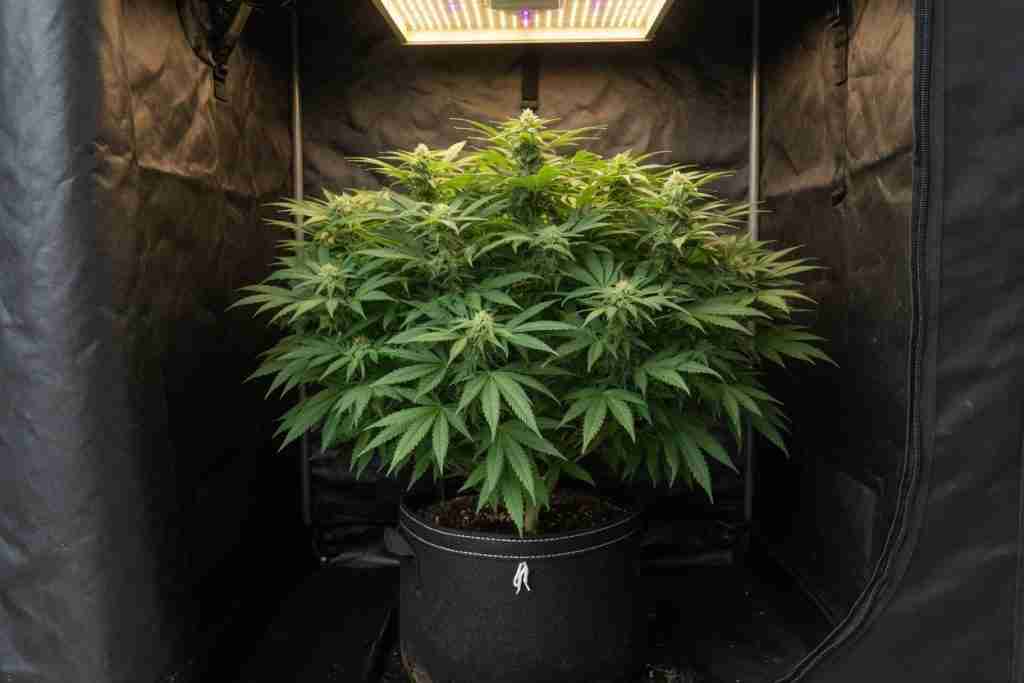
Training multiplies tops. It does not multiply plants. Eight colas on one stalk are still one plant when you count what is in the room. A second cup started “just to compare node spacing” is a second plant the day it sprouts. Topping does not create a legal extra. Bending does not either. If the cap is the limit, pick the seed that fits and train that one well, instead of popping a backup you are not allowed to finish.
In Canada the cap is four plants per household, not per adult. Quebec prohibits recreational home growing. Manitoba has allowed indoor growing only since 1 May 2025, and the age there is 19. A seedling counts. A second set of cups, started so you can pick a shorter gap after they veg, still counts. Do not start that set. The order of the grow you are actually keeping, from the seed through the dry, sits on the 10 steps page.
Tomorrow, before you change a bottle or a timer, count the true joints with the rule you can repeat. Ignore the seed leaves. Ignore the pale tip. Look at the gap between the joints you counted. If the gap is long and the lamp is far, move the lamp. If the plant is vigorous and sitting around four to six true joints, and you still have veg time, that is the window for one clean cut. If hairs are already out, stop cutting and support the stretch. The plant has been keeping the score the whole time. Your job is to read it.