Water Hardness & Bicarbonates: Hidden Enemies of Calcium Uptake

You’re watering, feeding, and babying your plants… yet the tops still crinkle, new leaves twist, and those little rust freckles show up like a bad rash. What gives? Nine times out of ten, it’s not your nutrient brand—it’s your water. More specifically: cannabis hard water and the sneaky bicarbonates riding along in it.
In this guide, you’ll learn exactly how hardness and bicarbonates hijack calcium uptake, how to read your water like a pro, and the cleanest ways to fix it—fast. We’ll keep it simple, practical, and very “do-this-now.” By the end, you’ll have a steady plan for rock-solid stems, lush new growth, and buds that don’t crumble from hidden deficiencies.
The Big Idea: Why “Cannabis Hard Water” Blocks Calcium
Hardness vs. Alkalinity (and why it matters to roots)
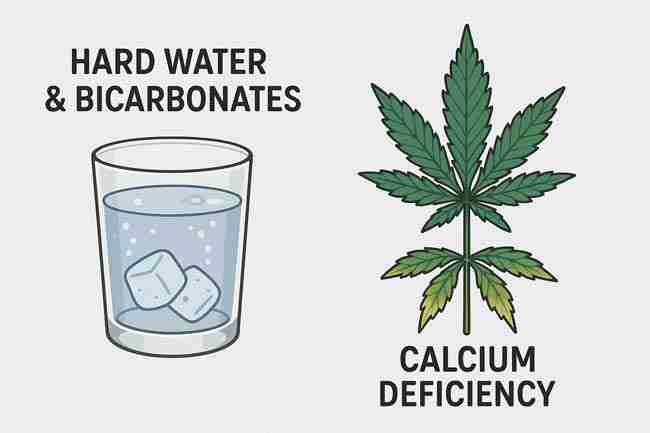
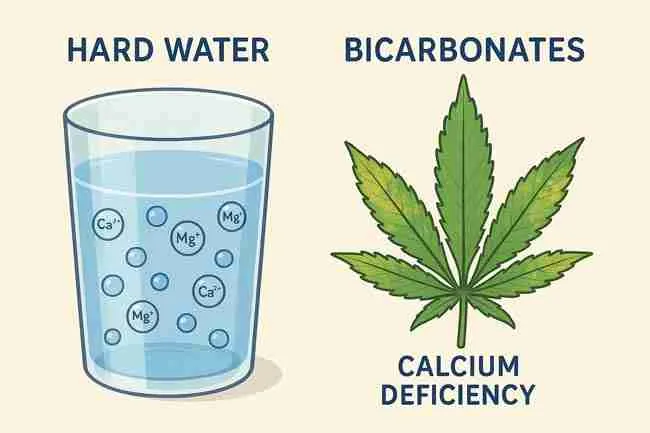
- Hardness = mostly calcium (Ca²⁺) + magnesium (Mg²⁺) dissolved in your water. It’s often shown as ppm as CaCO₃ or mg/L, and sometimes in °dH/°GH.
- Alkalinity = your water’s buffering power, mainly bicarbonates (HCO₃⁻). It resists pH change and nudges pH up over time. It’s shown as ppm as CaCO₃, mg/L, or °KH.
These are not the same thing. You can have:
- High hardness + low alkalinity
- Low hardness + high alkalinity
- Or both high (the classic “uh-oh” for growers)
The bicarbonate trap
Bicarbonates push pH upward in your nutrient solution and in your media. As pH climbs, calcium teams up with carbonates and phosphates and falls out of solution as tiny solids. You don’t see it at first. But you feel it later as:
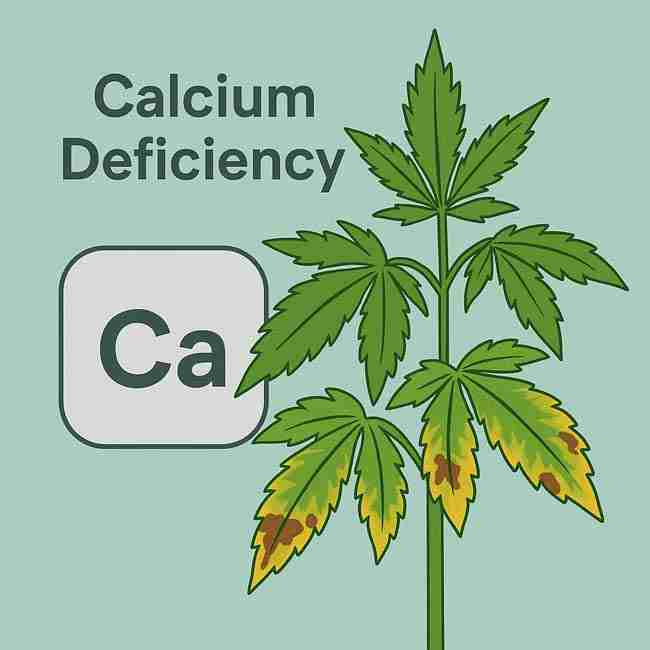
- Twisted new leaves
- Brittle, tip-burned growth
- Interveinal chlorosis (pale space between veins)
- Blossom-end-rot-style symptoms on fruiting crops (calcium shortage is classic across plants)
Calcium is immobile in plants. If new tissue can’t grab it right now, it won’t get back-filled later. That’s why “almost right” water makes “almost healthy” tops.
How cannabis hard water sneaks into your tent
- Cloudy, milky nutrient mix after you add Ca or base nutrients
- Sudden pH drift up every day, even after you set pH carefully
- White crust on pots, emitters, or top of media
- EC/ppm reads “fine,” but new growth still looks starved for calcium
Quick Reference Table: Hardness & Alkalinity
| Term | What it Is | Typical Units | Quick Conversion |
|---|---|---|---|
| Hardness | Ca²⁺ + Mg²⁺ concentration | ppm as CaCO₃ or mg/L | 1 °dH ≈ 17.9 ppm as CaCO₃ |
| Alkalinity | Buffering (mostly HCO₃⁻) | ppm as CaCO₃ or mg/L | 1 °KH ≈ 17.9 ppm as CaCO₃ |
| TDS/EC | Total dissolved stuff | ppm or mS/cm | Not a substitute for a full report |
| Bicarbonates | Main driver of pH drift | mg/L (as HCO₃⁻) or ppm as CaCO₃ | ppm as CaCO₃ ÷ 1.22 ≈ mg/L HCO₃⁻ |
Rule of thumb: Hardness feeds plants; alkalinity fights your pH. Your job is to control alkalinity so calcium can stay available.
Read Your Water Report Like a Pro
Which numbers to hunt down
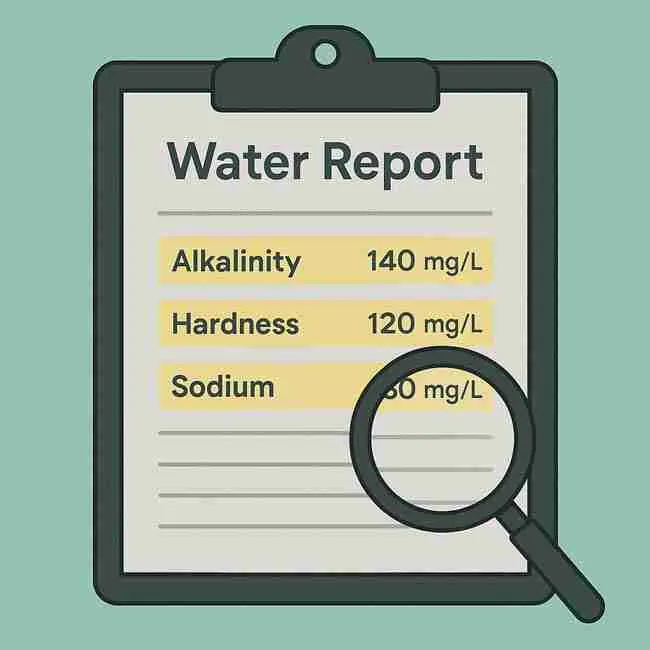
Look for these on a municipal report or lab test:
- Alkalinity / Bicarbonate (as CaCO₃)
- Hardness (as CaCO₃) and/or Calcium + Magnesium
- Sodium (Na) (keep it low)
- Chloride (Cl⁻) and Sulfate (SO₄²⁻)
- pH (raw water pH is just a clue; alkalinity is the power behind the punch)
- TDS or EC (context only)
- Iron/Manganese (can stain and mess with nutrients)
No report? Test in 10 minutes
- TDS/EC pen: quick snapshot
- GH/KH drop kits (aquarium style): cheap, surprisingly useful
- Taste/scale clues: white crust on faucets/kettles = hardness + alkalinity are present
Ideal Water Specs (Your “Specifications”)

Use these target ranges to shape your water. They work for most growers and media:
| Parameter | Hydro/DWC | Coco/Soilless | Soil/Living Mix |
|---|---|---|---|
| pH (solution) | 5.6–6.0 | 5.7–6.2 | 6.2–6.7 |
| Alkalinity (as CaCO₃) | 0–50 ppm | 30–60 ppm | 60–120 ppm |
| Calcium (Ca) | 60–100 ppm | 80–120 ppm | 80–120 ppm |
| Magnesium (Mg) | 30–50 ppm | 40–60 ppm | 40–60 ppm |
| Ca:Mg ratio | ~2:1 to 3:1 | ~2:1 to 3:1 | ~2:1 to 3:1 |
| Sodium (Na) | <20 ppm | <30 ppm | <50 ppm |
| Chloride (Cl⁻) | <50 ppm | <70 ppm | <100 ppm |
| Sulfate (SO₄²⁻) | 30–80 ppm | 30–120 ppm | 30–120 ppm |
The lower the alkalinity, the easier it is to hold pH steady—especially in hydro. For coco and soil, a little alkalinity buffers swings, but too much locks out Ca.
Fixing “Cannabis Hard Water” Step by Step
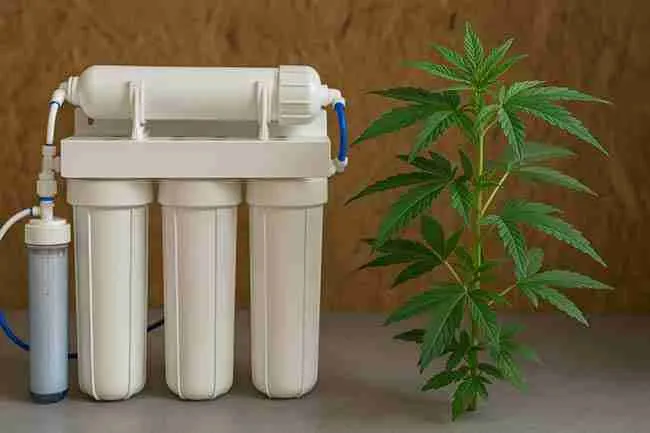
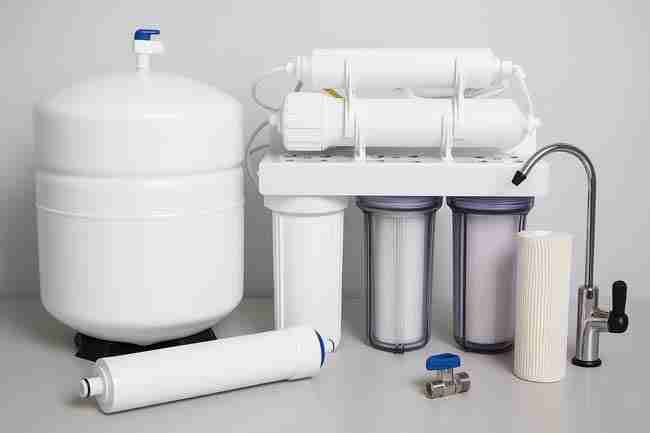
Option A: Blend with RO (the clean slate)
- Run an RO filter to strip almost everything out.
- Blend RO with your tap to land your target alkalinity and hardness.
- Add Cal-Mag intentionally (don’t rely on random tap levels).
Why it works: You set the baseline. Less guesswork, fewer precipitates, better pH stability.
When to choose it: Tap alkalinity > 100–120 ppm as CaCO₃, sodium > 30–40 ppm, or constant clouding/scale.
Option B: Pre-acidify (neutralize bicarbonates)
- Use pH Down (phosphoric in bloom, nitric in veg) to knock alkalinity down before adding nutrients.
- Do a jar titration (see below) to learn how many mL/L of acid it takes to hold your solution at the pH you want.
Why it works: Acid consumes bicarbonates so they can’t shove pH back up later.
When to choose it: Your alkalinity is moderate (e.g., 50–120 ppm) and sodium is low.
Option C: Media/Recipe tweaks
- Coco: pre-charge with Ca/Mg, keep a healthy Ca:Mg ratio, avoid pushing K too high.
- Soil: a touch of alkalinity can help, but keep sodium low and use gypsum (CaSO₄) if you need calcium without raising pH.
- Hydro: shoot for minimal alkalinity and top off with RO between feeds to keep drift down.
Option D: What not to do
- Don’t rely on a house water softener (it swaps Ca/Mg for sodium—bad for plants).
- Don’t mix concentrated Ca and phosphate or sulfate sources together before diluting (it’ll snow in your bucket).
- Don’t chase pH every hour; fix the bicarbonates, not just the number.
The Easiest Way to Pre-Acidify (No Math Degree Needed)
Tools
- pH meter (freshly calibrated)
- Your acid: nitric (veg) or phosphoric (bloom). Citric works short-term but isn’t stable.
- Safety: gloves, goggles, and always add acid to water, never the other way around.
Jar titration (your “dose map”)
- Fill a 1-liter bottle with your raw water.
- Add 0.1 mL of pH Down, shake, test pH.
- Repeat in 0.1 mL steps until your water holds at pH ~6.0 for 2–3 minutes.
- Record the total mL per liter—that’s your neutralization dose for this source water.
- Scale it up (e.g., 10 L x dose), treat the whole batch first, then add nutrients.
Tip: In veg, a little nitric gives extra N; in bloom, phosphoric gives P. Keep it simple and stay consistent.
Mixing Nutrients in Hard Water Without Snowstorms
Order of operations (prevents precipitation)
- Start with treated water (RO or pre-acidified).
- Add silica (if used), stir well.
- Add calcium nitrate or Cal-Mag, stir.
- Add magnesium sulfate (Epsom) if your recipe calls for it.
- Add base A/B nutrients and the rest, one at a time.
- Let it sit 5–10 minutes, then set pH.
- Check EC/ppm, adjust only if necessary.
Why this works: You avoid smashing calcium into concentrated phosphates/sulfates that would otherwise turn your mix cloudy and rob plants.
Media-Specific Tweaks (Coco, Hydro, Soil)

Coco/Soilless
- Coco holds onto calcium and magnesium at first. Pre-charge with Ca/Mg.
- Aim for Ca 80–120 ppm and Mg 40–60 ppm in solution.
- Keep K reasonable; too much potassium bullies Ca/Mg at the root surface.
- If you’re stuck with cannabis hard water, neutralize bicarbonates or blend with RO to stop pH creep.
Hydro/DWC
- Keep alkalinity low (0–50 ppm as CaCO₃).
- Maintain pH around 5.6–6.0 and top off with RO to minimize drift.
- Watch for scale inside lines; it’s a sign bicarbonates weren’t fully handled.
- If pH rises daily, revisit your bicarbonate neutralization.
Soil/Living Mix
- A little alkalinity helps buffer. Too much raises pH and starves Ca at the tips.
- Use gypsum for calcium boosts without pushing pH up like lime does.
- If your raw water has high sodium, it’s an RO time—don’t salt-stress your soil biology.
Real-Life Scenarios (And the Fix)

Scenario 1: Cloudy soup
You mix nutrients; the solution turns milky after adding Cal-Mag. Your report shows alkalinity 160 ppm and hardness 220 ppm.
- Fix: Blend 50/50 RO + tap, pre-acidify to pH ~6.0, then mix in the recommended order. The clouding stops, new tips relax, and color evens out.
Scenario 2: Silent sodium
Well water looks crystal clear but has sodium 45 ppm. Leaves edge-burn and curl with normal EC.
- Fix: Go full RO or heavy RO blend. Rebuild Ca/Mg with a clean Cal-Mag product. Sodium doesn’t help plants—cut it out.
Scenario 3: Seasonal swing
City water alkalinity doubles in winter. pH won’t stay put; it climbs daily.
- Fix: Re-do your jar titration and update your acid dose. Consider partial RO in winter to keep your workflow consistent.
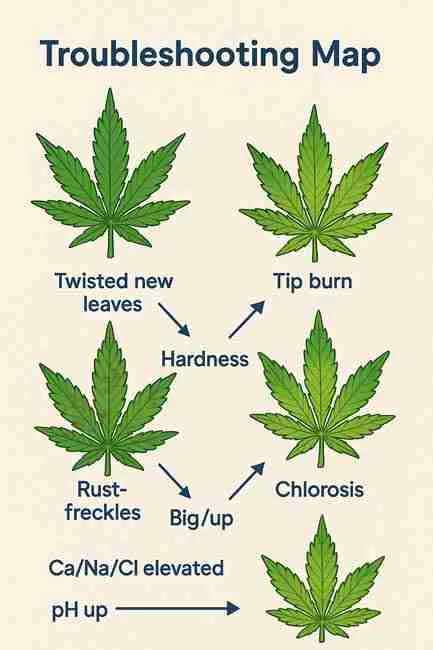
Troubleshooting Map
| Symptom | Likely Water Cause | What to Do |
|---|---|---|
| Twisted new leaves, rust freckles | Ca lockout from high bicarbonates (pH up) | Neutralize bicarbonates (pre-acidify) or blend RO; ensure Ca 80–120 ppm |
| Daily pH drift upward | Excess alkalinity | Lower alkalinity to target range; top off hydro with RO |
| Cloudy/milky mix | Ca meeting phosphates/sulfates at high pH/concentration | Pre-acidify; change mixing order; dilute concentrates before combining |
| White crust on pots/emitters | Carbonate precipitation | Lower alkalinity; periodic line cleaning; use RO blend |
| Tip burn at modest EC | Sodium/Chloride elevated | Switch to RO or higher RO blend; rebuild Ca/Mg cleanly |
| Pale between veins (new leaves) | Ca/Mg imbalance | Check Ca:Mg (~2–3:1), ensure adequate Mg (40–60 ppm) and Ca (80–120 ppm) |
Pros & Cons of the Common Fixes

Reverse Osmosis (RO)
Pros
- Clean slate, super consistent
- Easy pH control, less precipitation
- Lets you choose exact Ca/Mg levels
Cons
- Upfront cost + waste water
- You must add back Ca/Mg
- Filters need maintenance
Pre-Acidifying Tap
Pros
- Cheap, quick, and simple
- Keeps some natural minerals
- Great if alkalinity is moderate
Cons
- Needs a titration routine
- Seasonal water changes = dose changes
- Doesn’t fix high sodium
Blending (RO + Tap)
Pros
- Fine control of alkalinity
- Lower waste than full RO
- Works in coco, soil, hydro
Cons
- Still requires testing
- Two sources to manage
- If tap Na is high, blend won’t solve it fully
Your 10-Step Weekly Water Routine
- Test KH/GH or skim your latest report.
- Do a 1-L jar titration to confirm the week’s acid dose.
- Treat your whole batch to neutralize bicarbonates first.
- Add silica (if used).
- Add Cal-Mag or calcium nitrate; stir.
- Add the rest of your nutrients one at a time; stir.
- Let it sit; then set pH (5.6–6.0 hydro, 5.7–6.2 coco, 6.2–6.7 soil).
- Confirm EC/ppm; don’t chase numbers—watch plants.
- Top off mid-week with RO (especially in hydro) to control drift.
- Inspect tips and new growth. Adjust only one variable at a time.
Handy Conversions & Rules of Thumb
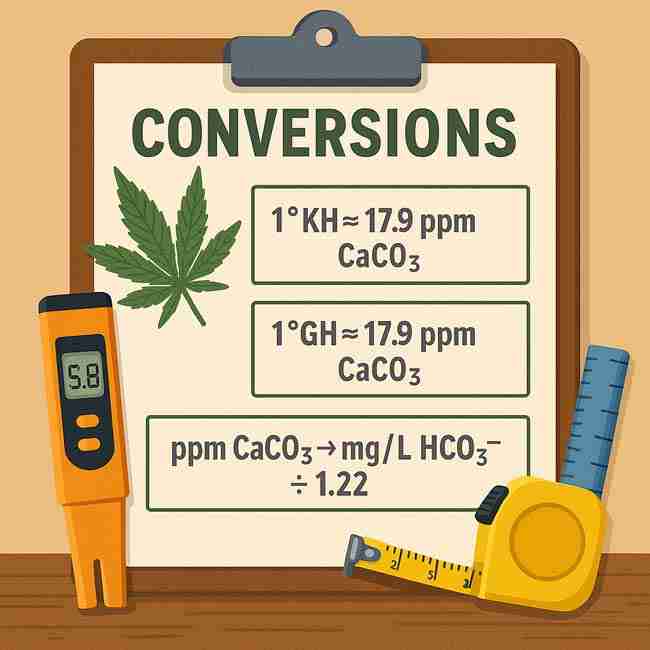
- 1 °KH (carbonate hardness) ≈ 17.9 ppm as CaCO₃
- 1 °GH (general hardness) ≈ 17.9 ppm as CaCO₃
- ppm as CaCO₃ → HCO₃⁻ (mg/L): divide by 1.22
- A stable pH day-to-day means your alkalinity is close to target.
- Cannabis hard water problems usually ease within 7–14 days after you fix bicarbonates.
“Specifications” You Can Copy
- Hydro/DWC: pH 5.6–6.0; alkalinity 0–30 ppm; Ca 60–100; Mg 30–50; Na <20
- Coco: pH 5.7–6.2; alkalinity 30–60 ppm; Ca 80–120; Mg 40–60; Na <30
- Soil: pH 6.2–6.7; alkalinity 60–120 ppm; Ca 80–120; Mg 40–60; Na <50
Keep the Ca:Mg ratio around 2–3:1 and don’t let potassium sprawl so much that it elbows Ca/Mg off the root surface.
FAQs (quick wins for real problems)

How do bicarbonates pH interactions mess with my feed?
Bicarbonates act like little bodyguards that shove pH up in your reservoir and root zone. As pH rises, calcium becomes less available and can precipitate with carbonates or phosphates. Neutralize bicarbonates first (pre-acidify or use RO) so your set pH actually sticks.
Can calmag issues be solved by just adding more Cal-Mag?
If cannabis hard water is the culprit, piling on more Cal-Mag won’t fix it. You’ll just create more opportunities for precipitation. First kill the bicarbonates, then set Ca/Mg to sensible targets (Ca 80–120 ppm, Mg 40–60 ppm). After that, extra Cal-Mag is rarely needed.
Is an RO filter grow worth it?
If your tap has high alkalinity (>100–120 ppm), high sodium, or constant pH creep, an RO filter grow is almost always worth it. It stabilizes pH, prevents cloudy mixes, and lets you dial Ca/Mg perfectly. You can also blend RO with tap to hit a sweet spot and reduce waste.
What about citric acid for organics?
Citric can work—but it’s short-lived. Microbes chew it up, and pH can rebound. For steady control, nitric (veg) or phosphoric (bloom) are more stable.
Do I need to acidify in soil?
If your soil blend is balanced and your alkalinity sits around 60–120 ppm, you might be fine. But if pH rises, tips crisp, or leaves twist at the top, try lowering alkalinity (RO blend or pre-acidify) and consider gypsum for extra calcium without boosting pH.
How often should I re-check my dose?
Anytime seasons change or plants act weird. A monthly jar titration is a good habit, and weekly if your city water swings.
Field Notes: Signs You’ve Fixed It
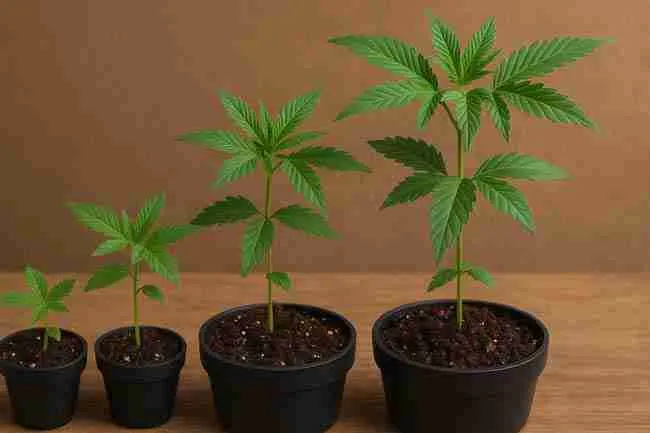
- New leaves grow flat and smooth, not crinkly.
- pH holds steady day-to-day.
- Nutrient mixes stay clear, not milky.
- Runoff pH stops creeping up.
- Stems thicken, internodes even out, and the canopy looks confident.
Give it a week or two after you correct bicarbonates and lock in your Ca/Mg. Once calcium rides the flow to the new growth on time, your tops will stop complaining.
Bottom Line (Action You Can Take Today)
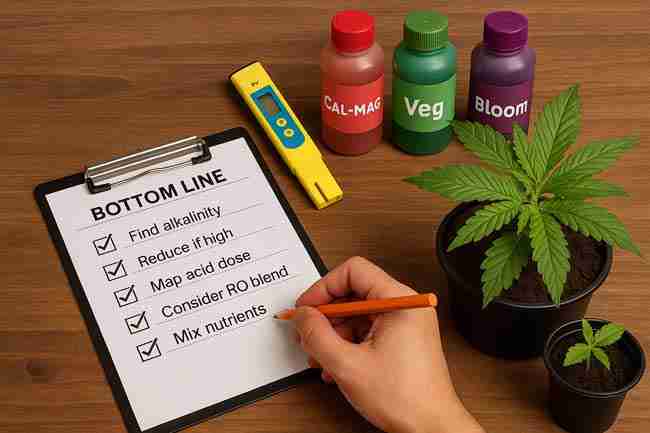
- Find alkalinity (report or KH test).
- If >60–80 ppm (coco/hydro) or >120 ppm (soil), plan to reduce it.
- Do the 1-L jar titration to map your acid dose.
- Consider a partial RO blend to land your targets cleanly.
- Mix nutrients in the no-snow order.
- Keep Ca 80–120 ppm, Mg 40–60 ppm, and hold a 2–3:1 Ca:Mg ratio.
- Watch the new growth like a hawk. That’s your calcium report card.
Tame cannabis hard water, and you’ll unlock what your genetics were trying to do all along—grow sturdy, glossy plants that cruise from veg to fat, healthy flowers.