Vigor vs Stability: How Breeders Balance Both


You want plants that leap out of the soil, shrug off stress, and stack fat, fragrant flowers. You also want every seed in the pack to grow the same way—same height, same terp profile, same finish time. That tug-of-war is the breeder’s life: vigor vs stability. In this guide, you’ll learn exactly how to spot each, how breeders balance them, and how you can apply the same logic in your grow—backed by a practical, step-by-step stable cannabis genetics case study you can copy.
The Core Idea (in Plain English)
- Vigor means “zippy growth.” Fast roots, thick stems, strong immunity, big yields.
- Stability means “predictable offspring.” Seeds make plants that look and act the same.
You can push vigor so hard that your offspring splinter into a dozen different phenos. Or you can chase stability so tightly that you squeeze some life out of the line. The craft is finding the sweet spot where your plants are both lively and reliable.
What “Vigor” Really Looks Like

The Signs of True Vigor You Can See Early
- Rapid germination: 24–48 hours to tails under normal temps.
- Explosive taproot: thick, white, and fast branching in the first week.
- Stout hypocotyl: seedlings stand tall without leaning or crutches.
- Leaf speed: first true leaves appear quickly, edges stay smooth, no twisting.
- Environment tolerance: seedlings don’t sulk when temps swing a little.
- Transplant bounce-back: little to no pause after uppotting.
Practical Vigor Tests You Can Do at Home
- Paper towel time trial: start 10 seeds; record hours to first tails and to 50%/90% germ.
- Cup-pull test: at day 10, gently slip the rootball from a solo cup—look for dense, white roots (not brown, not sparse).
- Light shift check: raise PPFD ~20% for a day; see if leaves pray (good) or droop (meh).
- Dry-down stretch: let pots get a bit lighter than usual; see which seedlings stay perky.
What Boosts Vigor (Without Cheating)
- Healthy parent plants (no pests, no hidden deficiencies).
- Broad, outcrossed genetics (heterosis—more on that soon).
- Solid microbe support (clean, not sterile; mycorrhizae at transplant).
- Clean seed handling (proper drying, cool storage, low humidity).
What “Stability” Really Means

Stability = Reproducibility
If you pop 10 seeds and get nine plants that look like cousins, you have stability. You can count on height, flower shape, color, aroma, days to harvest, and stress response to be repeatable.
Stability Markers You Can Score
- Uniform seedling height by day 14.
- Similar internode spacing by week 3.
- Matching flowering start window (±3 days).
- Consistent terpene notes across plants.
- Similar bud structure (not one foxtail, one golf ball, one broom).
- Low intersex risk under mild stress.
What Breeders Do to Build Stability
- Select, select, select: pick parents with the traits you want and low weirdness.
- Increase population size: more plants = more choices = fewer hidden recessives.
- Advance generations: F1 → F2 → F3/F4… (each step can lock traits).
- Backcross (BX): bring a child back to a parent to anchor key features.
- Self (S1): double down on traits by self-pollinating a keeper female.
The Tightrope Walk: Balancing Vigor and Stability

Why You Can’t Max Out Both (Usually)
- Vigor loves diversity. Mix two unrelated lines and boom—heterosis (hybrid vigor).
- Stability loves uniformity. Fix alleles over generations and you reduce variance.
So you aim for a vigor floor (plants never feel weak) and a stability ceiling (plants don’t split into a dozen phenos). Smart breeders slide the dial to fit the purpose: a production cultivar wants high stability; a craft breeder hunting unicorns may allow more variance early on.
A Simple Framework You Can Use
- Define the non-negotiables: harvest window, height, terp profile, mold resistance.
- Pick parents with overlap: both already express your must-haves.
- Outcross for vigor once.
- Test stress early: cull anything that throws nanners in light stress.
- Stabilize with generation work: F2/F3/F4 or BX, while guarding your vigor floor.
- Lock with a small S1 run (optional) to check consistency.
- Pre-release stress test across environments (tent, room, greenhouse).
The Generational Roadmap (What Each Step Buys You)

F1 – Where Hybrid Vigor Lives
- Upside: fastest growth, thickest stems, can be wonderfully robust.
- Downside: if parents aren’t already similar, phenos can vary more than you’d like.
F2 – The Shuffle
- Upside: traits split; you can find special combos (golden keepers) in numbers.
- Downside: variation is widest; not great for customers yet.
F3–F4 – The Lock-In
- Upside: you start seeing “this is the look” consistency; keeper phenos repeat.
- Downside: if you over-select narrowly, you might pinch vigor.
Backcross (BX)
- Upside: anchors a beloved trait (e.g., a specific chocolate terp) into the line.
- Downside: multiple BX generations can reduce diversity, nibbling at vigor.
Selfing (S1)
- Upside: exposes hidden issues and proves trait inheritance; boosts predictability.
- Downside: can unmask recessive problems; don’t S1 a marginal plant.
Stable Cannabis Genetics Case Study (Step-by-Step You Can Copy)

Scenario: You love a chocolate-forward cultivar for its 7–8 week finish, 23% THC, and easy grow style. You want to ship a pack where every plant smells like dessert and finishes together. Here’s a stable cannabis genetics case study walking through the exact moves.
Goal & Non-Negotiables
- Aroma/flavor: cocoa upfront with sweet pastry undertones.
- Finish: 7–8 weeks indoor.
- Structure: medium height, sturdy branches, low larf.
- Resilience: handles mild VPD swings; resistant to powdery mildew.
- Herm risk: near zero under standard tent mistakes.
Parent Selection (P and P’)
- Pick two lines that already hit chocolate terps and similar finish times.
- Reject any parent that ever threw intersex under reasonable stress.
Make the F1 (Outcross for Vigor)
- Pollinate P × P’.
- Pop 60–100 F1 seeds.
- Score vigor (germ speed, root mass), structure, terp pre-flower rubs.
- Stress screen: small light leaks, a mild dry-down, 1–2°F temp bump.
- Cull hard for any intersex response.
Hunt and Lock (F2 and F3)
- Open-pollinate selected F1s to create F2.
- Pop 150–200 F2 seeds (more variation means more choices).
- Tag plants that hit chocolate nose and 7–8 week finish.
- Clone your top 10; flower clones to confirm repeatability.
- Make F3 seeds from the most uniform performers.
Tighten With a Single Backcross (BX1)
- If chocolate intensity is just shy, backcross your best F3 keeper to the original best chocolate parent (P).
- Keep BX light (one step) to avoid crushing vigor.
Proof With S1 (Optional but Powerful)
- Self the top BX1 female to create an S1 seed batch.
- Pop 30–50 S1 seeds; check for uniformity and hidden issues.
- If S1s match the keeper—boom, you’ve confirmed trait stability.
Real-World Stress Testing
- Test the same line in:
- A 2×2 tent with LEDs (tight space).
- A 4×4 tent with mixed strains (competition).
- A greenhouse shoulder season (temp swings).
- Log PM pressure, feed mistakes, and finish spread.
Release Criteria (Don’t Skip)
- 80–90% of plants finish in 7–8 weeks.
- Terp agreement ≥ 80% (panel says, “Yep, that’s chocolate.”).
- Herm incidents < 1% under normal home grow mishaps.
- Average wet yield in test tents within ±10% of target.
Example Data Table: Vigor vs Stability Across Generations

| Generation | Seeds Popped | Avg Germ (hrs to 50%) | Intersex Incidents | Finish Window (weeks) | Aroma Match Rate | Notes |
|---|---|---|---|---|---|---|
| F1 | 80 | 36 | 0 | 7–9 | 55% | Big vigor, wider finish spread |
| F2 | 180 | 38 | 3 | 7–10 | 40% | Treasure hunt; huge variety |
| F3 | 120 | 36 | 1 | 7–8.5 | 70% | Uniformity improving |
| BX1 | 100 | 34 | 0 | 7–8 | 82% | Chocolate terp anchored |
| S1 (of BX1 keeper) | 50 | 35 | 0 | 7–8 | 86% | Stability verified; vigor still high |
This stable cannabis genetics case study shows a practical path: use outcross vigor, refine with F2/F3, lock target traits with a single BX, then verify with an S1.
How You (The Grower) Can Test a Breeder’s Claims

Your 10-Seed “Trust but Verify” Protocol
- Pop 10 seeds the same day, same temp, same medium.
- Record germ times (when tails appear; aim for a 24-48 hr cluster).
- Measure seedling height at day 14 (uniform = good stability).
- Light bump test (+20% PPFD for one day). Watch for prayer vs droop.
- Transplant all on the same day; note who sulks.
- Flip together; log days to first pistils.
- Nose check at week 3 flower; write the top notes.
- Harvest spread; count days from first ripe plant to last.
- Dry and cure the same way; repeat the nose check.
- Score intersex at every stage; even one nanner gets noted.
What Good Looks Like
- Germ cluster within ~24 hours.
- Seedling heights within ±15%.
- Pistil appearance within ±3 days.
- Matching top terp notes on 7–8/10 plants.
- Harvest spread ≤ 7 days for a production line.
Specs Breeders Should Publish (Ask for These)
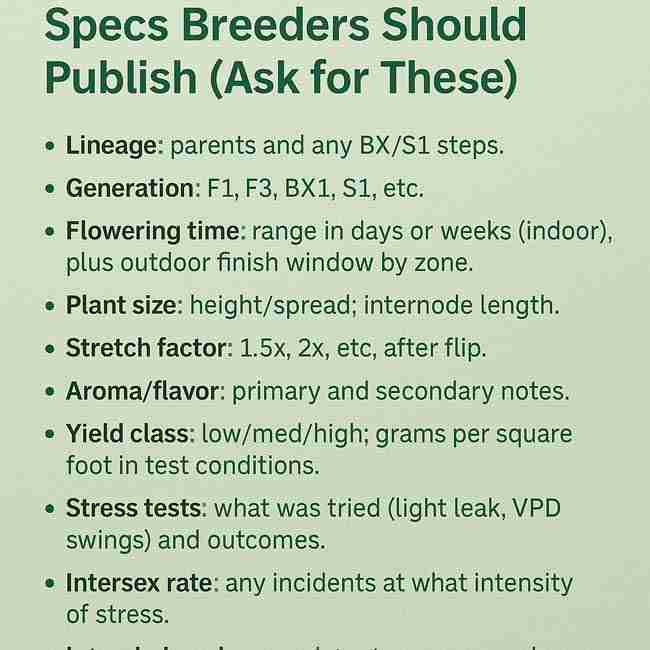
- Lineage: parents and any BX/S1 steps.
- Generation: F1, F3, BX1, S1, etc.
- Flowering time: range in days or weeks (indoor), plus outdoor finish window by zone.
- Plant size: height/spread; internode length.
- Stretch factor: 1.5×, 2×, etc. after flip.
- Aroma/flavor: primary and secondary notes.
- Yield class: low/med/high; grams per square foot in test conditions.
- Stress tests: what was tried (light leak, VPD swings) and outcomes.
- Intersex rate: any incidents at what intensity of stress.
- Intended environment: tent, room, greenhouse, outdoor.
- Feeding style: heavy or light feeder; EC range; pH sweet spot.
Pros and Cons: Chasing Vigor vs Chasing Stability

Vigor-First Breeding
Pros
- Faster veg, thicker stems, better stress handling.
- Often bigger yields per square foot.
- “Forgiving” for new growers.
Cons
- More pheno variation in unworked lines.
- Aroma/shape can be less predictable out of the box.
Stability-First Breeding
Pros
- Pack-to-pack predictability; great for SOG or uniform canopy.
- Tight harvest window (easier dry/cure planning).
- Easier to document and support customers.
Cons
- If overdone, vigor can dip (slower starts, picky feeding).
- Narrow genetic base may struggle with new pathogens.
How to Keep Stability and Vigor in Your Room

Your “Vigor Floor, Stability Ceiling” Checklist
- Fresh seed only: cool, dry storage from a reputable breeder.
- Clean starts: disinfect tools; start seedlings in mild media.
- Balanced light: avoid blasting seedlings; ramp PPFD gradually.
- Root health first: don’t drown roots; use airy mixes; ensure runoff.
- Controlled stress: tiny, planned challenges reveal the quitters early.
- Clone the winners: lock your favorite expression for future runs.
- Keep notes: dates, smells, behavior—your logbook is gold.
Troubleshooting Instability (What to Do Right Now)

If You See Wild Phenos
- Split the canopy: tall ones get supercropped; short ones get risers.
- Label everything: don’t lose track of which plant impressed you.
- Clone the keeper: run it again to confirm it wasn’t a fluke.
- Cull hard for intersex: don’t breed or clone a plant that pops nanners.
If Vigor Seems Weak
- Check basics: temps, VPD, EC, pH, and root oxygen.
- Re-pot earlier: small containers stall vigor.
- Add microbe support: but keep it clean; avoid mucky media.
- Feed evenly: avoid big swings; keep EC stable week to week.
Field Notes From the Bench: Tiny Moves That Matter
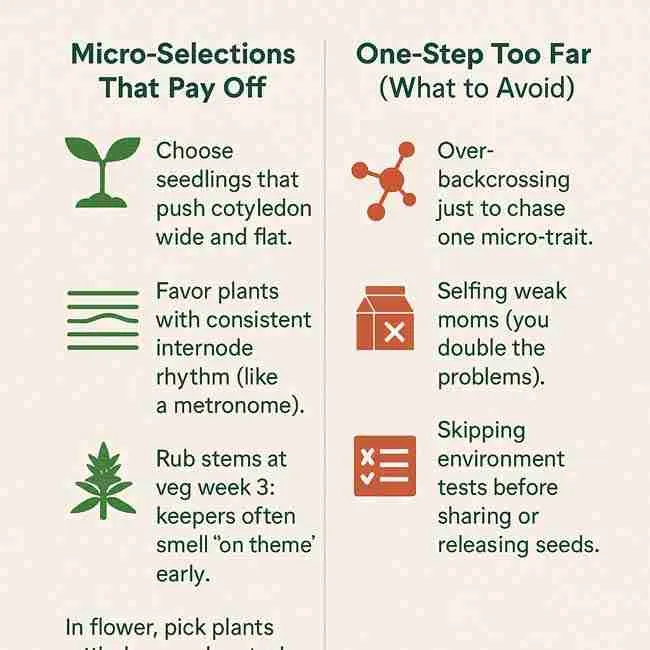
Micro-Selections That Pay Off
- Choose seedlings that push cotyledons wide and flat.
- Favor plants with consistent internode rhythm (like a metronome).
- Rub stems at veg week 3; keepers often smell “on theme” early.
- In flower, pick plants with dense calyx stacks (larf is a tax).
One-Step Too Far (What to Avoid)
- Over-backcrossing just to chase one micro-trait.
- Selfing weak moms (you double the problems).
- Skipping environment tests before sharing or releasing seeds.
Your 6-Step Action Plan
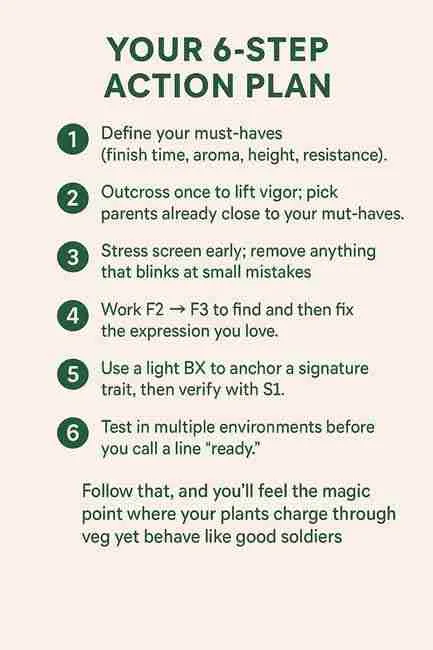
- Define your must-haves (finish time, aroma, height, resistance).
- Outcross once to lift vigor; pick parents already close to your must-haves.
- Stress screen early; remove anything that blinks at small mistakes.
- Work F2 → F3 to find and then fix the expression you love.
- Use a light BX to anchor a signature trait, then verify with S1.
- Test in multiple environments before you call a line “ready.”
Follow that, and you’ll feel the magic point where your plants charge through veg yet behave like good soldiers at harvest.
FAQ (targeted to “stable cannabis genetics case study”)
What’s the fastest way to tell if a line is stable?
Pop 10 seeds at once. If most plants match in height by day 14, start flower within ±3 days, and share the same top terp note, you’re looking at stability.
How does an F1 compare to an F3 for stability?
F1s can be very vigorous but vary if parents aren’t similar. F3s usually show tighter uniformity, especially if the breeder selected hard at F2.
Is backcrossing the best path to stability?
It’s a path. A single BX can anchor a favorite trait without crushing vigor. Multiple BXs can narrow the gene pool and sap energy if you’re not careful.
What’s the role of S1 in a stable cannabis genetics case study?
S1 exposes recessive issues and confirms that your keeper’s traits actually pass. In our stable cannabis genetics case study, S1 verified aroma, finish, and structure without raising intersex risk.
Can I keep vigor high while locking traits?
Yes. Use an outcross for lift, select for strong roots and stress tolerance every generation, and avoid over-fixing on micro-traits. Keep a vigor floor.
Do stable lines yield more?
Often they yield more per hour of your time because the canopy is uniform and easy to run. Raw yield depends on genetics, environment, and your dial-in.
Why do some “stable” lines still show a weird plant?
Seeds are living things. A small percent can deviate due to recombination, micro-environmental differences, or handling. True stability lowers the odds, never 100% eliminates them.
If I find a unicorn pheno in a stable line, what do I do?
Clone it. Run it again to confirm. If it holds, you’ve got a personal keeper for your garden—even in a stable line, special plants can pop.
Final Word (No Fluff, Just the Point)
Vigor keeps your plants alive and lively. Stability keeps your harvest predictable and profitable. When you tune selection with a steady hand—outcross for spark, refine for repeatability, test for toughness—you’ll grow lines that move fast and finish together. That’s the whole game.
Specifications (Snapshot Template You Can Reuse)

- Lineage & Generation: e.g., P × P’, advanced to F3, BX1, S1 verified
- Flowering Time: 49–56 days indoor (7–8 weeks)
- Stretch: ~1.7× post-flip
- Plant Size: Medium, sturdy laterals, low larf
- Aroma/Flavor: Chocolate forward; sweet bakery secondary
- Yield Class: High; responds to light defoliation
- Feeding: Moderate; EC 1.6–2.0 in flower; pH 5.8–6.3 (soilless)
- Environment Fit: Tent, room, greenhouse
- Stress Results: No intersex at mild light leak; stable under VPD swings
- Intended Use: Uniform home grows, small craft runs, SOG with topping