Sooty Mold in Cannabis Cultivation: Detailed Guide


Sooty mold in cannabis is a black film sitting on sugar. The sugar is honeydew. Sap-sucking insects dump it while they feed. The fungus grows on that mess. It does not punch into the leaf the way a true disease does. Wipe the film and the green is still there. Kill the insect or the film comes back by Friday.
White powder on the top of a leaf is a different job: powdery mildew on cannabis. Brown mush inside a cola is a different job: cannabis bud rot. The scout routine for every pest lives on IPM for cannabis. You are here because the leaf already looks like a chimney, and you need a way to name the insect, wash the film, and keep flower clean.
Start from named cannabis seeds. A 5-pack is the default order. Named packs sit around four dollars CAD a seed. Mix packs sit around a dollar. Genetics still set the ceiling. Sooty mold in cannabis decides whether those leaves can still work, or whether a honeydew maker is running the tent while you chase a bottle.
Sooty mold in cannabis is a film on honeydew
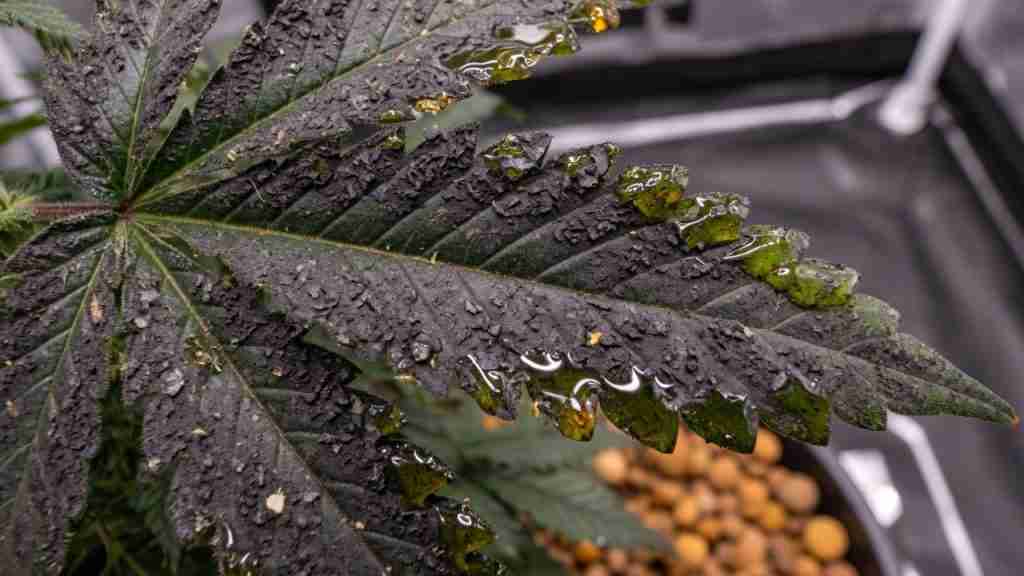
The name is honest. The growth looks like soot from a stove pipe. Garden people have used the same words for a century on citrus, oak, and houseplants. Several fungi make the same look. Growers talk about the film. You do not need a lab name to wash a leaf.
Honeydew is the meal. A sap feeder drinks more sap than it can keep. The leftover sugar and water come out the back end and land on whatever sits below: a fan leaf, a cola, the rim of a pot, the tent floor. Spores and bits of the fungus ride air and clothes. They land on the sugar and grow. No honeydew, no film. Rain outdoors can rinse some of it. A closed tent keeps every drop.
The film is a shade cloth the plant did not ask for. Light has to reach the leaf for the plant to eat. A heavy coat slows that work. New growth can look pale and slow even when the jug is fine. The insect is still draining sap at the same time. You are looking at two problems that share one sticky clue.
Sticky first, black later
Catch it early and you never see soot. Touch a leaf that looks too shiny. If your finger comes away tacky, that is honeydew. Dust sticks to it. Yellow cards get glazed. Ants show up and walk the stem like a highway. Write that down the same day. Wait for the black coat and you waited too long.
Resin on a flower is sticky in a different way. Trichomes sit as heads on stalks. They look like frost in a loupe. Honeydew is a smear. It is on fans that never flowered. It pulls lint off a shirt. If you cannot tell, look with the loupe before you wash a cola you meant to keep.
How to tell sooty mold from powdery mildew and bud rot
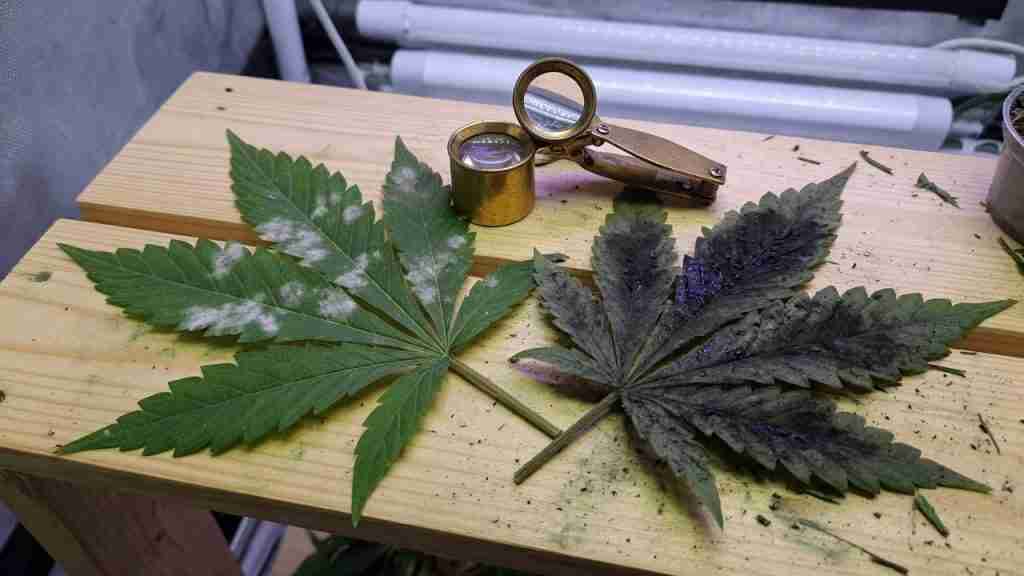
Wrong name sends you to the wrong bottle. Take thirty seconds and use your finger.
The wipe test
Sooty mold wipes. A damp cloth comes away gray or black. The leaf under a light coat is green. A heavy coat can flake in dry air and leave a crackled sheet. It lives on the surface. Powdery mildew is a white or gray dust, usually on the upper leaf first. It can smear, and it comes back in the same spots because it is living on the tissue. The full wipe-versus-trichome story sits on the mildew page. Bud rot starts inside a dense flower. A sugar leaf yellows, the cola feels soft, and gray fuzz shows up when you open it. That is a harvest-and-bag job, not a wipe job. Late-flower triage: harvesting cannabis with powdery mildew.
Dirt from a dry-back, algae on a wet rim, and carbon dust from a cheap filter can all look dark. Dirt rubs off dry. Algae sits on constantly wet plastic. Sooty mold sits on a sticky leaf and has an insect above it. If the leaf is dry, clean, and the underside is empty, keep looking. A pale plant with no shine is often water, light, or feed: cannabis nutrient deficiency.
Look above the soot and name the honeydew maker
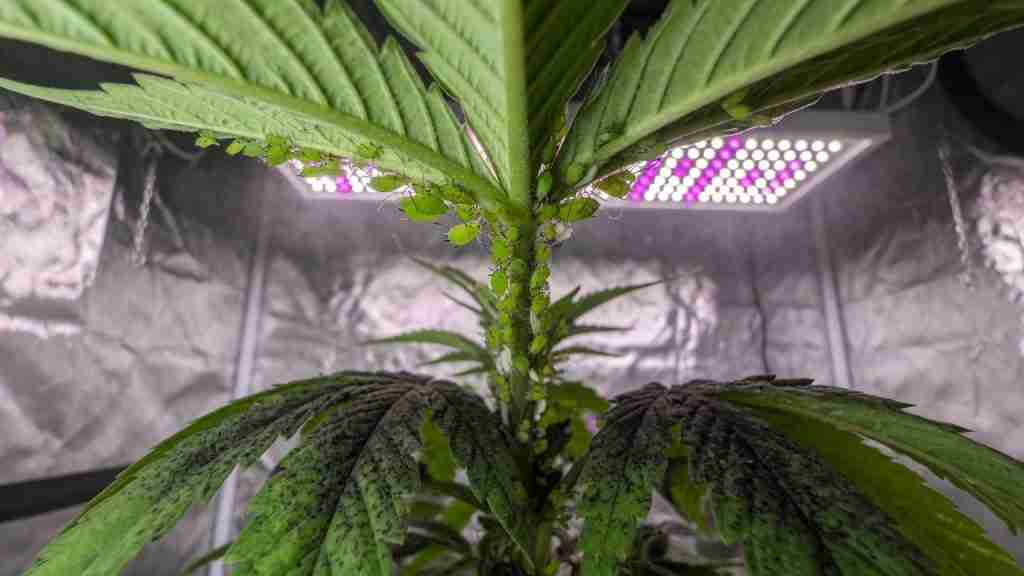
Honeydew falls. The black coat is often on a lower fan, a leaf that sits under a cluster, or the top of the pot. The insect is on new growth, the underside, the stem, or the hidden side of a cola. Flip the leaf above the mess. Use a loupe. A guess from a forum photo wastes a week.
Aphids
Pear-shaped. Soft. Green, yellow, or darker. They cluster on tips and undersides. Shed skins look like white flakes. They leak honeydew in volume. Cannabis aphid, green peach aphid, and a few cousins all do this job. The insect page: aphids on cannabis plants. Ladybugs and lacewing larvae eat them. Aphidius leaves a beige mummy. Release rules live on beneficial insects in your cannabis garden.
Whiteflies
Bump a stem and a cloud of tiny white moths lifts off. Scales sit on the underside. Honeydew rains onto the leaf below. Yellow cards catch adults and give you a count. Encarsia is the wasp used in a warm greenhouse. Ladybugs bought for aphids will not clear a whitefly bloom. The scout and card habit is on the IPM page.
Mealybugs and soft scale
Mealybugs look like bits of cotton in the crotches of stems. Soft scale looks like a small brown bump that does not wipe off. Both sit still and leak. They are slower than aphids and easier to miss in a dense canopy. A cotton swab with a little alcohol on a veg stem can knock a tiny colony. A whole plant covered in cotton is a bigger job. Hard scale is a different insect and a worse scrape. If you cannot name it, photograph the underside and compare before you oil the whole tent.
Ants as a scout
Ants farm honeydew. A trail up the stem with a tight aphid cluster is a ranch. The ants guard the herd and fight the hunters you paid for. Stop the trail at the base with a sticky barrier, then treat the insect. Outdoor ant story: ant colonies in outdoor cannabis grows. Companion flowers that hold hunters: companion planting for cannabis.
Spider mites stipple and web. Thrips silver the leaf and leave black specks. Fungus gnats fly off wet mix. Those pests do other damage. They are not the honeydew factory this film needs. Mites: cannabis and spider mites. Thrips: thrips on cannabis. Gnats: fungus gnats.
What the film does to a cannabis plant
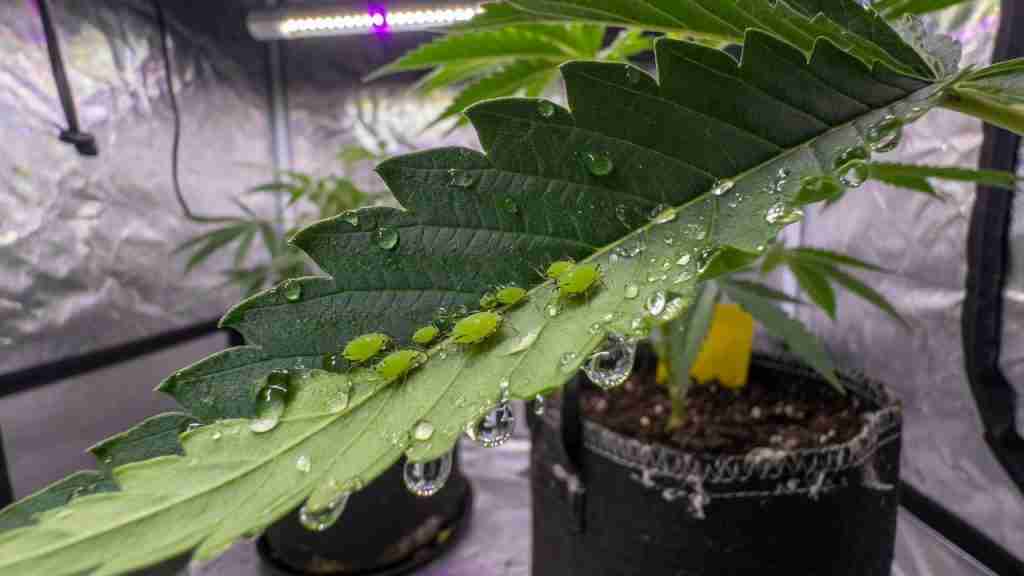
A thin film is ugly and still lets some light through. A thick film is a blackout curtain. The plant makes less sugar. Growth slows. Lower fans yellow from shade and from the insect above. In a 4×4 with four plants, one coated plant still shares air with the other three. Honeydew on a cola is worse than honeydew on a fan. Sugar on flower is a contamination problem at harvest, and it is a welcome mat for other fungi in a wet week.
The insect is the drain. Aphids and whiteflies steal sap while they paint. Twisted new growth, sticky cards, and ants are the plant talking. The film is the leftover. Treat the leftover alone and you will wipe the same leaf twice a week. Treat the insect and skip the wash, and the coat stays as shade. Do both, in that order: insect first, then wash.
Sooty mold also lands on plastic, pebble trays, and the tent floor. That is extra yeast and mold load in a room you wanted clean. Wipe the hard surfaces the same day you wipe the leaf. Room reset: cannabis grow room clean. Air that actually moves: ventilation for cannabis.
Stop the pest, then wash the leaf
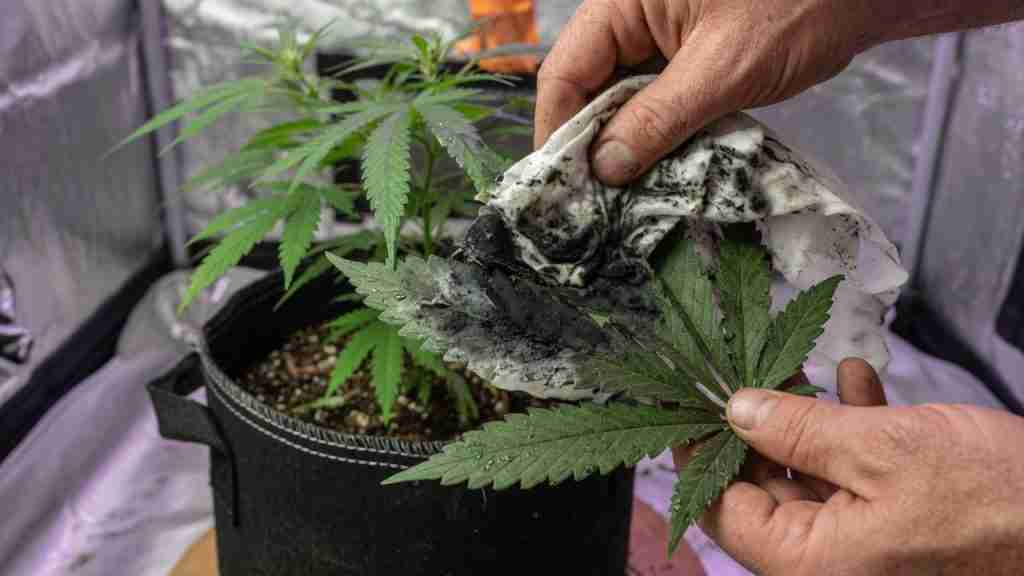
A four-plant room is small enough to work by hand. In veg, you can see every underside. Name the insect. Knock the herd down. Then wash.
Knock the herd in veg
On a small cluster, a wet finger or a strong spray of water from the underside dumps aphids. Repeat the next day. Insecticidal soap in veg hits soft bodies on contact. You have to wet the insect, undersides first, lights off. Neem in veg is a tool for the insect, not a mold killer: mix, timing, and the flower stop date live on cannabis pests with neem oil. Oil and soap also kill the hunters you just released. Pick one language for a week. Hunters, then no oil. Oil, then wait before you dump ladybugs. Pesticide-light rooms: pesticide-free cannabis cultivation.
Mild soap, then rinse
Once the live insects are down, wash the sugar. A few drops of a mild unscented soap in a litre of water is enough. Wipe the coated leaf with a soft cloth. Support the blade with your other hand so you do not crease it. Rinse with clean water after, or the soap sits and burns under a strong LED. Lights off for the wipe and the rinse. Let the leaf dry before the bar comes back on. A wet leaf under a strong LED is a burn you will blame on the soap. Heavily coated fans that will never see light can come off. Bag them. Do not shake a cloud of dry soot around the tent. Compost tea as a leaf spray is a phyllosphere idea, and it still leaves the sugar if you skip the cloth. The neighborhood map: cannabis microbiome.
Give it three days. New shine on the same leaf means the herd is still upstairs. A clean cloth on day three means you can stop wiping and keep scouting. Change one thing, then wait. Soap and a bag of lacewings on the same night hide which one worked.
A fungicide bottle for a surface film on honeydew is usually the wrong spend. The fungus is eating sugar on the cuticle. Take the sugar away and the film has nothing to live on. If a leaf is so coated it will not wipe, remove it. If the whole plant is a black sheet and the insect is still a mat in flower, you are in harvest triage, not in a spray contest.
What not to spray on open flowers
Oil on a cola is a residue you will taste. Soap on a dense flower sits in the creases. Sulfur and copper belong in veg if they belong at all. Late flower is a wash of fans you can reach, a bag for coated leaves, and a decision about whether that cola is still food. The IPM stop date is the same stop date here.
Flower, harvest, and what you do not smoke
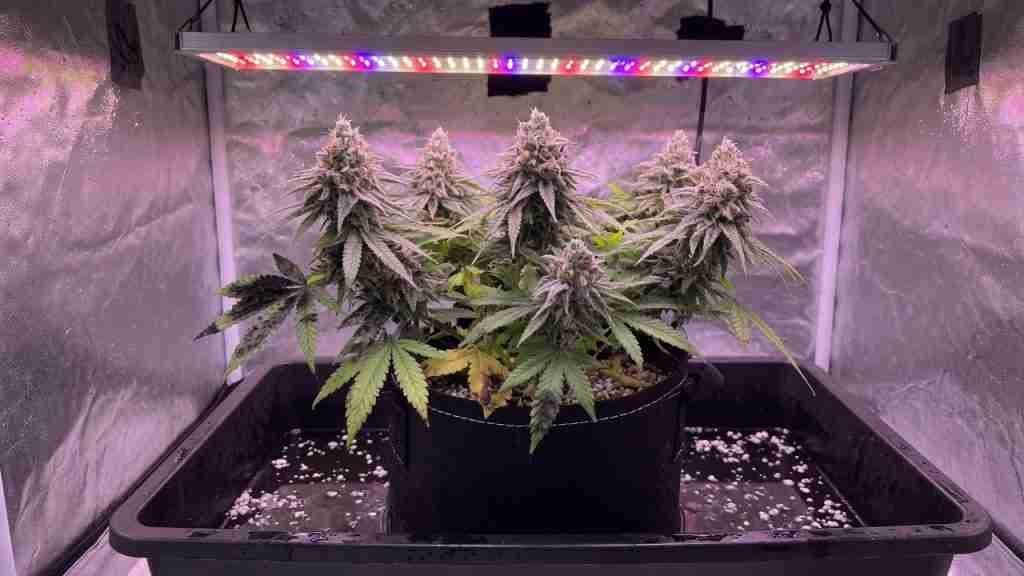
Flower is when honeydew hurts most. A coated fan is shade. A coated cola is a harvest you may have to throw. Sugar on flower feeds more than sooty mold. In a wet, still tent it invites the same rot you already fear. Keep RH in check, keep air moving through the flowers, and keep water off the cola. Environment as a physical system: environment, media, watering, and pot sizes. Flower as a stage: flowering stage.
If the film is only on lower fans, strip those fans, bag them, and keep the insect off the tops. If honeydew is on the cola itself, look at that flower in the light. A sticky, dull, sooty surface is not a trichome. Do not smoke it. Do not bake it into a story that heat made it safe. A bud wash can take surface dust off a light case. It does not make a coated cola a clean jar. Dry and cure still need a clean starting flower: dry, cure, and store cannabis buds.
Autos finish while you are still hunting. Photoperiods let you veg until the undersides are boring: photoperiod vs autoflower. A clone can walk honeydew makers into a clean tent. Hold a new cut in a separate cup for a week. Flip every leaf. A sticky card next to that cup tells you if whiteflies rode in. Wash the cup and the scissors after. Quarantine cuts: quarantine like a pro. Seedlings want a clean start: seedling stage. Veg is when you can still wash every leaf: vegetative stage.
Keep honeydew out of a four-plant room
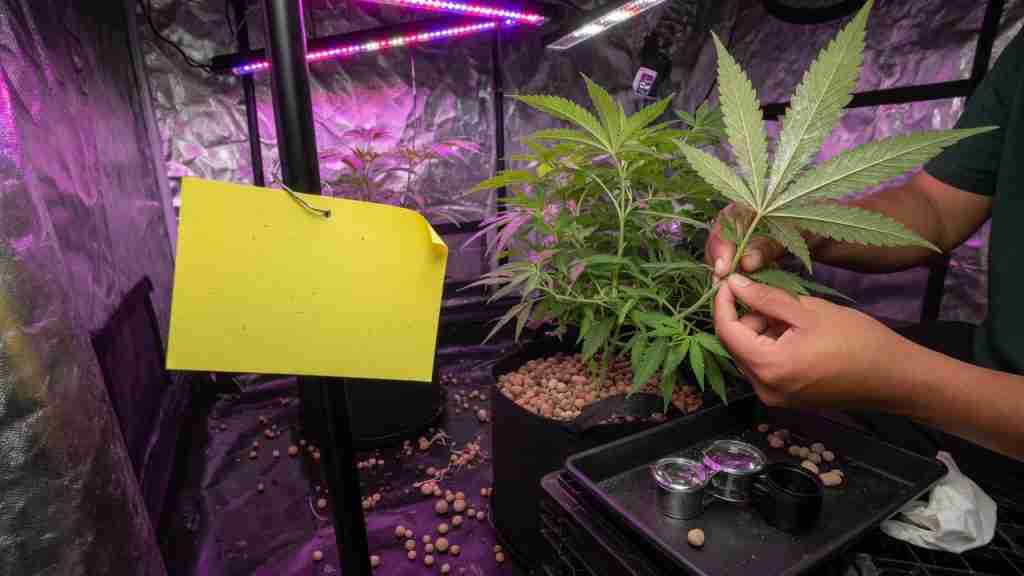
Canada’s Cannabis Act, section 12, caps recreational home cultivation at four plants per household. Quebec prohibits recreational cultivation. Manitoba has been indoor-only since 1 May 2025. Four plants is a small room. It is still enough to coat a canopy if you skip undersides for two weeks. A 4×4 with four plants in 5-gallon pots is a daily look. The same four in a backyard is a walk with a loupe after work. Match the scout to the plants you actually own.
Indoor drip
A tent has no rain. Honeydew stays. Exhaust that actually leaves the box, a fan that moves leaves without thrashing them, and space between plants so you can see an underside. Sticky cards at the edge, not a wallpaper of yellow that also traps wasps. Intake filters and a closed door beat a window that dumps greenhouse whitefly into veg. Indoor how-to: indoor cannabis growers guide. Tent as a box: grow tent for cannabis. Rank of jobs: most important things growing cannabis.
Outdoor rain and ants
Rain rinses some honeydew. It also hides the shine, so you scout after the leaf dries. Ants, leafhoppers, and a neighbor’s infested hedge are the outdoor path in. A net keeps larger chewers off. It does not stop aphids. Walk the plants. Look under. A hose on the undersides in veg dumps a cluster the way a tent spray does, then you still name the insect or it rebuilds. Outdoor crop: growing cannabis outdoors. Outdoor pest list: preventing fungi and pests in outdoor cannabis.
The notebook that makes it advanced
Date. Which plant. Sticky or black. Which insect, named with a loupe. What you washed. What you released or sprayed. Check the same plants three days later. If the shine is gone and no new skins show, you won that round. If the cloth turns black again, the herd is still upstairs. One change at a time. Two bottles and a bag of ladybugs on the same Tuesday hide which one did the work.
A sample week in a 4×4, four plants, veg. Monday: yellow card has a few whiteflies, lower fans on plant two are shiny. Flip the leaf. Aphids on the tip. Wipe the cluster, soap the undersides lights off, rinse next morning. Wednesday: no new shine, a few skins. Leave it. Friday: plant two clean, plant four has ants on the stem. Barrier at the base, look for the herd, wash after. You named the insect. You washed after. That is sooty mold in cannabis as a program, not as a panic.
Sooty mold in cannabis questions that keep coming up
What is sooty mold in cannabis?
A black surface film that grows on honeydew from sap-sucking insects. It shades the leaf. The insect is the cause. Marijuana yield still follows light, genetics, and a white root. A coated leaf just cannot use the light you paid for.
Does sooty mold infect the plant?
It lives on the sugar on the surface. Wipe a light coat and the tissue is still there. Heavy shade still slows the plant. The sap feeder is the one in the leaf.
Can you wipe sooty mold off cannabis leaves?
Yes. Mild soap in water, a soft cloth, then a rinse. Do this after you knock the insect down, or you will wipe the same leaf all week.
Do you need a fungicide?
Usually no. Take the honeydew away and the film has no pantry. A last-resort fungicide on a home weed plant is a residue decision, not a first move.
Will sooty mold ruin flower?
On fans, you can often save the run. On colas, sticky black flower is a throw. Do not smoke coated buds. Do not count on a wash or a cure to make them clean.
Is it worse indoors?
A tent keeps every drop of honeydew. Outdoors, rain helps and ants complicate. Scout both. The film follows the sugar wherever the sugar sits.
Can you reuse the pot after a sooty run?
Wash the pot. Wipe the tent. The film itself is on surfaces. The insect may have left nymphs in the canopy or on a clone. Clean mix and a quarantine beat a pretty pot with a leftover herd.
Does diatomaceous earth fix sooty mold?
DE is a dry dust for crawling insects. It is not a wash for a sticky film, and you do not want it in a cola or in your lungs. The dust page: diatomaceous earth and cannabis.
When do you stop and harvest?
When the insect is in the flower and oil is off the table, you bag dirty leaf, keep clean tops if they are clean, and chop a coated cola rather than spray it. Late flower is a knife and a bag. A new bottle on a ripe cola is how you add taste you did not want.
Root aphids and a pale plant
Root aphids live in the pot. The plant looks hungry or slow. The canopy can be clean. Ladybugs on the leaf do nothing. Foliar sooty mold still means a honeydew maker on the shoot. If the leaf is pale and dry with no shine, look at the root ball and the mix, then go back to the deficiency page. Do not wash a clean fan for a problem in the pot.