


Should I Trim My Autoflower or Leave It Alone?


Trim My Autoflower is a small choice you make with your own eyes, and the plant in the pot gets the vote. A big leaf is lying on a young flower and the tent looks messy. The leaf is the question and the plant is the answer. A green leaf is a little sugar factory. It catches light and it holds a bit of that food for later. When you cut it off, you do not get that factory back on a plant that is already counting days from the seed. A healthy open plant can stay as it is. A leaf that is dead, sick, or truly smothering a flower is a different story, and even then you take one leaf and you stop.
People search this because they have seen a long veg plant get a hard haircut and they wonder if the same haircut belongs on a plant that flowers by age. It does not. You can tuck a leaf before you cut it. You can bend a stem while it is still soft, and that job lives on the page about bending an autoflower. You can leave the plant alone on purpose. What you should not do is strip it bare because a picture online looked tidy. Read the rules where you live before you pop a seed.
Trim My Autoflower
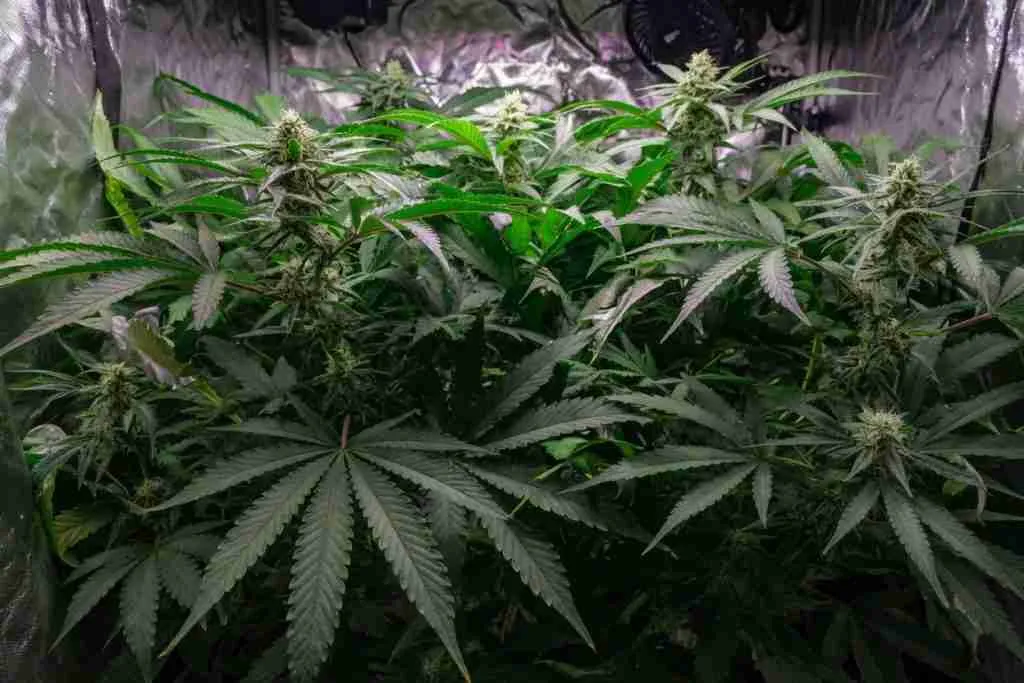
Start with the plant you actually have, not the plant in a thumbnail. If you can see the stems, the light reaches the young flowers, and the leaves are a good green, you are already in a fine spot. Big fans overlap, the stems hide, and a small fan sits in the back of the tent. That crowd is a reason to look harder. It is not a reason to give the plant a haircut in one evening. Move one leaf with your hand. If the flower under it can see the lamp after you move the leaf, you did the job without a cut.
A fan leaf is the big one with the fingers. Those are the solar panels. The small leaves that grow out of the flower are sugar leaves, and they stay. They are part of the flower, and pulling them off early just to make the cola look naked is a waste. If a fan is still working and it is not sitting on a bud, it stays. If it has turned fully yellow and it comes off with a gentle pull, it was already done. If it is still stuck on and still green, it is still working, so leave it.
Trim My Cannabis Autoflower
A friend of yours learned this the hard way. The plant was short, bushy, and just starting to show white hairs. The friend took every big fan that looked like it was in the way, and the tent suddenly looked open and proud. By the next evening the plant had not grown a new set of leaves to replace them, and the flowers kept forming on the clock anyway. The friend had more light and less factory. The harvest was smaller than the plants that only lost a leaf or two. One leaf is a test. A bare plant is a bet you cannot rewind.
A Leaf That Blocks a Bud
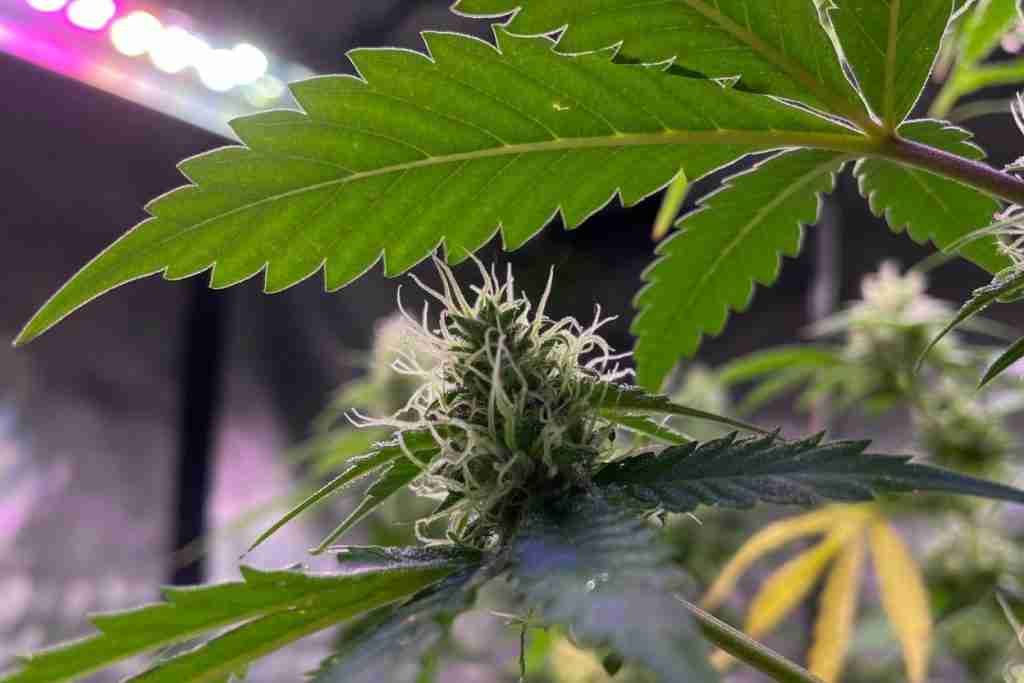
Here is the leaf that earns a look. It is large, it is lying on a small flower, and the white hairs are under the shade. A yellow leaf farther back is not the same job. The yellow one may already be spent. The green one on the bud is the one that is stealing the lamp from a flower that is trying to build. Lifting the big leaf off the young flower, the white hairs finally caught the lamp. If your fingers can hold that leaf aside and the flower stays in the light, you tuck it and you do not cut. A soft tie, a gentle bend of the leaf stem, or even the leaf pushed under a side branch can be enough.
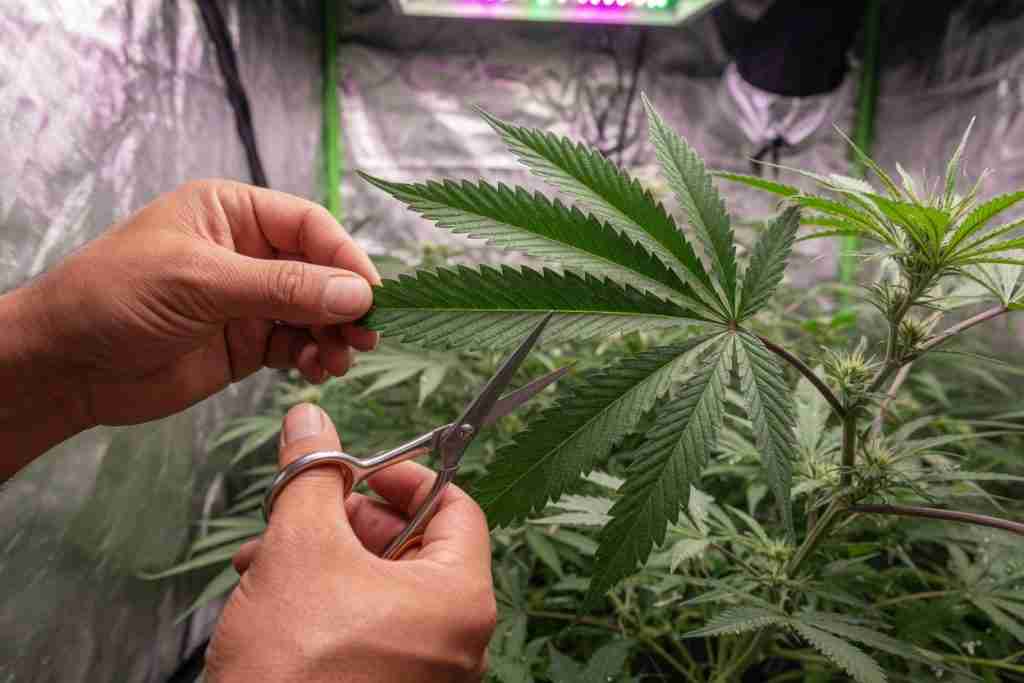
If the leaf springs back and covers the flower again, then you have a real cut. Take that one leaf at the stem, close to the plant, with a clean snip. Do not tear it. Do not take the leaf beside it because you are already in there. Do not take the little sugar leaves on the flower. You came for the one fan that was lying on the bud. When that fan is gone, stop and look. The flower should see light. The rest of the plant should still look like a plant, not like a stick with a pom-pom on top.
Lower sites that are only small and far from the lamp are a different page, the one about clearing the lower stems. Do not turn one fan on a top flower into that job.
A Leaf You Should Leave
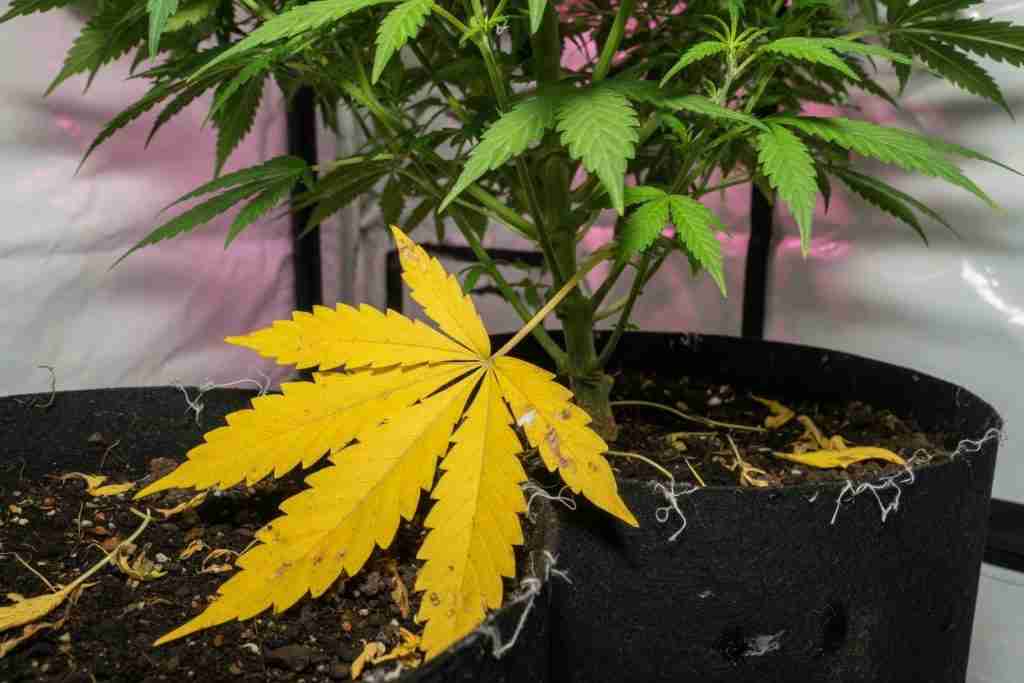
A yellow leaf on the soil is a spent leaf, not a diagnosis. It fell, or it was ready to fall, and the green growth above it is the part that still matters. You can pick that leaf up so it does not sit wet against the pot. You do not need to hunt the canopy for every leaf that has a pale tip. Cutting the leaf does not fix a color problem. If you strip the plant to hide a color problem, you now have two problems.
Leave the leaf that is green, clean, and not on a flower. Leave the leaf that is only a little yellow at the edge while the rest is working. Leave the sugar leaves on the cola. Leave the fan that shades a stem but not a flower. Leave the plant that is already open, even if a video told you that naked plants make bigger flowers. They do not, not on a clock that will not wait. A weed chart on your phone still cannot see the leaf that is lying on your flower.
If a leaf is mushy, brown in a wet patch, or covered in a pest you can already see, that one leaf can go so the mess has less to sit on. Do not invent a disease from one spot. Do not spray a recipe you found in a comment. Lift the bad leaf off, cut it if it will not release, and then read the page that owns the real problem. A wet flower with a dead leaf stuck to it is closer to bud rot than it is to a trim. Get the dead tissue off the flower and stop opening the cola up for the fun of it.
Trim My Marijuana Autoflower
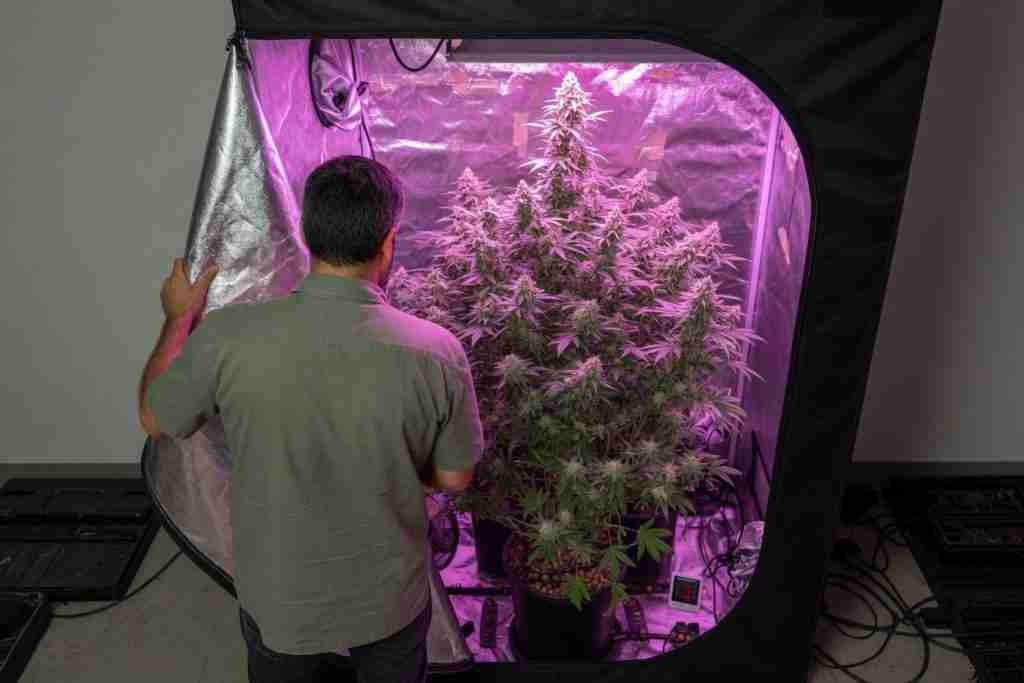
Stand in the door the way this grower is standing. The plant is large, it is flowering, and nobody has stripped it. You are looking for trouble, not for a project. Trouble is a leaf glued to a bud, a dead fan on the soil, or a canopy so tight that every cola is in the dark. If you do not see trouble, you close the door and you leave the plant alone.
Topping is the cut people argue about, and it is usually the wrong bet on this plant. Topping means you cut off the main growing tip so the plant has to build a new top. On a photoperiod plant you can give that plant more veg days under a long light. On an autoflower the age clock does not pause while the wound heals. You spent days you cannot buy back. If you want the shape changed, bend the soft stem and keep the tip on the plant. The page for a photoperiod plant and an autoflower is where the two clocks are explained, and this page will not repeat that lesson.
There is a sturdy window, and it is a feeling more than a date. The plant has several sets of real leaves. The stem is no longer a thread, and new growth looks firm. That is a plant that can lose one leaf and keep going. Before that, you are still in the seedling stage, and scissors do not belong there. After the flowers are stacking and the white hairs are everywhere, you are late, and scissors do not belong there either, except for a leaf that is dead and stuck where it can rot. The middle, when the plant is sturdy and the flowers are just starting, is the only time a single cut makes sense.
The Clock Does Not Wait
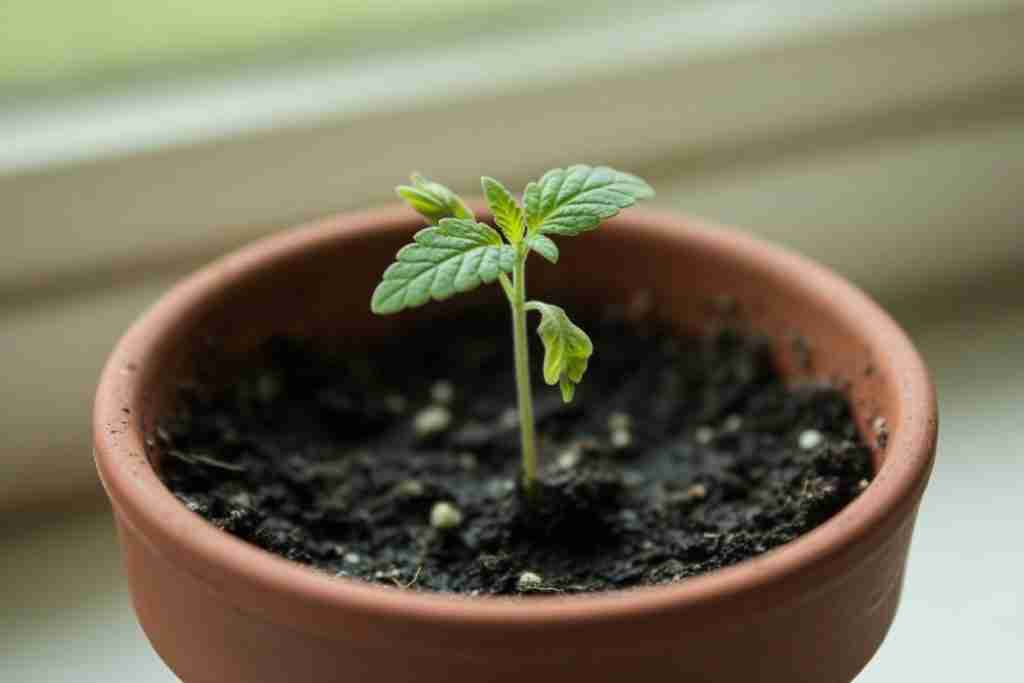
This seedling is too young to cut. It has a few true leaves, it is in a small pot, and it is still building the engine. Every leaf it has is a big share of the food it can make. You do not top it. You do not pluck fans to make it look like a grown plant. You give it light, a gentle drink, and time. Stay with the seedling page and the vegetative stage until the plant is actually in them. An autoflower slides from one stage into the next without a light flip, so you judge by the plant, not by a flip you never made.
Gardeners already know a short plant that sets fruit and then slows down is not the same job as a plant that keeps climbing all season. A university note on tomato plants calls the short kind determinate. It grows to a set size, sets fruit, and then declines. The climbing kind keeps going. Your autoflower is closer to the first kind. You do not get extra weeks by wishing. That same note is about tomatoes, not about your tent, and it still says a plant pruned just once keeps a heavier leaf cover than a plant you keep picking at. You want that green left on a plant that will not grow a new roof.
A photoperiod grower can strip leaves and then stay in veg until the plant replaces them. That job is stripping leaves on a long veg plant, and it is not this job. Copying it onto an autoflower is how people stall a plant that was doing fine. The flowering stage on an auto starts because the plant got old enough, even if you wanted another week of leaves. If you cut hard the week the white hairs show, you ask the plant to heal and to flower at the same time. It will flower. It may not have the leaves to feed those flowers the way it could have.
Choosing the pack is a different decision from trimming the plant. A short clock, a smaller plant, or a room where the light day stays the same is why people buy an autoflower. A plant you want to keep in veg, shape for a long time, or keep as a mother is a photoperiod. That shopping choice is on the page about choosing an autoflower pack or a feminized photoperiod pack. Once the seed is in the pot, the clock you bought is the clock you have.
Tuck Before You Cut
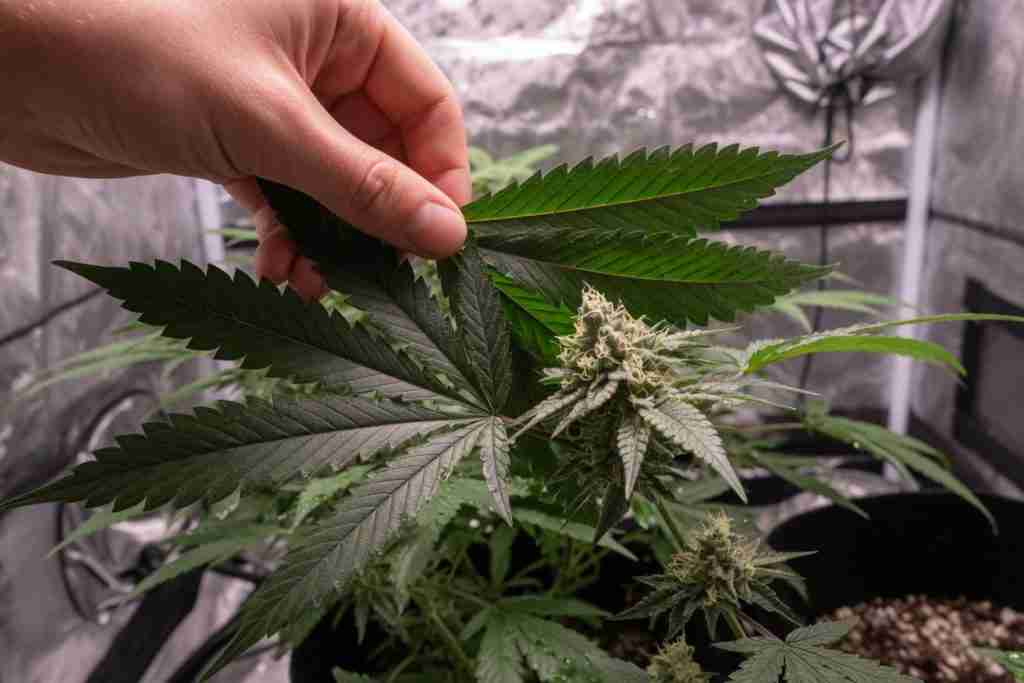
Tucking is the move in this picture. A hand lifts the fan off the small flower. No scissors. The leaf is still on the plant, still green, still making food, and the bud can see. That is the win you wanted. You can tuck the leaf under a neighboring branch, or you can ease the leaf stem down so it points out instead of in. Check it later. Leaves move as they grow, and a tuck that worked in the morning can pop back by night. If it pops back, tuck it again. You are still ahead of a cut.
When Flowers Are Already Busy
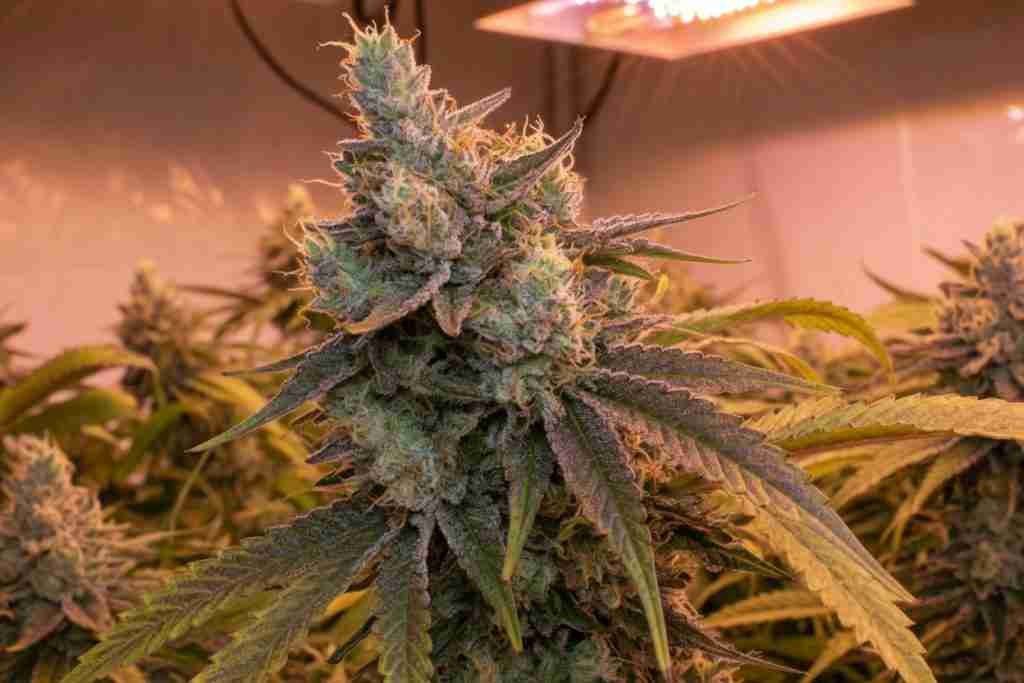
When the cola looks like this, you are done trimming for shape. The flower is dense, it is frosty, and it is still wearing its small leaves. Those small leaves stay. They are not fans you forgot. Pulling them now does not make the flower ripen faster, and it can scrape the frost you waited for. If a big fan is still glued on top of that cola and holding moisture, you can lift that one fan off. You do not remodel the cola.
White hairs widespread, flowers stacking, and a smell that fills the tent are your stop signs. Before that, one blocker is fair game if the plant is sturdy. After that, your hands are for watering, for holding a stem still while you look, and for cleaning up a leaf that is already dead. The common mistakes in a first indoor garden include doing extra jobs because you are nervous. This is one of those jobs. Nervous trimming in late flower is how a good cola gets handled too much. Close the tent. Come back tomorrow. If the flower still looks the same, you were right to wait.
Clean Steel and a Single Leaf
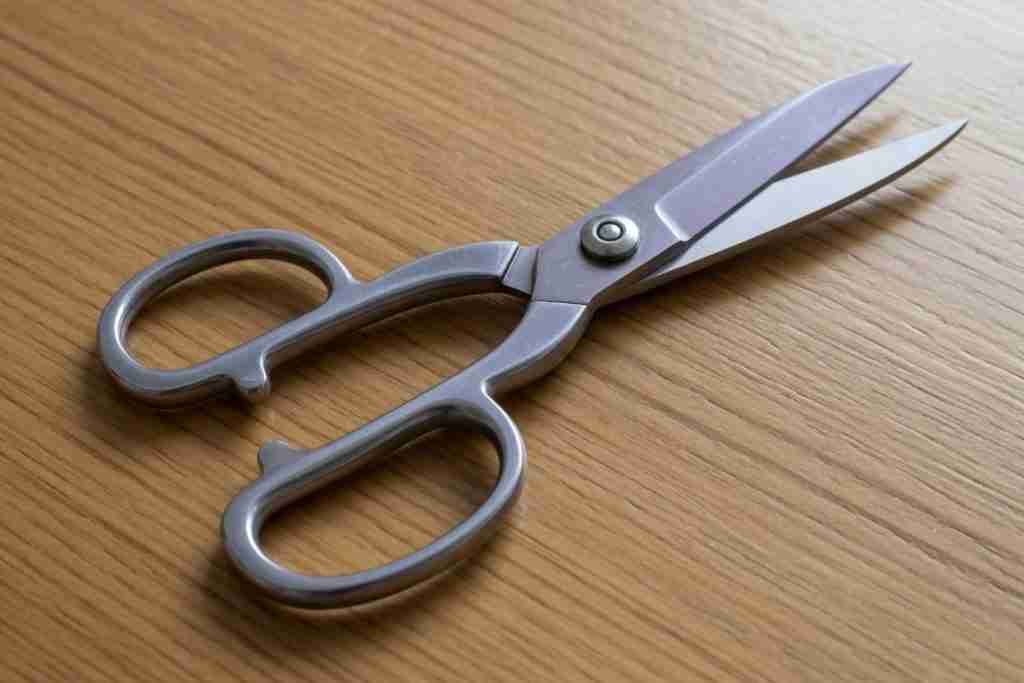
Bending the whole stem is the bigger version of the same idea, and it belongs on the autoflower bend page, not in a rush of cuts. A soft stem can be pulled gently so the top is not the only thing in the light. The photoperiod version of that bend lives on the page about bending a photoperiod plant, and the timing is kinder there because you can wait. On your auto, you bend while the stem still gives, and you stop making new bends when the stem is stiff and the flowers are busy. Do not also strip the plant.
If the tuck will not hold and the leaf is creasing the flower or keeping it wet, then you cut that one leaf. Setting the scissors down after one leaf, the rest of the plant still looked full. That is the picture you want on the table. One fan, the scissors, and a plant that still has its coat. If the plant looks bald, you went too far, and there is no tape that puts a leaf back. The next day, look. If the leaves are praying the way they usually do and the cut is dry, you are fine. If the plant wilts, you did more than it could spare, and the rest of the run is hands off.
Pros and Cons of One Cut
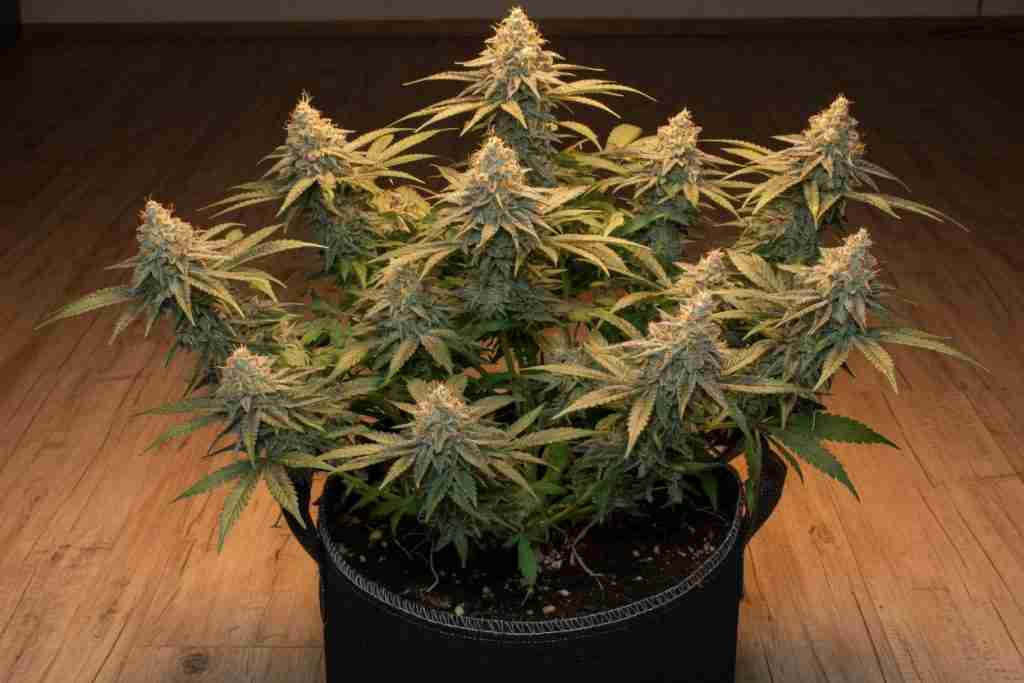
Look, a bushy plant with many tops can still be the right plant to leave alone. This one is full of leaves and full of flowers, and it is not a failure. The pros of one careful cut are simple. Air can move where a leaf was plastered on a bud. Light can hit a flower that was in the dark all day. A dead leaf is gone, so it is not a wet rag on living tissue. You can see the plant better, which helps you water and helps you spot a real problem. One cut is a small stress. A healthy sturdy plant shrugs at one cut.
However, the cons show up when one cut turns into a pile. Every green leaf you remove is food you removed. Too many cuts stall a plant that is already counting days, and you cannot add veg time to let it recover. Late cuts on fat flowers do not build those flowers. They just open wounds next to tissue that should be left quiet. A cut on a weak, pale, or drooping plant is a cut on a plant that needed water, light, or rest, not surgery. If you cannot name the single leaf, the con wins and the scissors stay down.
When Flowers Are Already Busy
When the cola looks like this, you are done trimming for shape. The flower is dense, it is frosty, and it is still wearing its small leaves. Those small leaves stay. They are not fans you forgot. Pulling them now does not make the flower ripen faster, and it can scrape the frost you waited for. If a big fan is still glued on top of that cola and holding moisture, you can lift that one fan off. You do not remodel the cola.
White hairs widespread, flowers stacking, and a smell that fills the tent are your stop signs. Before that, one blocker is fair game if the plant is sturdy. After that, your hands are for watering, for holding a stem still while you look, and for cleaning up a leaf that is already dead. The common mistakes in a first indoor garden include doing extra jobs because you are nervous. This is one of those jobs. Nervous trimming in late flower is how a good cola gets handled too much. Close the tent. Come back tomorrow. If the flower still looks the same, you were right to wait.
Clean Steel and a Single Leaf
Leave It Alone on Purpose
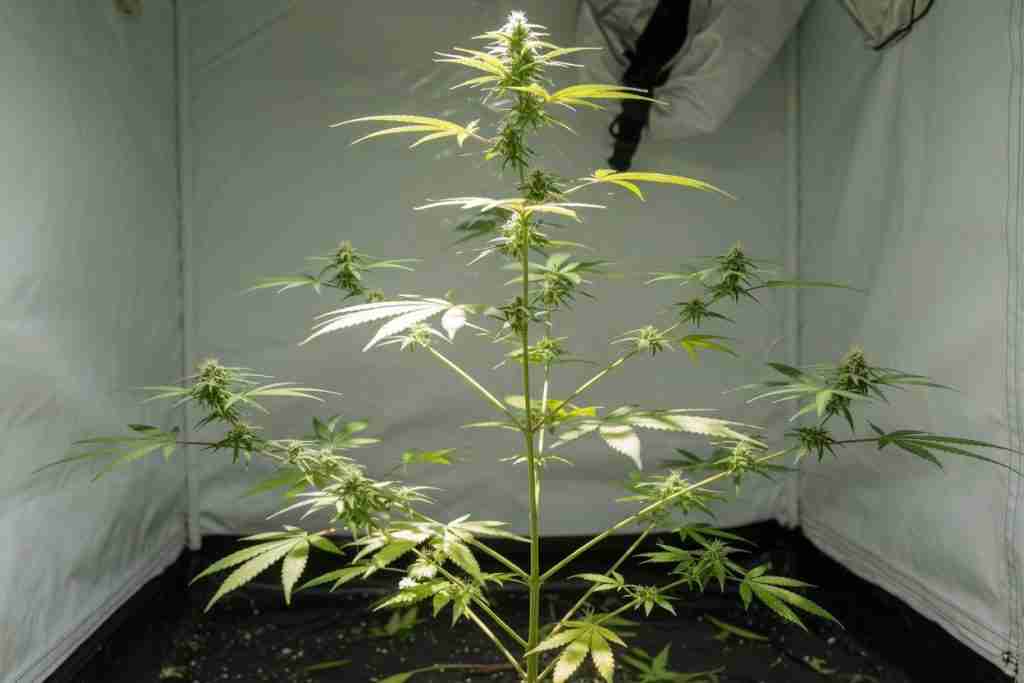
This plant already breathes. It is tall, the branches have light on them, and a few leaves on the floor are just leaves that finished. You do not owe this plant a trim. Leaving it alone is a decision, not a failure to act. The dropped leaves can be picked up so they do not stay wet on the floor. The living fans stay.
Leaving it alone also means you do not invent training in the last part of the run. No new bends. No new ties that bite a swelling stem. No top cut. No session where you remove a little more each night until the plant is a skeleton. If you wanted a flatter shape, that work happened while the stem was soft, on the bend page. If you missed that window, you missed it. The flowers you have are the flowers you will finish. Protect them. Do not redesign them.
A Plant That Already Breathes
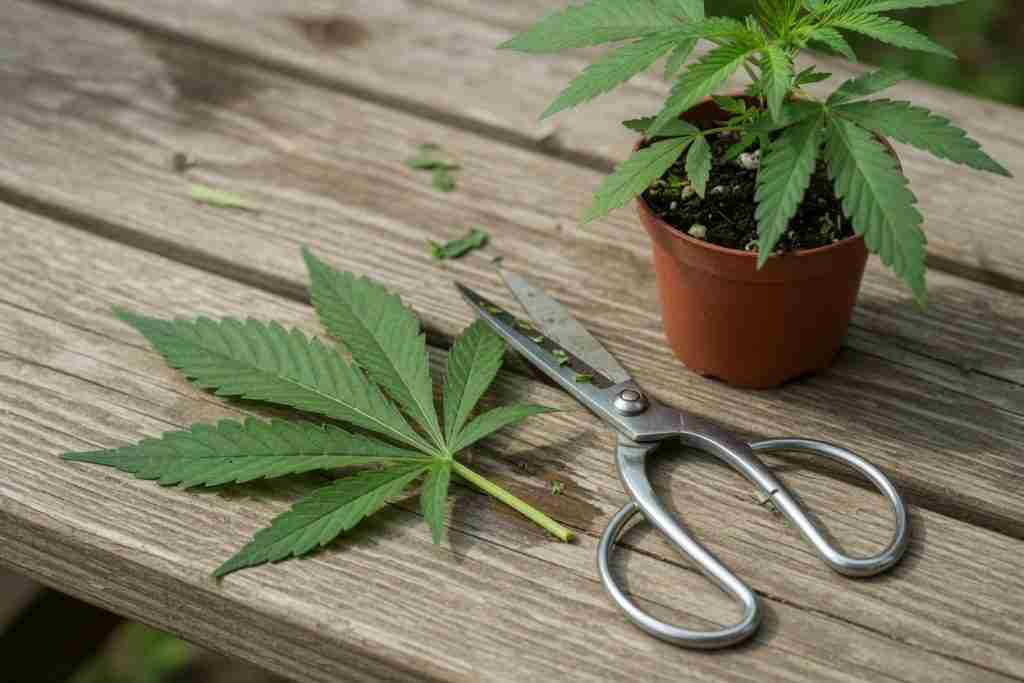
If you do cut, this is the honest picture. One fan leaf on the table. Scissors beside it. A small plant that is still leafy. You can count the cut with your eyes. One. The plant next to the scissors did not get stripped. That is the standard you take back to the tent. If your table has a pile, you are not in this picture, and the next leaves stay on the plant no matter how uneven the canopy looks. Uneven is fine. Bald is not.
When you are ready for the next seed, pick the clock on purpose. A short plant that will flower on age is an autoflower, and you will trim it the way this page says, which is almost not at all. A plant you want to shape for a long time is the other clock. The Canada seed list and the United States seed list are the maps, and the packs for Prince Edward Island and Georgia are there when you want a place to start. The leaf on the plant you already have is still today’s job. Tuck it if you can. Cut it only when you must. Then leave the rest of the green alone.
The tool is small scissors with a clean bite, not a kitchen knife and not your fingernails. Wipe the blades before you cut so you are not dragging a sticky mess from a sick spot onto a fresh cut. The blades in this picture are a little open, which is fine. You close them on the leaf stem, not on the flower and not on the main stalk. One snip. Then you stop. If the scissors crush the stem instead of cutting it, they are dull, and a dull crush is a bigger wound. Get a better edge before you try again, or do not cut today.
Here are the specs in plain words. The plant is sturdy, not a seedling and not a wilted mess. You already tried to tuck the leaf. The leaf still covers a flower, or the leaf is dead, or the leaf is clearly sick. You take one leaf. You leave every other green leaf. You leave the sugar leaves on the flower. You look the next day before you even think about a second leaf. You stop completely once white hairs are widespread and the flowers are stacking, unless a dead leaf is sitting on a bud and you are only lifting that dead tissue off. That is the whole specification.
Leave It Alone on Purpose
This plant already breathes. It is tall, the branches have light on them, and a few leaves on the floor are just leaves that finished. You do not owe this plant a trim. Leaving it alone is a decision, not a failure to act. The dropped leaves can be picked up so they do not stay wet on the floor. The living fans stay.
Leaving it alone also means you do not invent training in the last part of the run. No new bends. No new ties that bite a swelling stem. No top cut. No session where you remove a little more each night until the plant is a skeleton. If you wanted a flatter shape, that work happened while the stem was soft, on the bend page. If you missed that window, you missed it. The flowers you have are the flowers you will finish. Protect them. Do not redesign them.
A Plant That Already Breathes
If you do cut, this is the honest picture. One fan leaf on the table. Scissors beside it. A small plant that is still leafy. You can count the cut with your eyes. One. The plant next to the scissors did not get stripped. That is the standard you take back to the tent. If your table has a pile, you are not in this picture, and the next leaves stay on the plant no matter how uneven the canopy looks. Uneven is fine. Bald is not.
When you are ready for the next seed, pick the clock on purpose. A short plant that will flower on age is an autoflower, and you will trim it the way this page says, which is almost not at all. A plant you want to shape for a long time is the other clock. The Canada seed list and the United States seed list are the maps, and the packs for Prince Edward Island and Georgia are there when you want a place to start. The leaf on the plant you already have is still today’s job. Tuck it if you can. Cut it only when you must. Then leave the rest of the green alone.
The shade was the teacher. The leaf you left is still working. One clean cut is the whole job when a leaf is truly in the way.
