Noise, Smell, Light: Building a Stealth-First Cannabis Indoor Grow


You want a quiet, invisible, no-drama grow that stays off everyone’s radar. Good. This guide gives you the full playbook to build a stealth grow room that keeps noise, smell, and light locked down—even if you live in an apartment, share walls, or you’ve got curious visitors. We’ll keep the language simple, the steps practical, and the results real.
You’ll learn how to hush fans, kill odor (including odor control beyond carbon), block light leaks, and disguise the whole setup. We’ll also walk through clever micro-grow ideas (yep—like a PC case), specs to hit, and a startup checklist you can follow right now. Let’s build your stealth grow room the smart way.
The Stealth Rule of Three: Noise, Smell, Light
When someone discovers a grow, it’s usually because one of these three slipped. Keep all three low and you’re golden.
- Noise: Fans hum, pumps buzz, air whooshes. You’ll quiet them.
- Smell: Plants smell lovely to you, but loud to everyone else. You’ll layer filtration.
- Light: Stray light at night acts like a neon sign. You’ll trap it.
If you design around these three from the start, your stealth grow room naturally stays calm, cool, and hidden—like it’s not even there.
Quick Stealth Wins (Do These First)
- Put the tent or cabinet on rubber anti-vibration pads.
- Run your inline fan on a temperature/humidity controller (it only speeds up when needed).
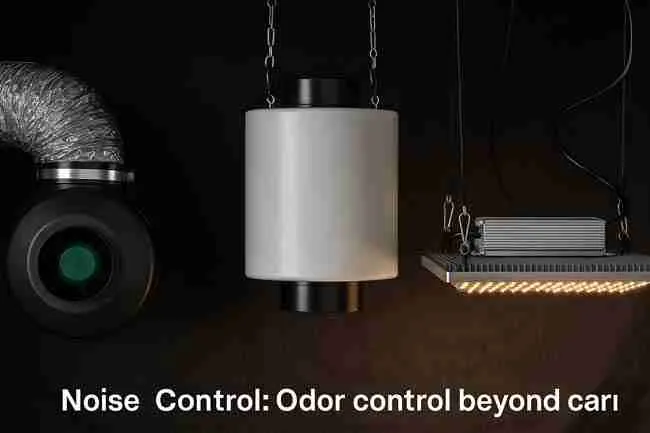
- Use insulated (acoustic) ducting and a silencer on the fan exhaust.
- Create negative pressure (tent sides suck in slightly) so smells don’t leak out.
- Add a baffled intake or a DIY light trap so no glow escapes.
- Water on a tray and wipe spills—wet smells travel more.
Your Stealth Specs (Targets to Aim For)
You don’t need expensive gear; you need the right targets. Hit these and you’re in stealth territory.
| Category | Target Spec for a Stealth Grow Room | Why It Matters |
|---|---|---|
| Noise | ≤ 30–35 dBA at 1 meter (roughly a whisper) | Disappears into room noise |
| Airflow | 1–2 full tent air exchanges per minute (add 25% for filter/bends) | Stable temp/humidity without overkill fan speed |
| Ducting | 6″ insulated if space allows | Lower turbulence = less noise |
| Filter | Carbon rated ≥ fan CFM, with prefilter sock | Full odor scrubbing + longer life |
| Pressure | Slight negative (walls pull in) | Keeps smell inside until scrubbed |
| Light Leaks | None visible in a dark room | No “glow tattletale” at night |
| Power | Dedicated strip, drip loop, GFCI if near water | Quiet + safe + no tripped breakers |
Noise: Make It Whisper-Quiet

Choose Quiet Fans the Right Way
- Pick EC (electronically commutated) inline fans. They run cooler, quieter, and handle speed control without motor chatter.
- Go up one size (e.g., use a 6″ instead of 4″) and run it slower. Bigger + slower = quieter.
- Use a fan controller that ramps smoothly (not on/off jolts).
Kill Vibration at the Source
- Hang the fan with straps or bungee cords. Hard mounts act like speakers.
- Put the tent, fan stand, and humidifier on rubber pads or yoga blocks.
- Use flexible couplers between fan and filter/duct so the fan can’t “shake” the tube.
Silence the Wind (Air Noise Matters)
- Add a can-style silencer after the fan.
- Use insulated ducting and keep bends smooth and few.
- Oversize duct runs when possible—air speed drops, noise drops.
Build a Soundproof Grow Tent (yes, really)
A soundproof grow tent isn’t truly soundproof, but you can make it ultra-quiet:
- Line the outside walls (not inside reflective surface) with moving blankets or mass-loaded vinyl (MLV).
- Place foam blocks under tent poles and the reservoir.
- Seal pinholes and zipper gaps (light + sound escape together).
- Keep the loudest gear outside the tent if you can (air pump, air stone). Or place pumps in a padded box with ventilation.
Pro tip: Put a bookshelf or dresser in front of the tent’s main wall. It acts as a free diffuser that breaks up any sound.
Smell: Odor Control Beyond Carbon
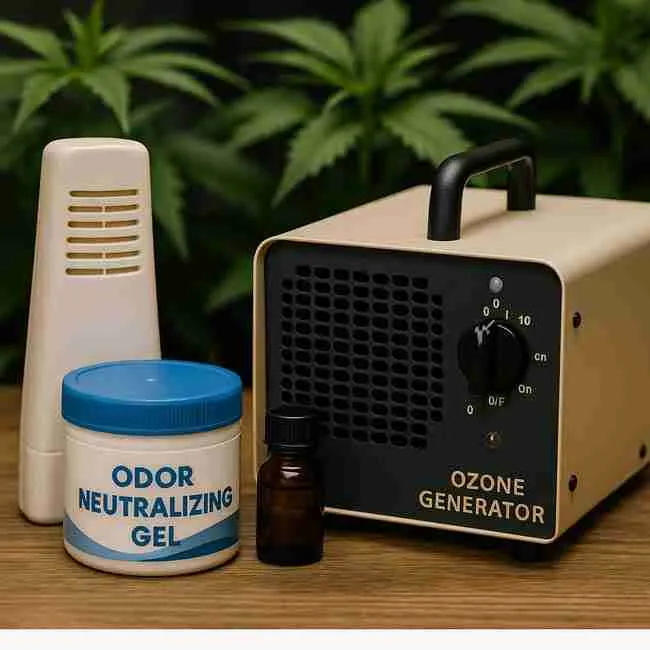
Carbon is king, but you’ll stack methods so even late-flower stink stays private. This is your odor control beyond carbon blueprint.
Layer 1: Carbon Filter + Prefilter
- Always use a quality carbon filter that matches or exceeds your fan’s CFM.
- Add a prefilter sock to catch dust so the carbon lasts longer.
- Put the filter inside the tent so it scrubs before air leaves.
Layer 2: Negative Pressure
- Make sure the tent walls pull inward slightly.
- Seal unused ports and zipper edges. Smell should only leave through the carbon.
Layer 3: Intake Hygiene
- Add a MERV 8–13 prefilter to your passive intake.
- Keep the floor clean, remove dead leaves, and wipe spills. Moist organic matter = smell amplifier.
Layer 4: Final Polish (Use Carefully, Use Smart)
- Ozone (exhaust-only): If used, it must be downstream of the carbon and never in the tent with plants or your lungs. Keep it low, intermittent, and only in ducting or a separate exhaust room.
- Photocatalytic oxidation (PCO) boxes: Place in the exhaust area (not in the tent) to neutralize remaining odor molecules.
- Odor neutralizing gels/solids: Keep outside the grow near the exit air path, never next to buds (they can flavor your harvest).
Layer 5: Timing & Air Turns
- Exhaust more after lights-off (terpenes peak) and when you enter the room.
- Don’t over-ventilate. Just enough keeps temps/odor stable without calling attention.
Light: Trap It Like a Ninja
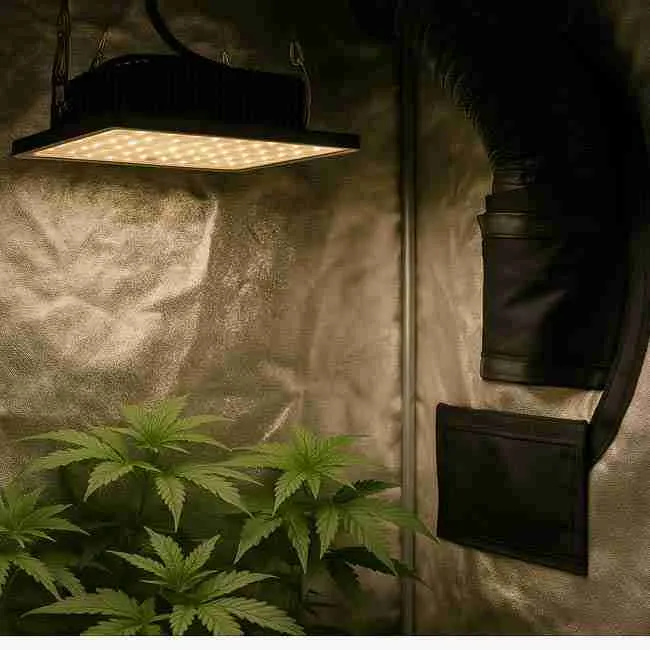
Light leaks tattle at night. You’ll build a maze for the air, not for the eye.
Baffled Intakes (DIY Light Trap)
Create a simple “S”-shaped path with black foam board:
- Cut a box that attaches over your intake.
- Add two internal baffles: one high, one low, so air snakes around.
- Paint the inside matte black (or use black board) to absorb stray light.
Seal the Glare
- Tape seams, cable ports, and zipper ends from the outside of the tent.
- Use blackout curtains over tent doors and windows of the grow room itself.
- If building a cabinet, install light-trap louvers or PC case fan grilles with foam baffles.
Inside Reflective ≠ Outside Shiny
- Keep the inside reflective (Mylar/panda film).
- Keep the outside dull. No glossy surfaces to bounce light under doors.
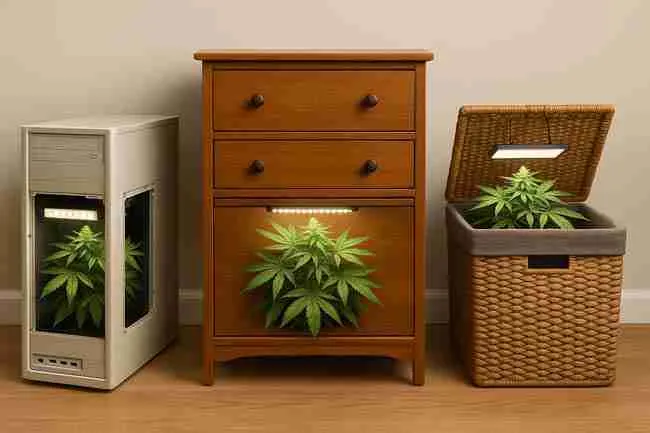
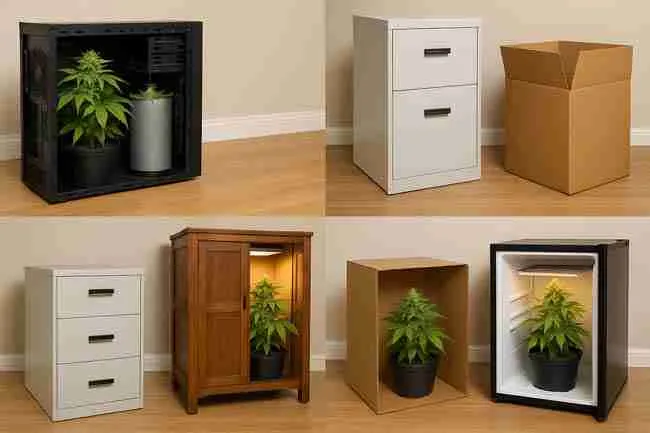
Rad Stealth Enclosures (Yes, Including a PC Case)
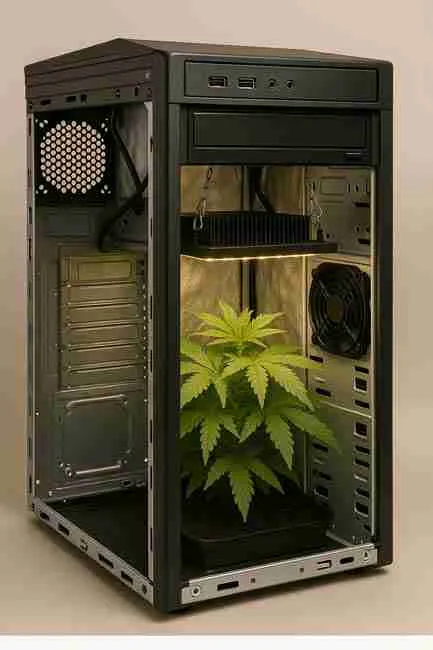
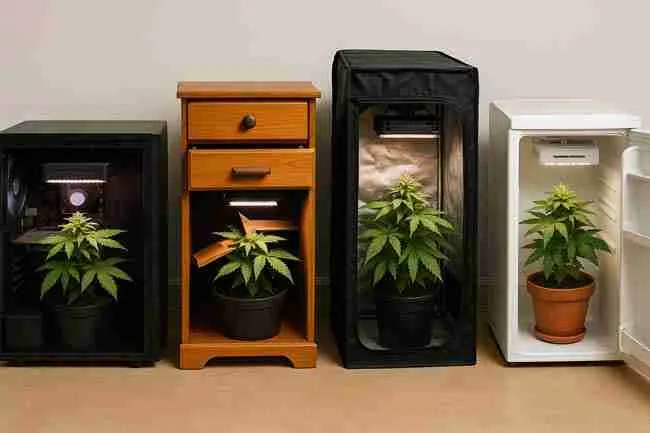
You don’t need a tent. You can hide in plain sight. Here are fun, sneaky builds that work.
| Enclosure Idea | Best For | Plant Count | Pros | Cons |
|---|---|---|---|---|
| Empty computer case (micro-grow) | Tiny autos/clones | 1 small | Looks normal, fans built-in, easy to disguise | Ultra small yield, tight work |
| Dresser drawer false-front | Micro photoperiod or auto | 1–2 | Totally blends in, easy access | Needs careful light/odor sealing |
| Wardrobe/armoire | Small tent replacement | 1–3 | Natural in bedrooms, good height | Must add intake/exhaust and light traps |
| Tool chest / rolling cabinet | Garage/utility rooms | 1–2 | Looks like tools, lockable | Metal amplifies vibration—pad it well |
| Mini-fridge (gutted) | Cool climates | 1 | Thick walls block noise/light | Cutting through metal is work; watch heat |
| Server rack | Tech rooms/offices | 1–2 | Already has fan spots; stealthy | Heavy; noisy if not damped |
| Under-stairs cavity | Hidden spaces | 1–3 | Easy to hide door, good volume | Odd angles; more carpentry |
| False wall/closet | Permanent stealth | 2–4 | Disappears completely | Advanced build; costs more |
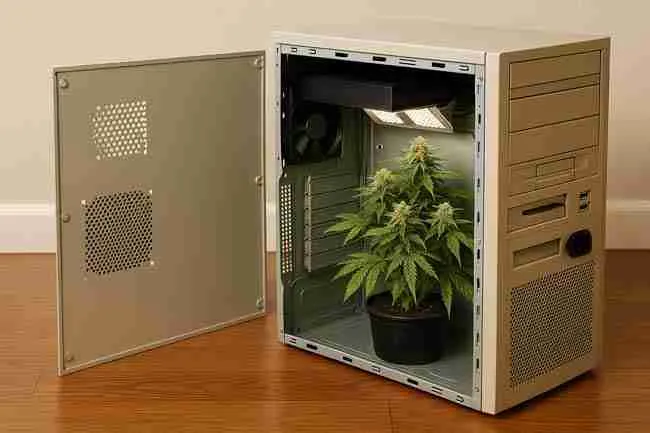
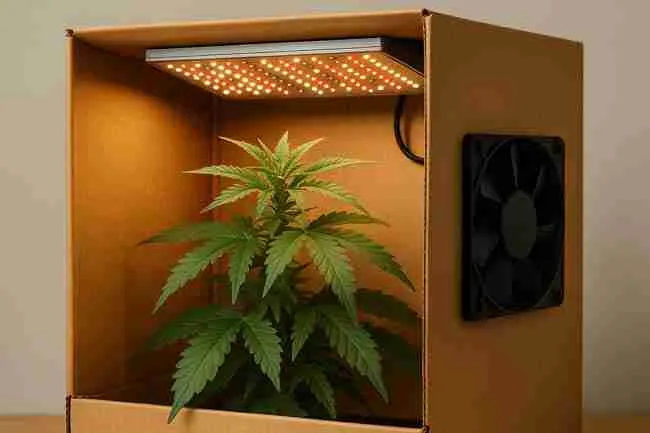
PC Case Grow Tips:
- Use low-profile LED board (cool and thin).
- Line with panda film and add a mini carbon filter (2″–3″ DIY) with a quiet DC fan.
- Mount fans on rubber grommets, and route a tiny baffled intake at the bottom.
- Perfect for a small auto or keeping a mother/clone alive.
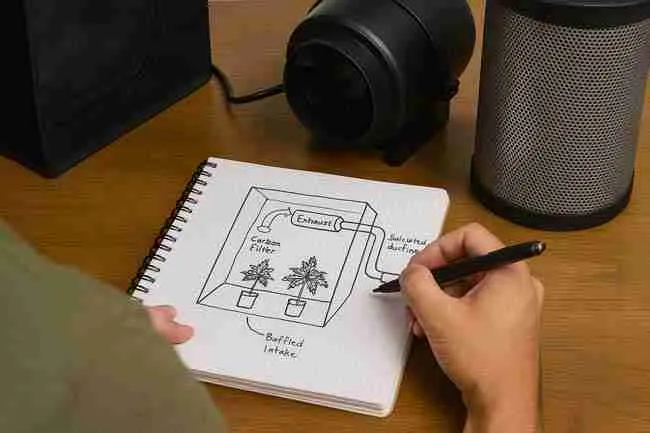
Layout: The “S-Flow” Quiet Air Path
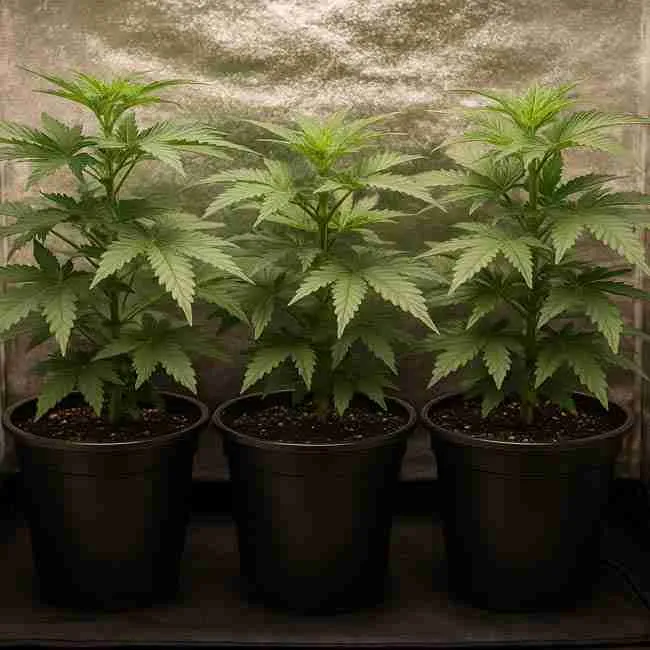
Picture your tent/cabinet from the side. You want air to enter low, travel across the canopy, and exit high—but slowly and smoothly.
- Passive intake low with a light baffle.
- Clip fan gently swirls air across leaves (no leaf flapping).
- Carbon filter high, fan after filter, then silencer, then insulated duct out.
Keep the duct run smooth, with gentle curves, and the outlet far from ears and noses. If you can vent into an attic or a laundry room with an outside vent, even better.
Power & Heat: Quiet, Safe, and Boring (That’s Good)
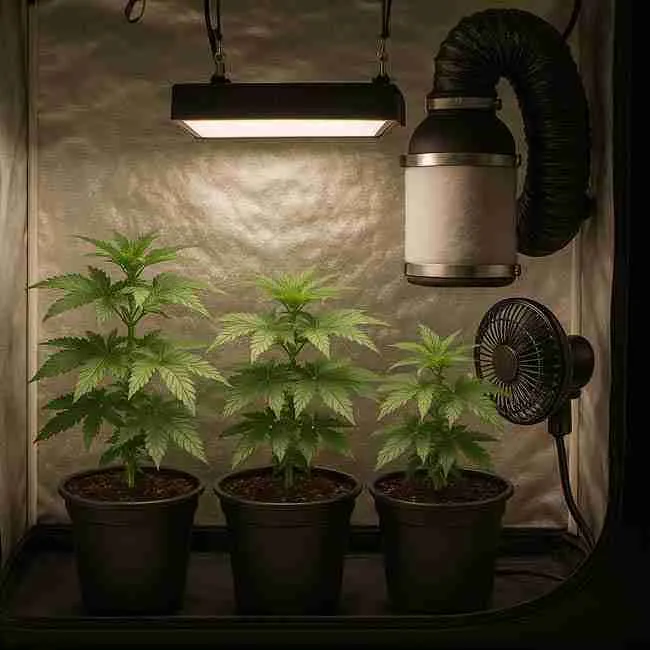
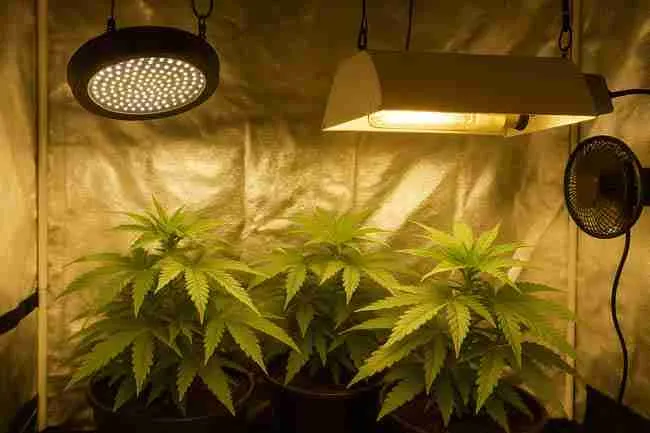
- Use LEDs with dimmers. Lower heat = slower fan speed = less noise.
- Keep cords tidy, drip loops below outlets, and a GFCI if water is nearby.
- Avoid overloading circuits. A quiet grow is also a safe grow.
Water & Smell: Keep It Dry to Keep It Quiet
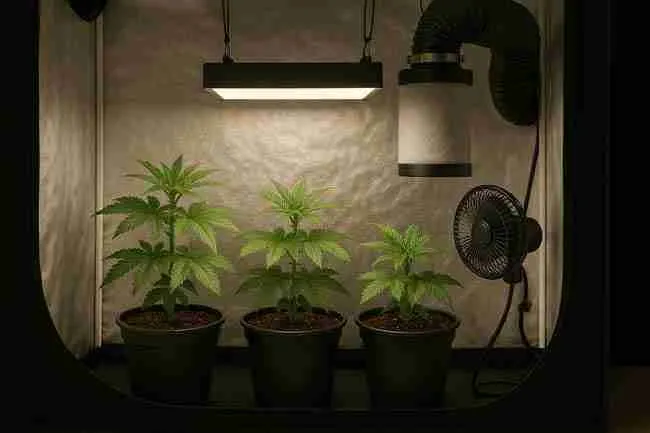
- Put plants on trays so spills don’t hit the floor.
- Wipe leaves and tent walls occasionally; dust carries scent.
- Wet towels, wet carpets, wet anything = musty smell + extra ventilation time.
Sound-Smart Plant Choices
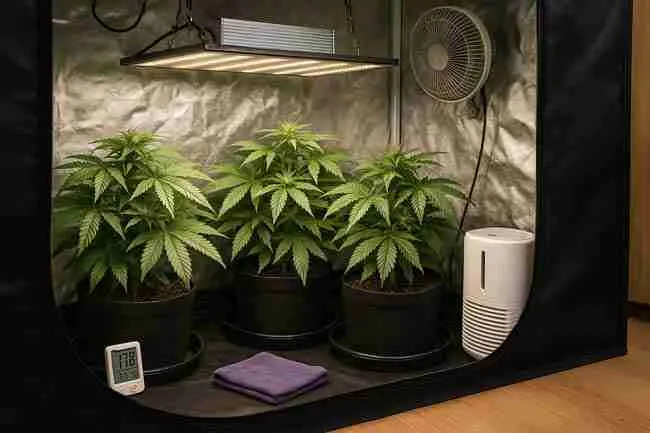
When you’re building a stealth grow room, choose plants that make staying stealth easier.
- Compact autos: quick finish, short height, gentle smell varieties.
- Indicas/short hybrids: easier to train low under the lights.
- Scents: If smell worries you, pick strains that are less pungent or lean earthy/chocolate over skunky/fuel.
Train plants with LST (low-stress training) so the canopy stays low and even; even canopies need less fan power and keep temps stable.
The Quiet Stack: Gear That Stays Under the Radar
- Tent/Cabinet: Thick fabric (600D–1680D) or wood panels + weatherstripping.
- Fan: EC inline, one size larger than you think; run at ~30–50%.
- Filter: Oversized carbon (≥ fan CFM) with prefilter.
- Ducting: Insulated, shortest smooth path; add a silencer.
- Controller: Temp/RH controller to ramp fans gently.
- Pads: Rubber feet under everything that vibrates.
- Intake: Baffled + filtered; no direct line of sight for light.
Build a Baffled Intake (Mini How-To)
- Cut two “baffle walls” from black foam board.
- Inside a small box, glue one near the top, one near the bottom, offset so air snakes around them.
- Mount the box over your intake hole.
Result: Air in, light out. Cheap, quiet, super effective.
Odor Control Beyond Carbon (Layered Recipes)
Recipe A: Apartment-Grade
- Big carbon filter inside tent → EC fan → silencer → insulated duct → out to room with PCO box in the exit area.
- Negative pressure; intake prefilter.
- Humidity ~45–55% (dry air carries odor less aggressively than humid air).
Recipe B: Max-Security
- Filter → fan → second inline filter (yes, two) → silencer → out through a long insulated run to a sealed attic space.
- A short ozone stage inside the duct before the outside vent (timed, low dose). Not in the tent, not in living space. Safety first.
Example Sizes & Airflow Numbers (So You Don’t Guess)
| Grow Size | Approx. Volume | Air Exchange Goal | Base CFM | Real-World CFM (add ~25%) | Filter Size |
|---|---|---|---|---|---|
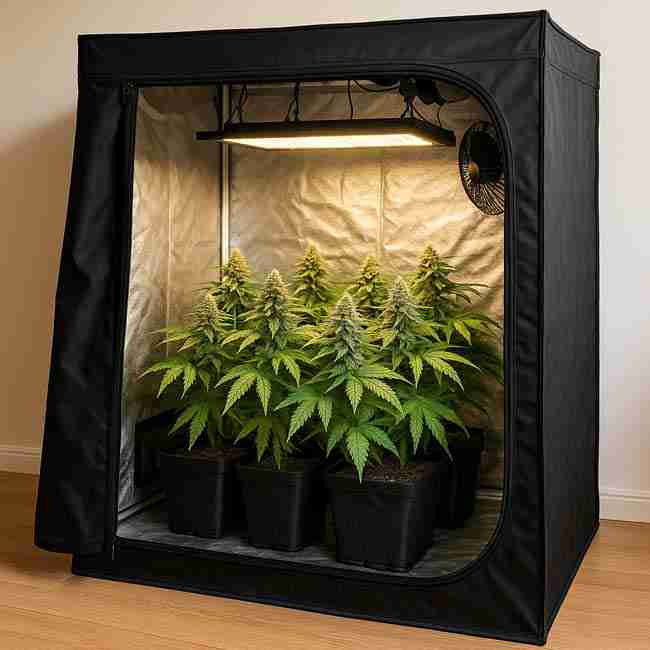
| 2′×2′×5′ tent | 20 ft³ | 1–2/min | 20–40 | 25–50 | 4″–6″ |
| 2′×4′×6′ tent | 48 ft³ | 1–2/min | 48–96 | 60–120 | 6″ |
| 3′×3′×6′ tent | 54 ft³ | 1–2/min | 54–108 | 70–135 | 6″ |
| 4′×4′×6.5′ tent | 104 ft³ | 1–2/min | 104–208 | 130–260 | 6″–8″ |
| PC Case (micro) | ~2 ft³ | 2–4/min | 4–8 | 5–10 | 2″–3″ mini |
Run bigger gear slow for quiet operation.
Disguise Techniques (Hide in Plain Sight)
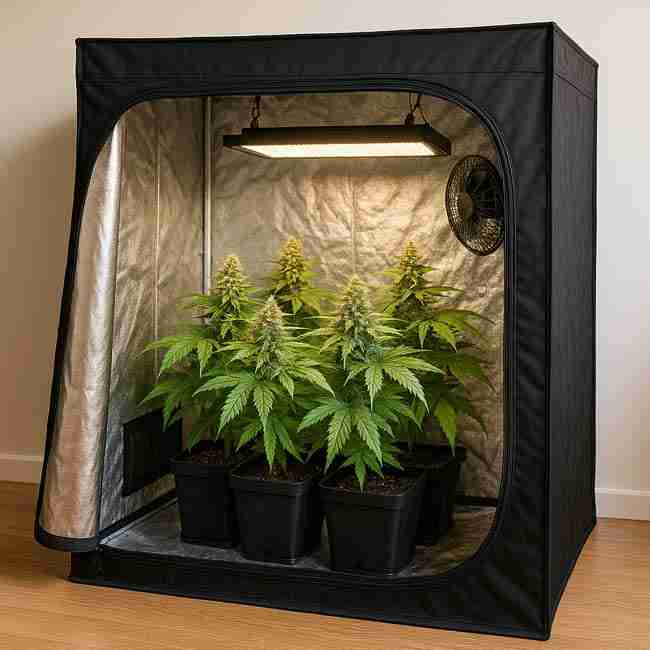
- Room staging: Put a treadmill, guitar amp, or bookshelf near the wall with your tent; it looks like normal clutter.
- Box the buzz: Build a ventilated plywood fan muffler box lined with foam. Cut intake/outlet holes; keep it safe and cool.
- Smell camouflage: Keep a clean laundry or kitchen scent in the general area (not in the exhaust stream).
Pros & Cons of a Stealth-First Build
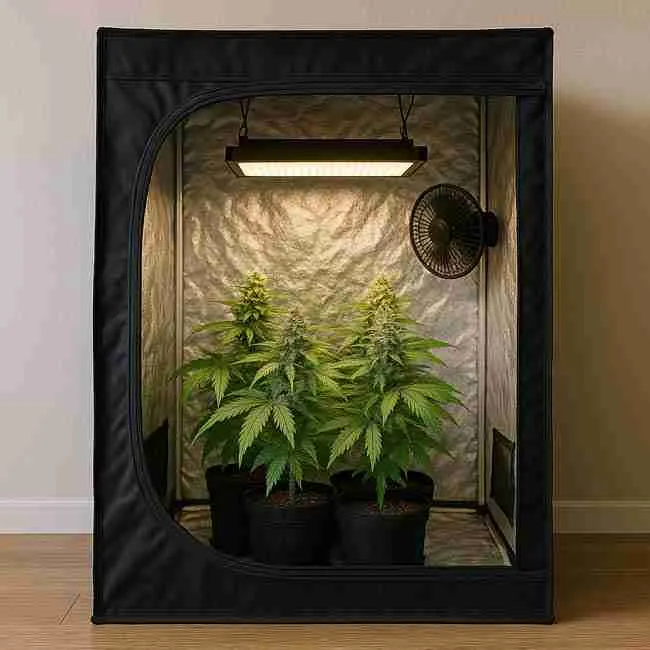
Pros
- Low stress: no questions, no complaints.
- Better climate: quiet gear often equals smoother temps and humidity.
- Safer: tidy wiring, controlled airflow, clean space.
Cons
- Slightly higher cost up front (silencers, insulated duct).
- Smaller plant numbers in micro builds.
- More planning and a little DIY.
Common Mistakes That Blow Your Cover

- Running fans at 100% when a bigger fan at 40% would be whisper quiet.
- Skipping the prefilter sock. Your carbon clogs faster, odor spikes later.
- Leaky intake that points straight out into the room with visible glow.
- Putting odor gels in the tent. They can taint terpenes and still won’t beat strong late-flower smell.
- Hard-mounting fans to wood or metal. The wall becomes a speaker.
One-Hour Stealth Hardening (Do This Today)
- Put rubber pads under tent poles, fans, and pumps.
- Swap to insulated ducting; shorten and smooth the run.
- Add a silencer (or stuff a DIY muffler box around the fan, leaving airflow).
- Tape zipper ends and unused ports; check for glow in a dark room.
- Wash the prefilter sock and wipe surfaces.
- Set the fan controller to ramp slowly and stop it from maxing out.
- Confirm negative pressure (tent walls should pull in a little).
Boom—quieter, cleaner, and tighter in under an hour.
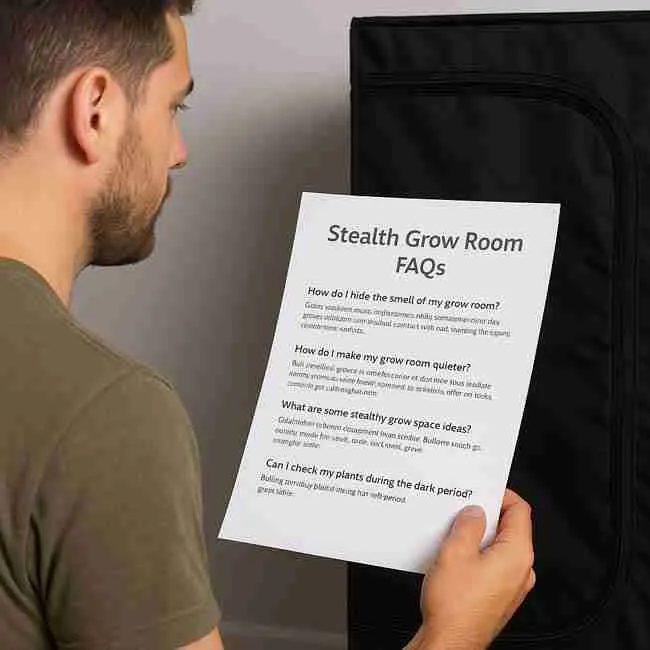
FAQ: Stealth Grow Room Questions (You’re Not the Only One Asking)

How quiet is “quiet enough”?
Aim for 30–35 dBA at one meter—basically a whisper. If you can’t measure, stand a meter away and listen during the quietest part of your day. If it blends in with normal home noise, you’re good.
Will carbon filters remove 100% of smell?
They’ll remove nearly all if sized right and paired with negative pressure. For late flower or super loud terps, add odor control beyond carbon (PCO box in the exhaust area, long insulated runs, and, if needed, carefully used ozone in ducting only).
What’s the cheapest way to quiet my fan?
Oversize + under-run the fan and add a silencer with insulated duct. Hang the fan on straps and add rubber feet. Cheap, huge difference.
Can I build a soundproof grow tent?
You can build a very quiet one. Add MLV or moving blankets outside the tent walls, hang the fan, use insulated ducting, and keep negative pressure. Total silence is unrealistic, but you can hit whisper-quiet.
Is a PC case grow actually worth it?
If stealth is king and you want a micro harvest or to keep clones/mothers alive—yes. It’s tiny but sneaky. Use small LEDs, mini carbon, and very quiet DC fans.
How many plants should I run in a stealth setup?
For most stealth tents, one to three trained plants work best. Fewer plants = easier airflow, lower smell, and less trimming noise.
What about water noise?
Use fabric pots on trays, avoid splashing, and water slowly. If you must use air pumps, put them in a padded box with airflow.
Will a dehumidifier blow my cover?
Pick a small, quiet model, isolate it on rubber pads, and run it during daytime when normal house noise covers it. Better yet, control humidity with plant count, airflow, and temperature first.
Can I run odor gels in the tent?
Nope. Keep them outside the grow and away from buds. They can change how your flowers smell/taste.
Is there a best time to exhaust?
Often right after lights-off and when you enter the room. That’s when odor peaks. Controlled bursts keep things discreet.
Stealth Grow Room Checklist (Print This)
- EC inline fan (one size up), speed controller, silencer
- Oversized carbon filter with prefilter sock
- Insulated ducting, minimal bends
- Negative pressure confirmed
- Baffled intake built and sealed
- Rubber pads under tent/cabinet and pumps
- Clip fans on low; no leaf flapping
- LED with dimmer; power cords with drip loops
- Floor tray for spills; wipes handy
- Optional: PCO box or duct-only ozone for odor control beyond carbon
Your Stealth Game Plan (Start to Finish)
- Pick your enclosure (tent, cabinet, PC case).
- Map airflow (low intake → across canopy → high carbon → fan → silencer → out).
- Mount quiet gear (hang fan, rubber pads, insulated duct).
- Seal leaks (light and smell).
- Set fan controller (slow ramps, no 100% peaks).
- Grow low & even (LST, moderate plant count).
- Clean routine (filters, floors, prefilters, wipe leaves weekly).
- Audit at night (sound and light check).
Follow this and your stealth grow room will look like a regular room, sound like a library, and smell like… nothing.
Specifications Snapshot (Copy for Your Build Notes)
- Noise Goal: ≤ 35 dBA @ 1 m
- Air Changes: 1–2 per minute (add ~25% CFM for filter/bends)
- Fan Type: EC inline, one size larger than calc; run 30–50%
- Filter: Carbon ≥ fan CFM + prefilter
- Ducting: Insulated, smooth, shortest path + silencer
- Pressure: Negative (tent walls pull in)
- Intake: Baffled + prefiltered
- Lighting: Dimmable LED, matched to space (e.g., 100–150 W for 2×2)
- Power: GFCI if near water, drip loops, tidy management
- Water: Trays, slow watering, no splashing
Final Word

Stealth isn’t magic. It’s a stack of small choices that add up. You’ll oversize and under-run your fan, you’ll scrub and baffle and pad, and you’ll keep things dry and tidy. Do that, and your grow fades into the background—quiet, clean, and invisible. That’s the whole point of a stealth grow room, right? Eyes off, nose off, ears off. You got this.