Foxtailing Cannabis


Foxtailing cannabis is two jobs that look like one. Ranking pages in 2026 keep landing on the same split: some cultivars stack calyxes into spears from week one of flower, and some plants throw pale new pistils off a finished cola because the top is too hot or too bright. You tell them apart by where the towers sit, when they started, and whether the new growth has frost. Shop seed in the cannabis seeds store. The rest of the grow library is on the cannabis cultivation blog.
Canada’s recreational cap is four plants per household. Quebec still bans rec home grow. Manitoba has been indoor-only since 1 May 2025. Four weed plants under one bar is enough light to cook the tips if you hang by eye. This page is the tent job: how to name the foxtail, what to change this week, and how to harvest marijuana when the tips keep throwing white hairs. Indoor rooms: indoor cannabis growers guide. Tents: grow tent for cannabis seeds. Flower stage: cannabis flowering stage.
What Foxtailing Cannabis Looks Like
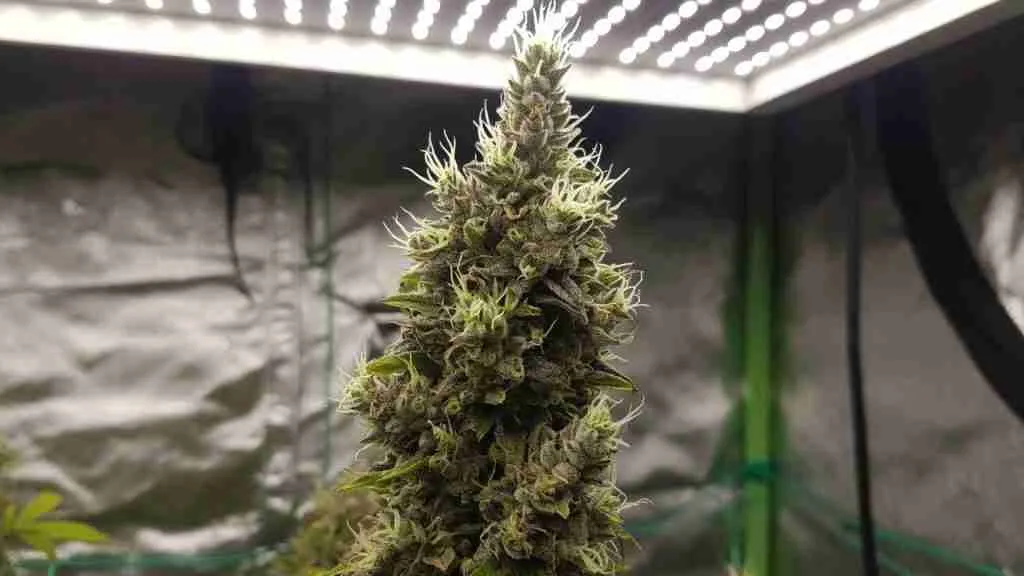
A round cola swells out. A foxtail stacks new calyxes on top of old ones so the bud climbs like a fox tail, a spire, or a staircase. Fresh pistils on those stacks are pale. The tissue under them is often greener and thinner than the mature flower below. That is the picture. It is not hermaphrodite bananas, not a foxtail weed grass in a lawn, and not a nutrient burn by itself. Bananas are pollen sacs. Foxtails are flower. You can have both on a stressed plant. Check for nanners with a loupe if the room has been brutal.

Early stacked calyxes on a young flower are not a crisis. Many lines build that way in week two and three, then fill in. The panic shot is late flower: a brown, frosty bud with a tuft of new white hairs shooting out of the crown. That tuft has almost no trichomes. It will not catch up if the rest of the plant is already cloudy. Airy buds from weak light are a different problem. Foxtails from a slammed LED sit on the hot tops. Weak light makes popcorn everywhere: light and fluffy cannabis buds. Quality structure: growing quality cannabis buds.
Genetic Foxtails Versus Stress Foxtails
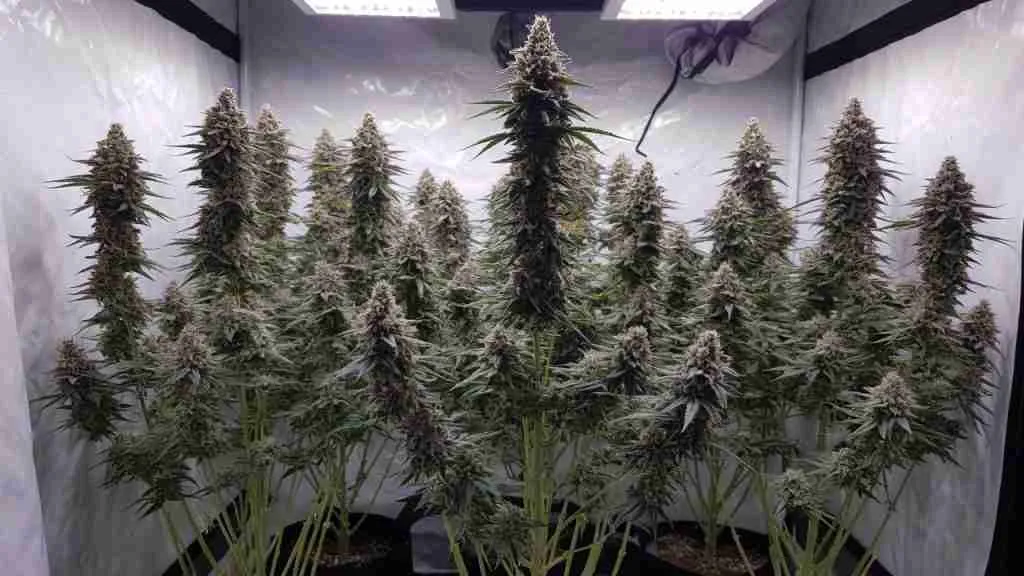
Where the towers sit tells you more than a forum poll. If every cola foxtails, including the lowers far from the lamp, it is the cultivar. Long-flowering sativa-leaning lines, many Haze descendants, and some equatorial landrace cuts build spears on purpose. The stacks start early. Colour matches the rest of the flower. Trichomes still frost the calyxes. You do not “fix” that with a dimmer. You harvest on trichomes and you accept a lower density-to-volume ratio. Rare and landrace-leaning packs: rare cannabis seeds. Mutant and odd architecture: mutant cannabis genetics.

Stress foxtails are local. Only the colas nearest the diodes throw new pistils. Lowers stay dense. Sugar leaves taco. Tips bleach. The new growth looks watery next to the mature bud. That started in week six to nine on a flower that already had shape. Heat and PPFD arrive together in a tent, so do not pick a religion. Cool the tissue first, then measure light. A line that foxtails genetically will still get worse if you cook it. Stress-testing how a cut behaves in heat: stress-testing cannabis genetics.
When it started is half the diagnosis

Write the week. Genetic spears are visible as soon as the plant makes flower. Stress towers appear after the bud had already bulked. A photo from week four next to week eight is the whole argument. If you never photographed the plant, you are guessing. Phone photos dated in the tent beat memory. If one plant in a four-plant tent foxtails on every site and the other three stay round under the same bar, that plant is the pack talking. If all four only foxtail on the crown, the bar is talking.
Walk the plant from the top down. Crown, mid, lower, inside the bush. Genetic foxtails repeat at every site. Stress foxtails stop once you leave the hot stripe. A single cola that ran through a hole in a net and sat in the diodes is a local problem. Tie it down. Do not dim four plants because one spear escaped. Look at sugar-leaf colour next to the stack. Green and frosty with even pistils is genetics. Pale, crispy, and new-white on a brown body is stress. If you still cannot tell, treat it as stress for a week. A 10 percent dim will not ruin a Haze spear. Leaving a cooked top will ruin terpenes.
Heat at the Cola, Not the Thermostat on the Wall
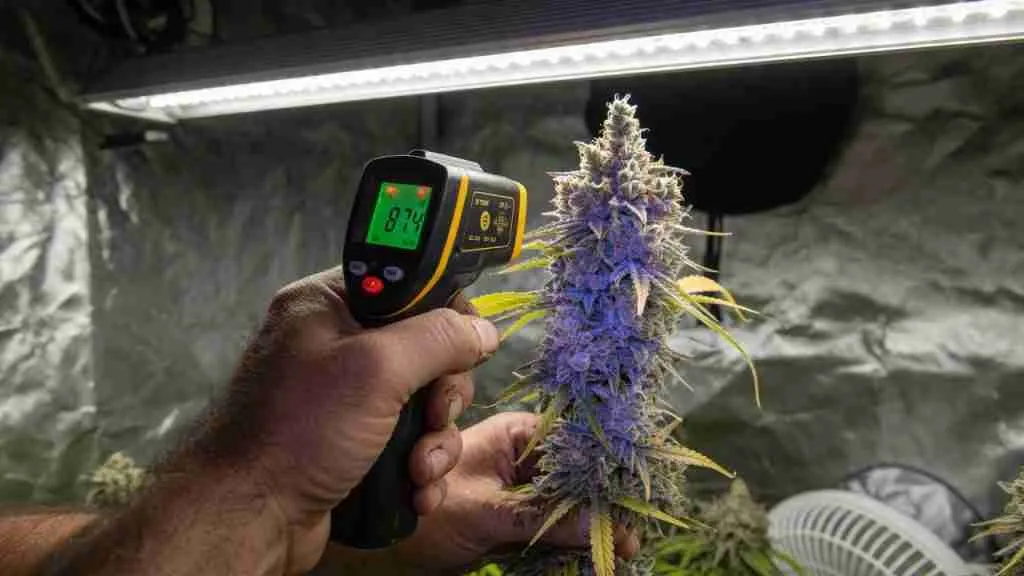
The probe on the tent pole reads mixed air. The cola under the LED is hotter. Aim an IR thermometer at the top buds. Flower quality slides as canopy tissue sits above about 28–30 °C. Terpenes leave first. Then the plant keeps making new pistils on a bud that should be finishing. A wall thermostat at 25 °C with a 32 °C cola is how people “run a cool room” and still fox the tops. Hang a second cheap meter at canopy height on the hot side. If the two disagree, you have a microclimate. Environment, media, pots: environment, media, watering, pot sizes. VPD: cannabis VPD explained.
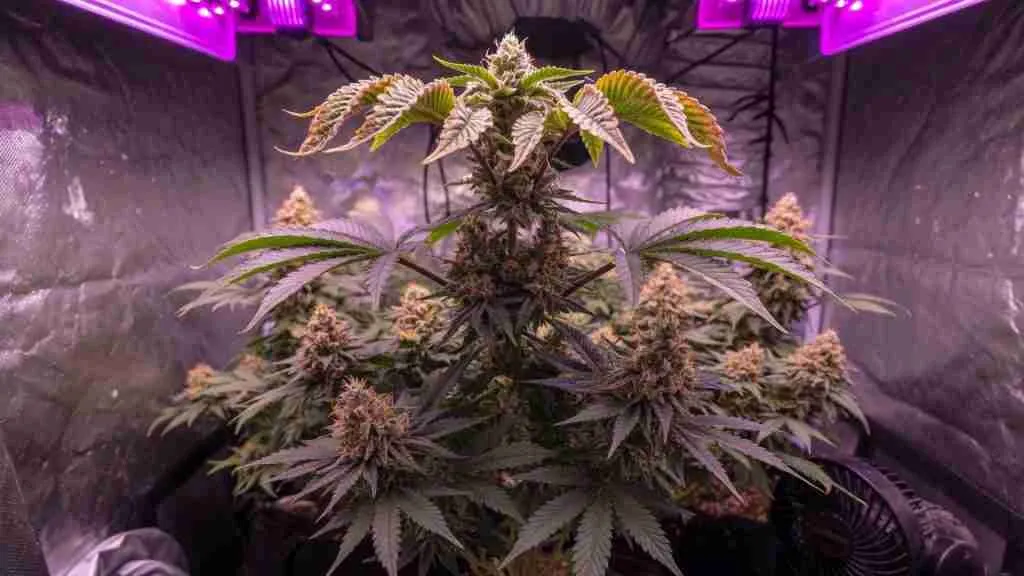
Tacoing leaves at the crown are the heat flag that walks with foxtails. Edges cup up. Tips dry. Lowers stay flat. Exhaust that actually dumps heat. A circulating fan that moves air across the tops without windburn. Dead corners cook one plant and spare the other: map airflow dead zones. Night a few degrees cooler than day helps finish. A lights-on spike at the first twenty minutes of the photoperiod is worth watching. Cheap heaters and sealed tents overshoot. Four legal plants do not need a greenhouse AC unit. They need the bar farther from the cola and an exhaust that can keep up.
Touch the cola. If it is warm in your fingers while the room feels fine, trust your hand over the wall probe. LEDs dump less radiant heat than HPS, so growers hang them closer and then act surprised when the tissue is 4 °C above the air. That gap is the foxtail. Open the tent door for a minute and watch the IR number fall. If it falls fast, your exhaust is undersized for the bar you bought. A 6-inch fan on a 4-inch hole is not a flex. Match duct to fan. Filter the intake so you are not pulling attic heat. Summer tents in a spare room need lights at night. Winter tents in a basement can run day. The plant does not care about your sleep. It cares about the number on the bud.
Light Intensity: Measure PPFD, Then Move the Bar
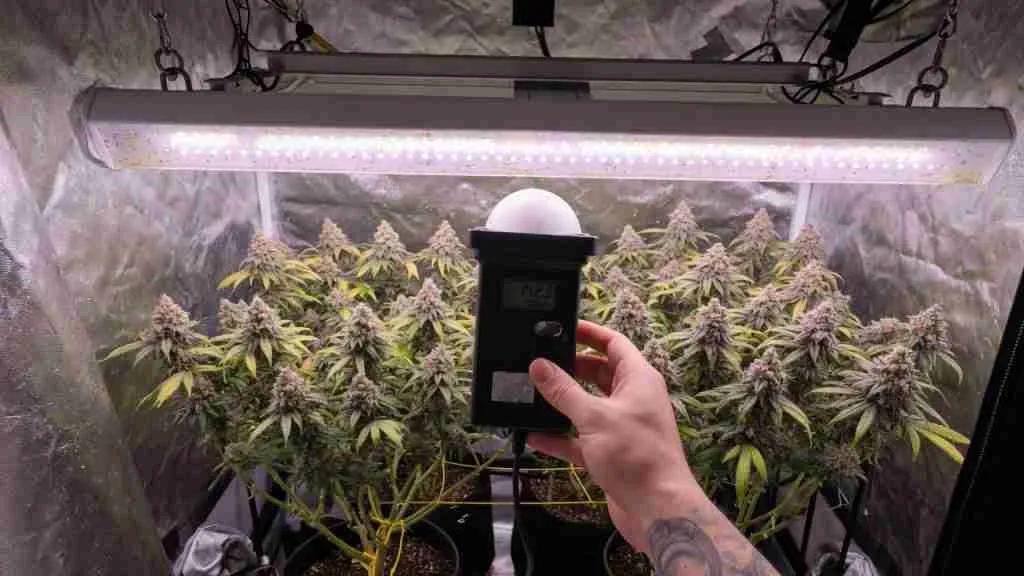
Modern LEDs throw a lot of photons with less radiant heat than old HPS, so you can hang them close enough to bleach a tip while the tent still feels comfortable. That is why “the room is not hot” is a weak argument. Measure PPFD at the top of the cola, not at the floor. Flower in a home tent without added CO2 usually lives in a band around 700–1000 µmol·m⁻²·s⁻¹ at the tops. Numbers north of that, especially over 1200 on a plant that has no extra CO2, are how you get pale stacks. Cheap PAR meters lie a bit. They still beat guessing from wattage. Lighting trends: cannabis lighting. CO2 is a separate room: boost cannabis CO2 naturally.
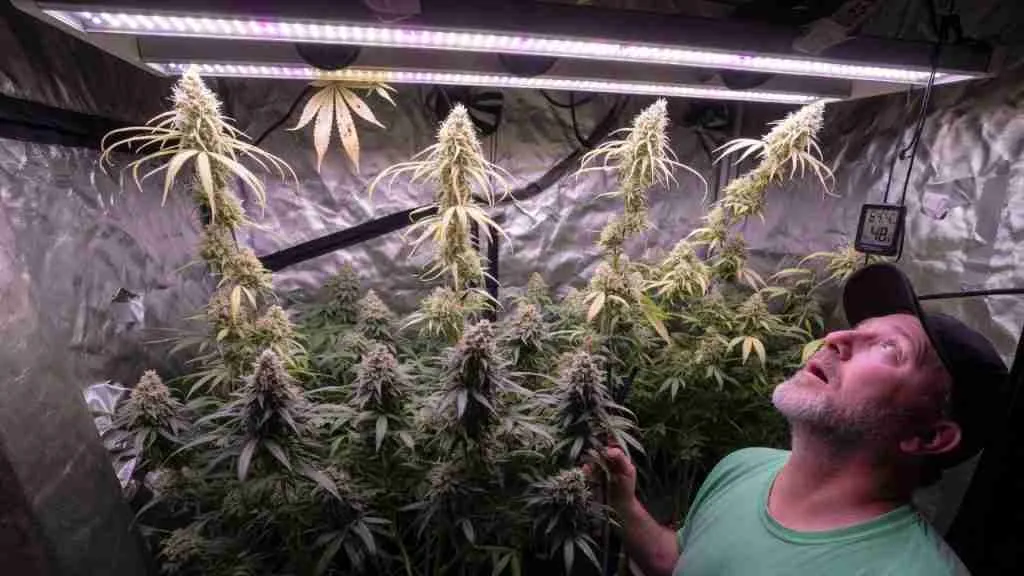
If only the spears nearest the diodes look cooked and the lowers are fine, raise the bar or drop the dimmer today. Do both if the IR reading is also high. A 5–10 cm lift is a real change. Overlapping bars in a small tent make a hot stripe down the middle. Pull plants toward the walls or dim the centre. Bleached sugar leaves next to new pistils is light plus heat, not a calcium myth. Do not add UV or a “finishing spectrum” in week seven on a plant that is already foxtailing. That is more stress on a bud that is trying to finish. Photoperiod timing so the canopy is not in the diodes: control flowering with photoperiod seeds.
PPFD is not wattage. A 240-watt bar in a 2×4 at 30 cm is a different photon load than the same bar in a 4×4 at 50 cm. Read the manufacturer map, then verify with a meter at your actual hanging height. Corners of a tent are darker. Middles run hot. If you train a flat canopy, every top sees similar light and you stop one plant from eating the bar. If you grow four Christmas trees, the tallest foxes and the short one stays larfy. Even the canopy in veg so flower is a table, not a forest. A meter reading of 900 at the top and 250 at the lower sites is why you lollipop. It is also why you do not crank the dimmer to “feed the bottoms” and cook the crowns.
What to Change This Week
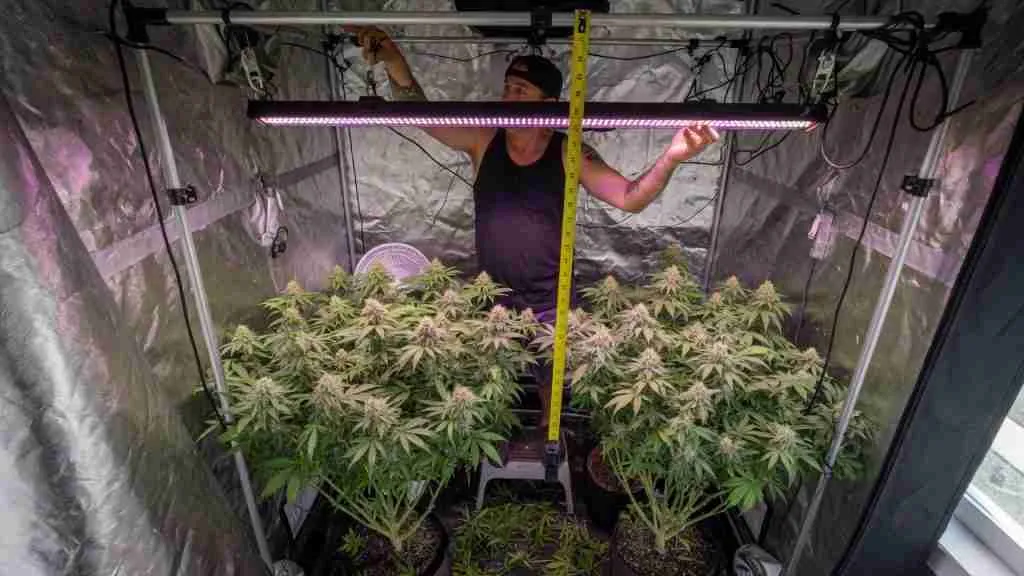
Raise the light. Dim 10–20 percent. Point a clip fan across the crowns, not straight into one cola. Check the IR number after an hour. If the tissue is still hot, exhaust harder or run lights at night when the house is cooler. Tie down a cola that is kissing the diodes. A SCROG net that holds the canopy flat stops one spear from running into the bar: SCROG your way to a bumper cannabis harvest. Trellis that actually supports the branch: trellising cannabis.
You will not unscrew a foxtail that already grew. You stop the next one. New pistils that launched this week stay airy. The mature flower below them is still the harvest. Do not strip the plant bald in late flower to “let light in.” That is more stress. A modest clean-up of fans that shade lowers is enough. High-stress training belongs in veg: high-stress training. Veg habits: cannabis vegetative stage.
Nitrogen and a plant that will not finish
Heavy nitrogen late in flower keeps the plant in a growth mood. New pistils, leafy buds, and a fade that never starts can ride along with heat foxtails. Drop N as you enter bloom. Do not dump a bloom booster on a cooked top and expect density. If the leaf is dark and the crown is stacking, the feed is part of it. Nutrition by stage: cannabis nutrition across all stages. Deficiency chart so you do not chase the wrong pale leaf: cannabis nutrient deficiency. Magnesium under LEDs: magnesium for growing cannabis. A water-only finish does not glue a foxtail back: flushing cannabis. Signal versus myth on fade: final flush, fade, and flavor.
Read the whole plant, not one leaf. Dark, clawed fans with foxtail crowns is a feed plus heat story. Pale lowers with a cooked top is the bar. A marijuana plant that is hungry will not stack extra calyx towers to spite you. It will fade. If you cut feed to “stop the fox” while the IR still says 31 °C, you just added a deficiency to a heat problem. Cool first. Then ease N. Then wait a few days and loupe again. The fox you already have stays. The next pistils are the test.
Harvest on Mature Trichomes, Not New Pistils
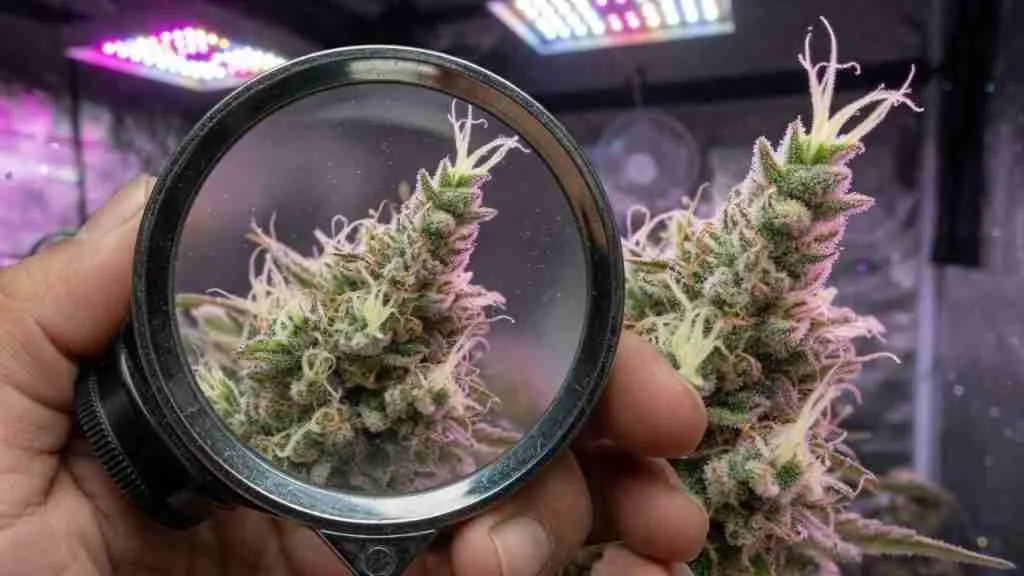
The foxtail tip will look young until you chop. That is new tissue. Read trichomes on the calyxes of the lower, mature part of the same cola, not on the white hairs at the crown. Clear heads are still cooking. Cloudy heads are the usual cut for a brighter jar. A little amber is heavier. If the mature flower is ready and the tip is still throwing pistils, harvest. Waiting two more weeks for the fox to bulk is how you oxidize terpenes on the good bud while the tip stays airy. Harvest and cure: harvest and cure cannabis.

Frosty, tight flower still counts when a few spears sat on top. Trim the wispy tips if they have no resin. Smoke the dense body. Stress foxtails can be harsher and less loud in the jar because heat already drove terpenes off. Genetic spears with full frost smoke like the rest of the plant. You do not throw a whole cola because the crown is a staircase. You do throw a cola that is bleached white and cooked. Dry slow in a cool, dark space. A hot dry closet turns foxtail flower into hay faster than a dense nug.
Wet-trim the empty fox if it will mold in the dry tent. Leave sugar leaf on the dense body. Foxtail stacks have more surface area and dry faster than a golf-ball nug on the same hanger. Check them a day earlier. A stem snap on the dense part is the cue, not the tip. Cure in glass. Burp. If the jar smells like grass, you dried too fast or too warm. That is common on stress foxtails because the tissue was already cooked. Next run, cool the last two weeks. The smoke you want is made in those weeks, not in a miracle flush.

A cola that filled in with frost and only a mild spire at the tip is a keep. Compare that to a plant whose entire top is a tower of pale calyxes. Same word, different jar. Outdoor plants foxtail from genetics more often than from a lamp, but a heat wave in late flower will still stack loose: growing cannabis outdoors. First crop so you are not learning hanging height in week eight: planning your first cannabis crop. Seedling through veg so stretch does not put the crown in the diodes: cannabis seedling stage.
Prevention for the Next Run
Set hanging height from a map, not from a photo of someone else’s 2×4. Measure PPFD at the future canopy before you flip. Leave headroom for stretch. A photoperiod that doubles after the flip will kiss a bar you hung “just right” in veg. Dim for the first ten days of flower if the stretch is unknown, then walk the number up. Keep canopy even. One spear in the diodes is a foxtail factory. Clip that site down. Canada seed FAQ: Canada cannabis seed FAQ. Buying in Canada: buy cannabis seeds in Canada.
Roots that sit wet and hot will stress a plant into odd flower too. Dry-back that matches the pot. Watering: water cannabis plants. Roots: healthy cannabis roots. Coco that runs high EC under a hot LED is a double hit: growing cannabis in coco coir. Living soil stays cooler at the root if the tent air is sane: organic cannabis soil. A clean room will not stop genetic spears. It will stop you blaming pests for a light problem: cannabis grow room clean. Pest walks still matter in flower: pesticide-free cannabis cultivation. Powdery mildew loves a wet, still crown: powdery mildew on cannabis. Do not foliar the foxtail: foliar feeding in flowering.
A camera on the crossbar helps you see a crown creeping toward the bar between walks. It will not read trichomes. Sensors and scouting: AI in cannabis cultivation. If you want dense golf-ball flowers, pick a cultivar known for that structure and keep the tops under 28 °C. If you like long sativa spears, grow them on purpose and stop treating the shape as a defect.
Keep a hanging log. Date, dimmer percent, IR at the hottest cola, PPFD if you have a meter, and a one-line note: “crowns 8 cm from diodes, no new pistils” or “new white on plant two only.” That log is how you stop repeating week-eight panic. The next pack in the same tent should start from the last good numbers, not from a guess. Four plants is a small sample. One foxtail plant is a phenotype. Four foxtail crowns is the room. Do not throw a cultivar you like because you hung a 240-watt bar like a 100-watt bulb.
Foxtailing Cannabis FAQs
Is foxtailing always bad?
No. Genetic spears on a frosty plant are architecture. Stress towers on a cooked top are damage. Same silhouette, different harvest. Name which one you have before you dim the whole tent or blame the pack.
Can I reverse foxtails that already grew?
No. You stop new ones. Raise the light, cool the cola, and harvest the mature flower on trichomes. The pale tip will not turn into a dense nug in a week.
Does foxtailing ruin potency?
Genetic foxtails with full trichome coverage are the same plant you grew. Heat-stress foxtails often come with terpene loss and airy, under-resined new growth. Trim the empty tips. The dense body is still usable.
Is it heat or light?
In a tent they arrive together. Measure tissue temperature at the bud and PPFD at the same spot. Fix the hot number first. Then dim or raise if PPFD is still extreme. Do not pick one cause from a meme.
Should I wait for the new white pistils to turn brown?
No. Those hairs are new. The flower below them may already be ready. Loupe the mature calyxes. If they are cloudy, chop. Waiting on the fox is how you overshoot the good bud.
Do autos foxtail the same way?
Yes. An auto that stretches into the bar in week four of a short life will fox the crown fast. You have less time to correct. Hang high from seed, dim early, and do not chase extra PPFD on a plant that finishes in ten weeks. Photoperiods give you a veg window to flatten the canopy first. Autos do not. Treat hanging height as a seed-day decision, not a week-six rescue.