Mother Cannabis Plants: Keep the Plant You Would Grow Again


Originally published 7 December 2022. Updated 1 October 2026.
A mother cannabis plant is a female you keep in vegetative growth so you can cut the same plant again. She is not a strain name on a pack, and she is not “another seed of the one I liked.” The guides that rank for this agree on the job, even when they argue about pot size. Hold her on long days. Keep her short and full of soft shoots. Take cuts on a rhythm, then let her recover. Replace her with one of her own healthy cuts when those cuts get weak. Flowering her, starving her, or turning her into a bare trunk are the ways people lose the only plant they meant to keep.
A seed is a sibling. A mother is the plant.

Those seeds are how you find a plant. They are not the plant. Marijuana grown from seed, even feminized seed out of the same pack, is a new combination of those parents. Two sisters can both be worth smoking and still finish, smell, and yield differently. A cutting is that one plant in a new pot. Same growth habit, same sex, same flower, as long as you grow the cut as carefully as you grew her. That is the only reason to keep a mother. If you are happy buying a fresh pack every run, you do not need one sitting in a tent all year.
She has to be a photoperiod. An autoflower starts flower on age, and leaving the lights on will not talk her out of it. You cannot park an auto in the corner and take cuts for a year. She will flower in a solo cup if you wait long enough. Photoperiod plants stay in veg while the nights stay short, which is the whole trick of mothering. The photoperiod seed guide is that split, if you are still deciding what to pop.
If the seed is regular, sex her before you hand her the tent. A male is not a mother, and pollen on the females you meant to keep is a seeded crop you did not ask for. The male and female guide is how you read the preflowers without guessing from the shape of a fan leaf. A clone taken from a plant you have already confirmed as female is female. You do not sex those cuts again unless the labels got mixed.
See the flower before you keep her

That cola is the test. A pretty plant in week three of veg has not taken the test. The honest way to choose from a seed pack is slow, and it is the one that works. Grow the candidates until they have a real root system and several side branches. Take two or three cuts from each plant you might want, and mark each cut with the same mark as its donor. Leave those cuts on long days. Flower the donors under 12 hours of light and 12 of uninterrupted dark. When you harvest, you know which plant you actually want in the jar. That plant’s cuts become the mother. The donor you flowered is finished. She is not the mother anymore.
If you flip your only copy because she looked strong in veg, you get a harvest and a memory. You do not get the plant back. Take the cuts before the flip, or accept that this run ends when she does. The flowering stage guide is the clock those donors are on. The cuts stay off that clock.
You do not need a standing mother if you grow one crop and then stop for months. Take the cuts a couple of weeks before you flip, root them, and flower the donor. Those rooted cuts are the backup, sitting in small pots until you decide the flower was worth repeating. A mother that occupies a tent every day of the year earns that space only if you will use the cuts. A lot of home growers keep a bush out of guilt and then buy seeds anyway.
How old should she be before the first cuts you trust? Old enough to spare them. A filled-out root system and several soft side shoots, which a plant usually has after a few weeks of real veg once she is established in her pot. A ten-day-old seedling does not have a shoot to give you, and cutting her then stalls both of you. There is no birthday that makes a mother. There is a plant with tips you can remove and still leave her growing.
Every rooted cut is a plant of its own. On a four-plant household limit, a mother plus three cuts is the whole allowance, so a hunt stays small, or you root the next round only after the donors are chopped. A tray of twenty cuts is not a free way around that count.
Long days are the whole trick

Eighteen hours on and six off is the schedule most mother rooms run, and it is the one to copy unless you already have a reason not to. The nights are too short for a photoperiod to flower, and she still gets a dark period. Running the lamp for twenty-four hours also holds veg. It also runs the heat and the power bill for no extra cuts. Dropping under about sixteen hours of light is how she starts to flower. A timer that resets after a power cut, light leaking into the tent during the dark, or parking her in the flower room “for a week” will do it just as well as a deliberate flip.
If white pistils show, put her back on 18/6 the day you notice. She can return to veg. The flowers she started are not a harvest you should chase on a mother, and the return is ugly for a few weeks: single blades, twisted new shoots, slow growth while she reorganizes. Stopping a plant that has started to flower is that rescue. It is cheaper if the timer never leaves 18/6. Do not flower your only mother “to see what the bud is like.” That is how you delete the plant you were keeping.
She does not need a flowering lamp sitting on the canopy. Veg-level light keeps shoots coming. A fixture close enough to bleach the tops makes a stretched, thirsty bush and more pruning, not better clones. The vegetative stage guide is the climate around that light. Roughly the low-to-mid 20s °C, humidity closer to a veg tent than to a dry flower room, and air moving through the interior so a dense mother does not hold wet leaves in the middle. Cold roots slow her the same way they slow any veg plant. A basement that sits under 18°C will give you a mother that looks underfed when she is mostly cold.
Keep her out of the 12/12 room. A mother sharing a tent with plants in flower is a mother that is now in flower, even if you meant the visit to be temporary. If your only light is in that tent, she needs her own timer and her own dark, or she is not a mother.
Give her a pot she can live in

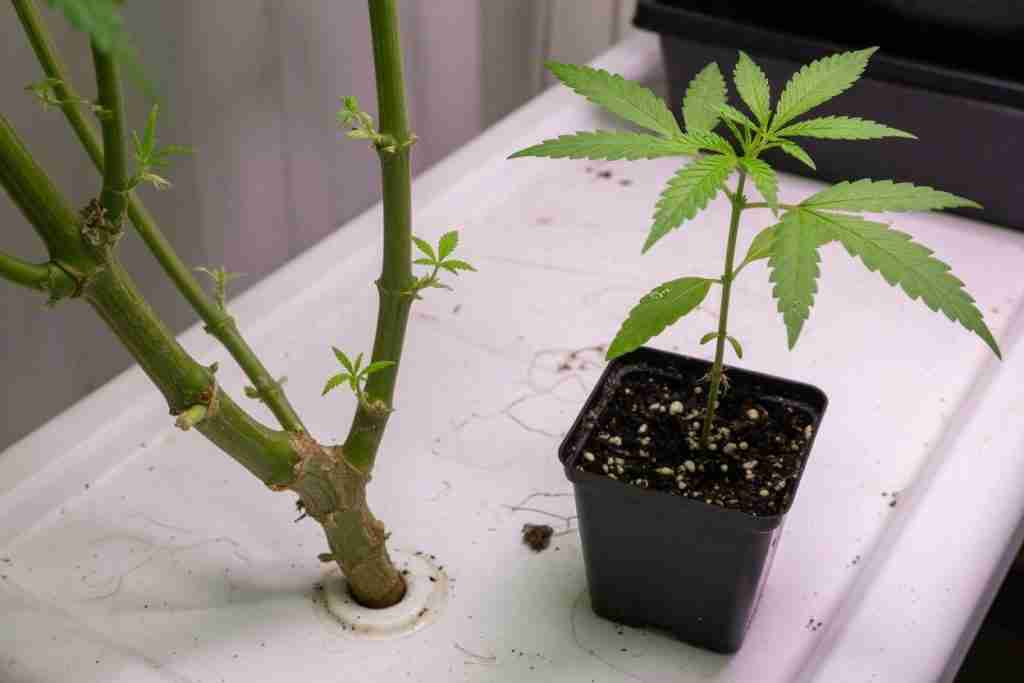
A fabric pot in the 3 to 7 gallon range is a normal home mother. One gallon becomes a root brick in a few weeks and then a daily watering chore. Twenty gallons becomes a plant you cannot lift and a canopy that eats the tent. Match the pot to the bush you are willing to prune. The plant in that photo is the size that still fits a workbench. A warehouse mom in a huge pot is a different job, and most homes do not have the room or the reason.
Water her the way you water any plant in veg. Lift the pot. Water when it is light, and water enough that the whole root ball gets wet, not a dry pocket under a damp surface. A mother who sits in soup grows a weak, sour root system and then gives you slow, yellow cuts that you will blame on the genetics. The watering guide is that habit, and it matters more on a plant that lives in one pot for months.
Soil wants about 6.0 to 6.8. Coco wants about 5.6 to 6.2. A hydro mother, if you are running her in a bucket instead of a pot, wants about 5.8 to 6.2. The pH guide is the longer version of checking the pen before you trust it. A mother on a drifted pH looks hungry for months. The usual answer, a stronger bottle, salts the pot up and makes the next month worse.
Feed a vegetative mix at a strength she can live on every week, not a bloom booster and not the heavy dose you might run for a short stretch. You are not building a cola on her. You are keeping soft green tips. Lush, overfed growth roots poorly as a cut and stays attractive to pests. If the tips burn, the mix is high, same as any other plant in the room. Read the new growth a few days after you change anything. The deficiency guide is how those leaves get misnamed, and a mother gives you a long time to misname them.
Roots are the part that fails quietly. A fabric pot air-prunes tips at the wall, which delays the day the ball becomes a circling brick. When growth stalls between cuts and the root ball slides out as one solid mat, shave the matted outside, shake off dead medium, and set her back in the same pot with fresh mix around the ball. Leave green shoots on the branches when you do it. A frame with no growing tips can die back from the cuts you just made. Do not root-prune her the same week you take a heavy round of clones. She can recover from one hard job. Two at once is how a mother dies on the bench and takes the next tray with her.
Shape her for shoots, not for a cola

Top her once she has several real nodes, then top the new leaders when they run away from the canopy. You want a short, wide bush with a lot of soft tips at one height, close to what that canopy is doing. A single untopped leader gives you one cutting and a tall plant that hits the lamp. Bend the long branches down so the side shoots get the light. Low-stress training is that bend. On a mother it is not about a bigger cola. It is about keeping lower shoots alive until you need them.
Leave some lower growth. If you strip the interior bare every time you take cuts, the next shoots only exist at the top, the lower stems turn to wood, and you are left with a trunk and a tuft. Rooms that keep mothers for a living call that a palm tree, and they stopped doing it because the plant gets harder to cut and harder to rebuild. Shape from the top. Thin the shaded interior lightly so air can move. After a round of cuts, a green frame should still be standing.
Then leave her alone for a bit. A couple of weeks between heavy rounds is a normal pace in a home tent. A plant you scalp every few days never has a shoot that is both young and sturdy. The cuts get thin, the mother stalls, and you decide the strain “doesn’t clone” when the schedule was the problem. Take what you can spare. Stop. Let the next set of tips firm up.
The shoot you actually cut

That tip is the one you want. Young, still green, flexible if you bend it, with a few nodes and healthy leaves. A brown stem from an old branch will sit in a plug and sulk, or it will root late and grow a weak plant you then blame on the mother. If the only growth left on her is wood, the shape failed or she is old. Either way, forcing those sticks into a tray is not a cloning method.
Count nodes, not inches from a video. Two or three nodes on a soft tip is enough to strip the lowest leaves, leave a bare stem, and still have leaf on top to pull water. A long floppy cutting with a heap of leaves wilts under the dome. A tiny nub with no leaf has nothing to grow from. Match the cut to the plug or the cup you are actually using.
Take a few cuts, then label them

The clone guide is the full method, including what to do when a tray just sits there. The part that belongs here is how the cut treats the mother. Pick soft tips. Cut just below a node with a sharp blade. Strip the lowest leaves so a bare stem can sit in the medium, and keep the top small enough that it does not collapse. A moist plug under a humidity dome is the usual home setup. A cup of water works if you would rather see the roots. A rooting gel is optional. The dose is the one on the label, not a heavier dip because last week’s tray was slow.
Wipe the blade with alcohol between plants, and do it again before you touch the mother if you have been in another garden. Hop latent viroid and ordinary stem rot both ride a dirty cutter. A mother room is where one sick cut becomes every plant you flower for the next year, because every future plant is her. Do not take cuts from yellow, mite-chewed, or twisted growth to save a branch. You would be copying the problem into the tray. Quarantine anything that arrived from outside. Friends’ cuts go on a shelf away from the mother until they have grown a clean set of leaves.
If more than one donor is in the hunt, the label is the entire point. A tray of matching cuts with no marks is a tray of strangers, and you will not know which cola they belong to when the donors finish. Mark the cut and the donor before anybody moves to 12/12. Tape on the pot beats a memory. A chart on the phone beats tape that falls off in the dome.
Take the cuts while she is still in veg. A branch that is already deep in flower can be rooted and then walked back to veg, and it is slower and stranger than a veg tip: reveg growth, single leaves, weeks before you have a normal shoot again. Do that only when you forgot to cut before the flip and the plant is worth the wait. It is not the weekly method.
Stop spraying the mother a week before you take cuts. A leaf wet with a foliar feed, stuck under a dome, is a mold farm, and it tells you nothing about whether the root zone was healthy. If you use anything on the leaves, the dome is the place it causes trouble. The pot is still where she eats.
Replace her with a clone of herself
A mother can stay alive a long time. Useful is a shorter word. In a home tent, many growers get a run of months, and a well-kept bush can go past a year, before the cuts are obviously worse. Commercial rooms often retire a mother in a few months because a tired plant costs them a whole cycle, not because the plant drops dead. You do not need their calendar. You need the signs on your plant.
Growth slows when the light, the pot, and the feed have not changed. New shoots come in hard and woody instead of soft. Cuts that used to root in about a week now sit for two, or they root and then grow weakly beside cuts you took from her earlier. A pest you already beat keeps returning, or the leaves twist in a way feeding does not fix. Any one of those, after you have checked pH, water, and the timer, is a reason to retire her. Waiting for all of them at once means you waited too long to take the cut that replaces her.
The replacement is one of her own healthy tips, rooted and grown up as the new mother. Same plant, young stem, new roots. Cloning does not water a line down into a weaker copy. A weak clone is almost always a tired mother, a dirty blade, a cold dome, or a dried-out plug. Start that new mother while the old one can still give you a soft tip. If every shoot is already wood, you have nothing honest to continue, and the next step is a new seed pack and another hunt.
Then flower the old plant if you want one last run and the plant count allows it, or compost her. Do not keep two full-size mothers of the same cut out of sentiment. One healthy bush is the library. Two of them is a tent you could have used for the flower those cuts were for.
You can also skip the standing mother. Pop the pack, take cuts before you flip if a plant might be worth repeating, and flower the donors. That is a complete method for someone who runs one or two crops a year. What you cannot skip, if you are keeping her, is the light schedule, the label, and a clean blade. Those are how people lose the only marijuana plant they meant to hold onto.
The weed in the jar came from one plant. The next run from her cuts should be that plant again, not a niece of it. Check the timer. Leave a green frame when you cut. Take the shoots you can spare and then let her rebuild. When those shoots get weak, root the next mother from the best tip she has left, and stop asking an old trunk to do a young plant’s job.
If you are starting the hunt from seed, start photoperiods, not autos, and only as many plants as the tent and the local plant count can actually hold. Sex regulars before they matter. Flower the donors. Keep the cuts of the one you would happily grow a second time. That second time is the mother doing her job.