Massive Cannabis Buds


Massive cannabis buds are a light, root, and time problem that bottles keep trying to steal. Ranking pages in 2026 still sell PK powder, CO2 tanks, and “double your harvest” screens. This URL already had the honest spine: genetics set the ceiling, bigger marijuana flowers are not stronger weed, any stall in the room shrinks the cola, weeks 2 to 5 build sites, the last weeks bulk, phosphorus and potassium plus calcium do the feeding work, three or four main tops beat twenty-five popcorn tips, super cropping thickens stems, and you have to wait. That spine stays. What the ranking pages add now is PPFD you can measure, a canopy that is actually even, humidity that does not sit wet in late flower, and the difference between one trophy cola and a tray of even ones.
A 15-watt fluorescent over a solo cup will never make a magazine cola. A Big Bud cut under a dim corner will still look like a skinny spear. The limiting factor in a home tent is usually usable light at the flower, roots that can drink, and a finish window you do not chop short. Packs that actually stack weight live in the cannabis seeds store. How to pick a line before you waste a run is how to pick cannabis seeds. Square-foot yield, which is a different question than one huge bud, is high yield cannabis seeds.
Genetics Set the Ceiling

Seeds decide the shape of the flower before you mix a drop of bloom. Internode length, calyx-to-leaf, how hard the cola stacks, how long flower actually runs, how the plant handles heat, and whether the tops fox-tail under a hard LED are all in the pack. You can train around a Christmas-tree habit. You cannot train a lanky sativa spear into a golf-ball indica cola. That is not a morale speech. It is why two tents with the same light and the same bottle chart still hang different jars.
Poor genetics have a ceiling. You can keep the room clean, feed on time, and still harvest small, airy weed. That is the plant doing what it was bred to do. Heavy commercial lines were selected for dense tops under strong light. Haze-leaning lines were selected for stretch and a longer finish. Both can be excellent marijuana. Only one of them looks like a baseball bat. If the photo you saved was a dense indica hybrid, do not start a 14-week equatorial cut and then blame the nutrients when the flowers stay foxtailed and open.
Feminized photoperiod packs keep the sex fight out of a four-plant room so the veg weeks actually build structure. Autos finish on their own clock, which means they have fewer days to bulk. Fast finishers can still make dense tops if the light is honest; they just do it in a shorter window. Breeding and trait talk lives on cannabis breeding a beginners guide. Feminized packs for a real room are why choose feminized cannabis seeds. Indoor rooms start at indoor cannabis growers guide.
Bigger Buds Are Not More Potent

This is the line this page has always told, and ranking pages still skip it. Bigger buds are not more potent than small ones. Dense cannabis buds are not more potent than looser ones. You can hang the fattest hemp cola in the tent and it still will not out-test a small, resin-heavy indica flower from a stronger line. Size is biomass. Potency is genetics first, then how the plant was grown, dried, and cured. A golf-ball of high-resin weed can out-smoke a soda-can of airy, poorly finished flower every day of the week.
What size does give you is more to smoke. A weaker CBD marijuana strain that fills a jar still fills a jar. That is yield, not strength. Trichome coverage, the finish on the heads, and how you dry the weed decide how that jar actually hits. Cannabinoid-rich flowers are a separate job from cola size: how to get the most cannabinoid rich cannabis flowers. Resin work, including the live typo slug, is increase resin production. Foxtails that look huge and still smoke thin are mystery of foxtailing.
Do not chase “massive” if what you wanted was loud, oily flower. Some of the stickiest weed on a table is small and ugly. Some of the biggest colas in a contest tent were grown for cameras. Decide which jar you are hanging before you start topping for twenty sites or starving nitrogen in week two because a forum said it makes buds “frostier.” Frost is resin. Weight is calyx. They overlap. They are not the same knob.
The Environment Is the Weakest Link

Most hybrid photoperiods get about eight weeks of flower, some nine or ten, a few sativa-leaning lines more than that. That window is not a suggestion. Light leaks, heat spikes, a dry-back that goes too far, a wet tent that sits still, a feed that burns the tips in week three — every stall costs calyxes you do not get back. When the plant slows, the buds slow. You cannot “catch up” in week seven with a double dose of bloom. The sites were either built or they were not.
Keep flower under about 85°F / 30°C at the leaf. Hotter than that and you start stacking fox-tails and looser flowers even on dense lines. Relative humidity in flower should stay under about 60 percent. Last two to three weeks, drop toward 40 to 50 percent so the cola can dry on the plant instead of holding a wet core. That wet core is where bud rot starts, and a massive cola is a perfect wet core. Oscillating air through the canopy, not a fan blasting one top. VPD numbers for people who run a chart live on mastering vapor pressure deficit. Watering that does not drown roots is water cannabis plants.
Darkness has to be dark. A hallway light under the tent zipper in week four is enough to stall a photoperiod. Autos forgive a leak. Photoperiods do not. If you want the eight-week window to actually be eight weeks of flower, treat lights-off like a vault. The flowering-stage clock, stretch included, is growing cannabis flowering stage of growth. Veg structure before that clock starts is cannabis vegetative stage.
When Buds Actually Put On Size

Flowers start in earnest about a week after the flip to 12/12. Most strains put on the most new flower sites from week 2 to week 5. That is stacking: new calyxes, new pistils, the shape of the cola. The bulk people photograph happens later. The last two to three weeks the flowers swell. Growers mix those two clocks up every harvest. They see swelling and think “this is when it grows.” The sites were already there. The swell is water, oils, and calyx fill on a structure you built a month ago.
Cut at week 6 on an eight-week line and you donate a lot of that swell. A common working figure is about a quarter of the final dry weight showing up in those last two to three weeks. That is not a law for every cut. It is why the “are they done yet” posts with white pistils and clear heads keep happening. The plant is still working. Outdoor colas do the same thing on a calendar instead of a timer: short days stack, then a cold snap and a dry finish tighten the flower. Outdoor seed and season talk is outdoor cannabis seeds. Harvest timing that is not a calendar is how can I harvest and cure cannabis plants.
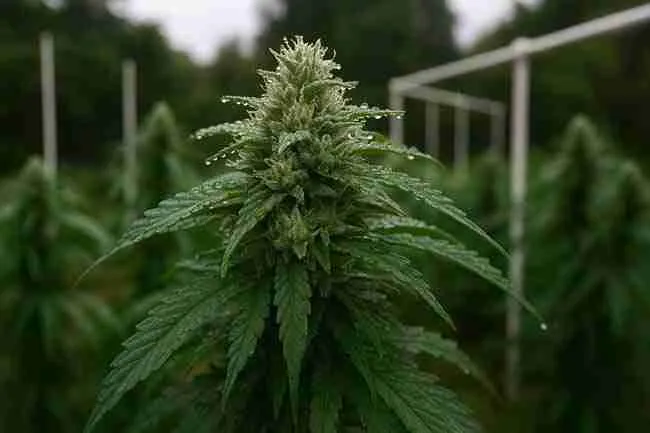
Week 1 of flower is stretch, not bulk. If you wanted four even tops, that work already happened in veg. Flip a tall, untrained plant and you get one spear and a skirt of popcorn. Flip a flat canopy and week 2 to 5 fills a screen of similar sites. Then you wait. The outdoor frost in the photo is what late flower looks like when the plant was allowed to finish: tight, sugary, not a lime-green spear with white hairs.
Light That Actually Hits the Cola

Cannabis is a light plant. Flowering cannabis is a hungrier light plant. Genetics, feed, and training cannot rescue a dim canopy. You will not grow massive cannabis buds under a 15-watt fluorescent. You will not grow them under a blurple panel that reads bright on a phone camera and still measures 300 µmol at the tops. The cola in that close-up sat in strong light. The popcorn under it did not.
Usable light is what lands on the flower, not what the box printed in watts. A 240-watt LED over a 2×2 that is even will beat a 600-watt HID with a hot spot and dark corners. Distance, dimmer, and a cheap PPFD meter tell you more than a brand name. Side and under-canopy light help lower sites if you insist on keeping them; most home tents do better by removing those sites. Lighting basics: grow lighting for cannabis. Lower-canopy work: understanding under canopy and side lighting.
Spectrum and PPFD in Flower

For a home tent without extra CO2, flower PPFD at the canopy is about 600 to 900 µmol/m²/s. Start near 600 in early flower, push 700 to 800 in the middle weeks, and sit 800 to 900 in the last stretch if the leaves stay happy. Sibling yield pages on this site use 800 to 1000 as a working band when the room is dialed. Past that without CO2 you bleach tops, taco leaves, and grow fox-tails. Diminishing returns start long before the 1800 µmol lab curve people screenshot.
Spectrum still matters. A full-spectrum LED with a real red bump in flower stacks calyxes better than a leftover veg panel. Deep red around 660 nm drives flower. A little far-red helps penetration and the Emerson effect. UV-B is a resin toy, not a bulk tool, and it is easy to overdo on a small tent. Trichome spectrum notes: best grow light spectrum for trichome production. How to actually map the canopy instead of trusting the center reading: light uniformity and real PPFD measurement.
Daily light integral in flower for dense buds sits roughly 40 to 50 mol/m²/day. Twelve hours at 800 to 900 PPFD gets you there. Twelve hours at 400 does not, no matter how pretty the tent looks at night. If the corners of the canopy are 350 and the middle is 950, you do not have a light problem at the middle. You have an evenness problem. Train or move plants until the tops sit in the same band. Then stop raising the dimmer because a forum said more watts equal more bud.
Feed for Flower, Not for Leaves

A plant that cannot veg cannot bulk. Flower feed is not veg feed with the bottle cap twisted further. Nitrogen stays in the mix, just lower. Phosphorus and potassium do the flower work: more sites in the first weeks, then fill and oil later. Calcium is the one home LED grows keep skipping. Calcium builds cell walls. Soft, floppy flowers and brown spots on new growth under diodes are often Ca, sometimes Mg, sometimes both. A Cal-Mag bottle is not magic. It is a patch for RO water and LED rooms that run drier and hungrier than old HID rooms.
The jar in the photo is a phosphorus-heavy bloom powder, Grotek Monster Bloom 0-50-30, from a grower’s shelf. It is an example of the class, not a product pitch. PK boosters belong in weeks 3 to 6 of flower if the plant is drinking and the tips are not already burned. They do not belong in week 1 on a plant that just flipped, and they do not belong in week 8 on a plant you are trying to fade. Follow the bottle’s own chart, then cut it if the leaf edges crisp. More PK on a plant that is not using it is salt, not size.
Liquid lines and salt bottles have a job in coco and hydro. Soil can run a lighter bottle or none if the mix was built. Flower deficiencies, the yellowing and the purple petioles people misread, are how to stop flowering stage nutrient deficiencies. Salt-based programs: synthetic cannabis fertilizers. Hydro bulk, if that is the room: using DWC hydroponics to grow cannabis. Medium choice: the best soil for growing cannabis seeds and best medium to grow cannabis.
Organic Top Dress: Rock Phosphate and Bat Guano

Organic rooms feed the soil, then the soil feeds the plant. The two top-dresses this page has always named are rock phosphate and high-phosphorus bat guano. Start about two weeks before the flip so they have time to move. A handful around the stem of a normal fabric pot, every two weeks, until two weeks before chop. They break down slowly. They will not spike a week-3 bottle burn. Water them in. Do not pile a cup of powder against a wet stem and walk away.
Gaia Green and similar dry amendments follow the same idea with a chart on the box. Top dress is not a reason to skip pH and dry-backs. A hot organic mix can still lock phosphorus if the water is a mess. Amendment walk-through: organic growing amendments cannabis. Guano specifics: what is bat guano. A beginner dry-amend path: growing cannabis with Gaia Green.
Train a Few Strong Tops, Not Twenty Popcorn Sites

An untrained plant is a Christmas tree. One main cola in the hot spot, everything under it shaded, a skirt of airy weed you will trim into the compost. Training flattens that tree so several tops sit in the same light. That is the whole trick. Low-stress training bends and ties in veg. Topping at the fourth or fifth node splits the main. A screen of green weaves the branches so you cannot cheat. The live page already said the quiet part: many growers keep three or four main colas instead of twenty-five small ones. The plant has a budget. More tips means smaller flowers on each tip.
Training often adds 20 to 40 percent more usable flower because the lower junk is gone and the remaining sites actually see the lamp. Doubling a harvest is a lucky screen, not a promise. A four-plant Canadian recreational room (Cannabis Act s.12, four plants per household) makes this sharper: you do not have twenty plants to hide a bad canopy. Four even plants with four even tops beat four Christmas trees. LST how-to: low stress training cannabis. ScrOG: scrog your way to a bumper cannabis harvest. ScrOG versus super cropping: training cannabis what is the difference ScrOG and supercropping. Mainline math: quadline vs manifold vs mainline.
Do the bending in veg while stems are still soft. Flower stretch will lift the canopy; leave headroom. Ties that cut into a swelling stem in week 5 will girdle a cola you spent a month building. Check them. Canada hub if the four-plant cap is the room you are packing: buy cannabis seeds in Canada.
Super Cropping for Stems That Can Hold the Weight

Super cropping is a pinch, a twist, a bend past the point of comfort without snapping the branch. The stem knuckles. The plant rebuilds that knuckle thicker than it was. Water and feed move through a stronger pipe. A massive cola in week 7 is heavy. A skinny petiole snaps. A knuckled branch leans and holds. Pinch with fingers, not pliers. If you hear a full crack and the branch hangs by a thread, tape it. It often takes. If you puree the stem, you just topped by accident.
Do this in late veg and very early flower, not on a swollen cola in week 6. The photo is the point of the work: several tops in the light, ties in place, stems that can take the weight. Branch strength beyond the pinch: strengthen cannabis branches stems. Pruning that is not a panic strip: prune cannabis plants.
Lollipop the Lower Third Early

Lollipopping is taking the lower third — the shaded popcorn, the weak inner shoots, the fans that never see the lamp — off early in flower so the plant stops paying for them. Do it around the flip or in the first two weeks, not as a week-6 panic strip that shocks a swelling cola. Targeted defoliation is a few fans that block a bud site. A full strip is a different, harsher job. The live defoliation walk is defoliate cannabis. Leave the tops. The photo is the shape you want: a clean stem, four or five sites in the light, nothing wasting sugar in the dark.
Massive buds and total dry yield are not the same bet. A few huge colas look like the magazines. A screen of even, mid-size colas often weighs more. Pick one. A ScrOG of twelve similar tops is usually the heavier jar. Four spears on an untrained plant is the photo people send. Both are valid if you know which one you planted for. Yield math without the bottle myth is increase cannabis yields for all strains. Crop steering if you are already in coco and want to push stretch versus bulk: crop steering for cannabis.
CO2 Only After the Light Is Already Maxed

CO2 is a supercharger. It does nothing for a car that is out of fuel. Ambient air is about 400 ppm. A sealed, well-lit room can use 1000 to 1200 ppm. Old forum charts still print 1500 as the home default. That is a commercial sealed room with light already past 900 µmol, cooling that can take the extra heat, and a sensor you actually read. A leaky tent at 500 µmol with a bag of mushroom compost is theatre.
The plant is always limited by the weakest link: light, roots, feed, water, temperature, or carbon. Extra CO2 only pays after the canopy is already in the 800 to 900 band, the room can hold the gas, and you have a meter. Bottled CO2 with a regulator into a sealed tent is the honest home setup. A tank on a zipper tent you open six times a day is a bill. Safety is not optional; you do not live in 1200 ppm. Levels, yields, and the point where grams per extra ppm fall off: high CO2 home grows, safe levels, yields, and diminishing per-gram returns.
Let Them Finish

That photo is not done. White pistils, open structure, the cola still drawing the shape. Growers post this stage every week asking if they can chop. They are bored. The plant is not. The last two to three weeks are when the flowers swell. Harvesting because you are excited is how you get smaller buds than the pack was capable of. The breeder week count is a window, not a birthday. Look at the trichomes.

Cloudy heads with a scatter of amber is a common chop for a balanced jar. Clear heads are early, even if the calendar says week 8. All amber is a heavier, sleepier jar and a plant that already peaked. Use a loupe. Do not trust a phone zoom from two feet. Overripe flowers that went too far: how to tell when your cannabis buds are overripe. A flush, if your medium actually needs one, is flushing cannabis. The dry and the cure are where a massive cola can still turn to hay: dry cure store cannabis buds.

Week 7 colas lean. Stake them, yo-yo them, net them. A snapped cola on the floor is the dumbest way to lose weight you already grew. Bamboo and a clip cost less than the flower. Check the ties as the stem thickens. Keep air moving through those dense tops while they finish. A massive wet cola in still air is rot. Once you cut, dry slow, then cure in jars you actually burp. The grow is not done at harvest. It is done when the jar smells like the flower, not like chlorophyll.
They named a strain Big Bud for a reason. Genetics still do the heavy lift. Even light, a few strong tops, a feed the plant can drink, and a finish you do not rush do the rest. Named packs that were bred to stack sit in the cannabis seeds store. What an ounce actually costs to hang, light included, is how much does it really cost to grow an ounce of cannabis.