Low-Stress Training Cannabis: How to Bend for an Even Canopy


A cannabis plant wants one Christmas tree. One tall top. Everything else in the shade. Indoors, that wastes your light. Low-stress training cannabis is the boring fix: you bend the tall stuff down and out, tie it, and keep the canopy flat so many tops sit the same distance from the lamp. No new light. No extra tent. Just a tie and a few minutes every other day in veg.
This page is how to do LST the way growers who rank for it actually do it: start at 3 to 5 nodes, water first, first bend 30–90 degrees, star shape from above, check ties daily, stop major bends after stretch. Autos, photoperiods, snaps, SCROG, and why topping is optional. The original live copy is still the backbone. We are filling in the steps people search for, not padding it.
What Low-Stress Training Cannabis Actually Is

LST is bending and tying. That is the whole trick. You are not cutting the top off unless you choose to. You are not crushing the stem. You are moving the main tip sideways so it stops hogging auxin, the hormone that says “I am the boss, stay small down there.” Side branches then race up. You tie those out too. From above it should look like a wheel or a star, not a pole.
People call it bonsai for cannabis because you decide the shape. A 9-foot sativa habit can live in a 7-foot tent if you start early and keep the tabletop flat. Yields often jump because more sites become “tops.” A guaranteed 50 percent is marketing. A real win is eight decent colas instead of one monster and a pile of popcorn. Canopy logic: cannabis canopies and light.
How LST Works: Apical Dominance, Not Magic
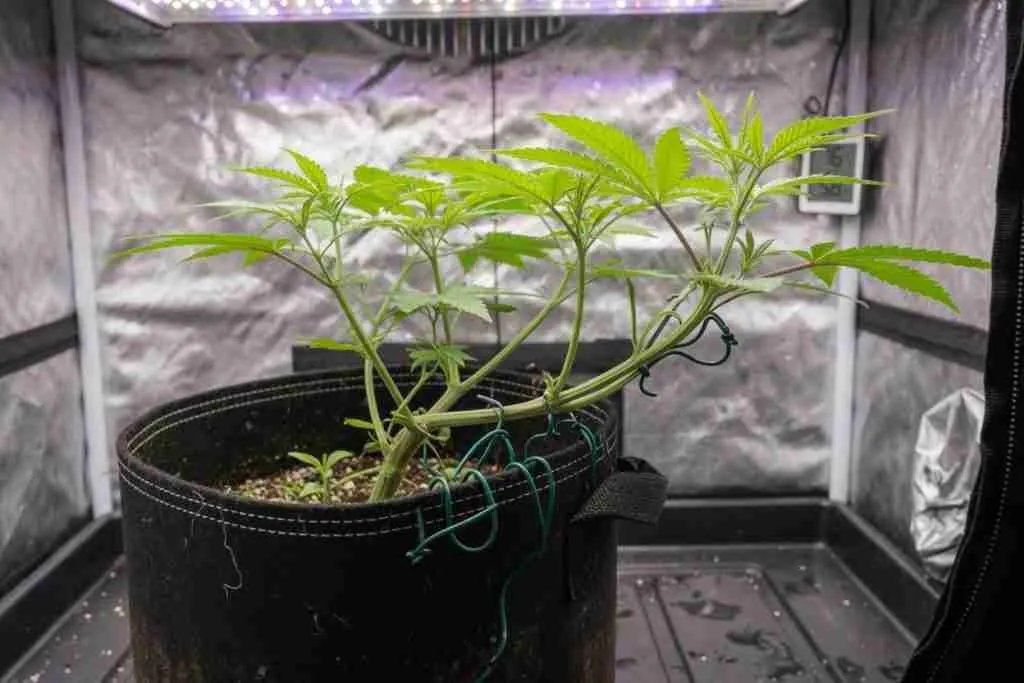
Untrained, the highest tip makes most of the auxin. That hormone travels down and tells lower shoots to wait. You get a Christmas tree: one king cola, skinny sides. Bend that tip below the laterals and the plant treats several tips as “the top.” Nutrients and light spread. Hormones: how training redirects plant hormones.
Do this in veg, while stems are still green and rubbery. Flower stretch will lift everything. You can tuck a bit in week one of 12/12. Mid-flower wood snaps. Autos only give you a few weeks, so start as soon as the stem will take a bend — often node 3 or 4. Photoperiods you can wait for node 4–6 if you want more to work with. Veg timing: cannabis vegetative stage.
LST vs High-Stress Training
High-stress training is topping, FIMing, mainlining, manifolding, supercropping. You cut or crush. The plant stops to heal. Low-stress training is the opposite on purpose: little or no wound, little or no stall. Both want a low, even canopy and as many lit sites as the footprint allows. HST slows the clock more. Autos hate that stall. Photoperiods can take a top plus LST if they are healthy.
| Method | What you do | Recovery | Best for |
|---|---|---|---|
| LST | Bend and tie | Hours, tips turn up | Autos, beginners, short tents |
| Topping / FIM | Cut the tip | Days | Photoperiods with veg time |
| Supercrop | Pinch then bend woody stems | Days, tape if you split | A branch that already lignified |
| SCROG | Net plus tucking | Low | Filling a whole light footprint |
If you squeeze the inside of a stem until it goes soft, that is supercropping, not LST. Useful. Different cost. Heavier methods: quadline vs manifold vs mainline.
What You Need (and What Cuts Stems)

Soft coated garden wire, Velcro plant ties, pipe cleaners, or fabric tape. That photo is the real thing: loose loops, not a noose. Bare string, fishing line, and thin metal wire girdle the stem as it thickens. That is the second most common failure after training too late.
Anchor points: holes around a plastic pot rim, fabric-pot grommets, bamboo canes, or a stake in the mix. A counter-tie at the base stops you yanking the root ball sideways when you pull the top. Keep tape or a splint in the drawer. You will snap one eventually. Water the plant first so stems are turgid. Do not bend a wilted plant. Light and water still matter more than a fancy clip: how much light cannabis needs and how to water cannabis plants.
How to Do LST, Step by Step
1. Start on a healthy plant with 3 to 5 nodes
Original advice on this page was two to three nodes. That is the earliest some stems will bend. Ranking growers wait for 3–5 nodes so you have something to hold. If the plant is pale, wet, or stretching for light, fix that first. LST on a sick plant is just another stress.
Topping a week before is optional. It makes two leaders that are easier to spread. It is not required. Autos: skip the cut unless you know the cultivar. Photoperiods: one clean top above the 4th or 5th node is plenty if you want it.
2. The first bend
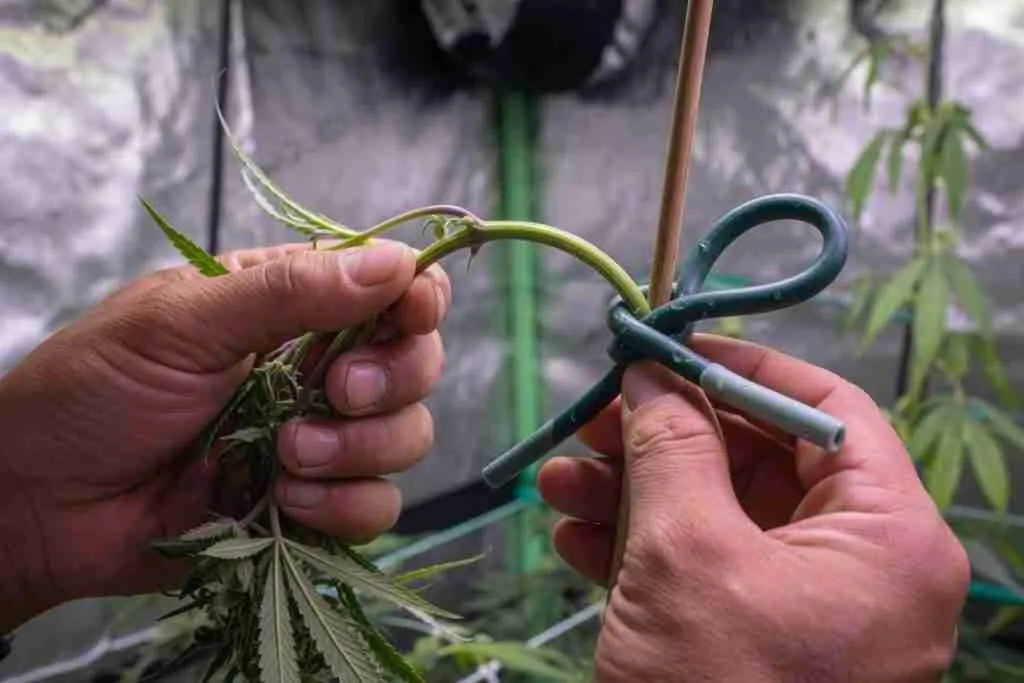
Support the stem with one hand above the bend and one below. Slow pressure. Aim 30–60 degrees the first session, not flat on the soil in one go. A 90-degree laydown is the goal over a few days, not one yank. Loop the tie above a node, not through a leaf. Leave slack for the stem to thicken. Anchor to the opposite rim. The old top should sit at or below the height of the side branches. Tips turn up toward the light within hours. That is normal. You will bend them again.
Never pry a branch at the trunk like you are opening a door. Bend farther along the stem. Young tissue flexes. The crotch splits.
If the pot wants to tip, tie the base the other way. You are training the plant, not dragging the whole cup across the tray.
3. Spread laterals into a star

Look down. Open middle. Branches radiating out. Tie the next pair of sides to new holes, same as the original live steps: line holes up with the branches, pull outward, keep the top level. Some growers snake the main stem around the pot like a coil. Either works if every tip sits in the light and none is sitting on its neighbor.

Canes work when the pot rim is not enough. Cable-tie the cane to the container. Tie the main stem to a middle cane. Side branches go to the outside canes. That labeled photo is from a real garden, not a drawing. Loosen anything that starts to bite.
4. Check every day, not once a week
New tips shoot up fast. A tie that was loose Tuesday is a tourniquet Friday. Move it. Add a new one farther out. You are maintaining a tabletop, not performing a one-time ceremony. Most growers want 7 or 8 main flowering tops by flip. That number is a target, not a law. A small 2×2 may only want four even colas. Plant count: how many cannabis seeds.
If You Snap a Branch
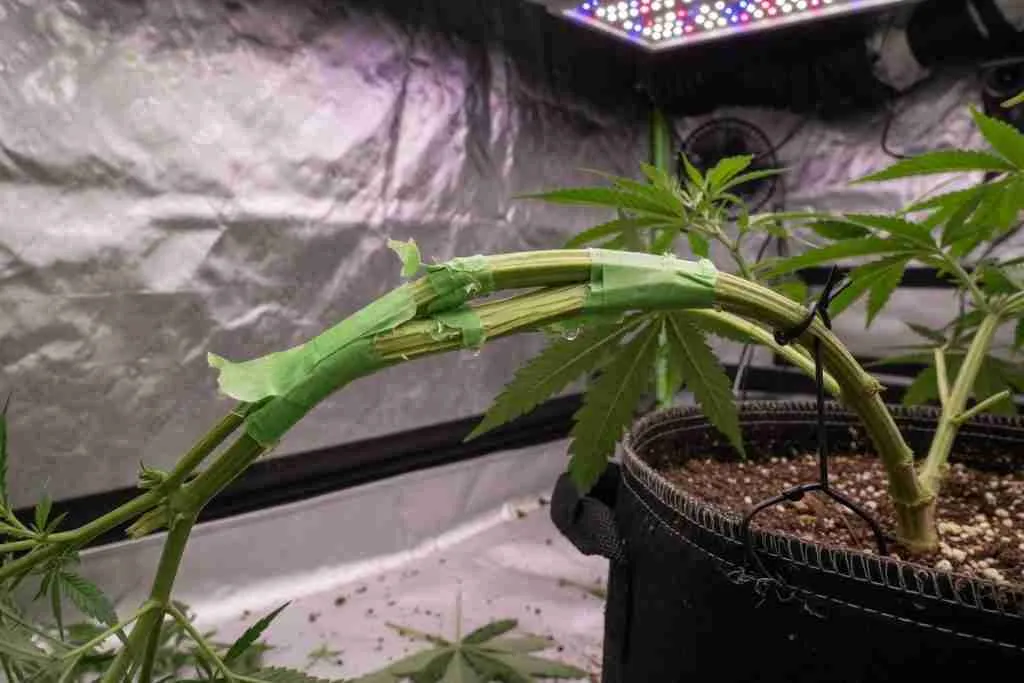
If it is still attached, tape it like a cast. Electrical tape, grafting tape, even a clean strip of duct tape. Splint with a toothpick if it is floppy. Leave it. Cannabis will callus. A clean break that fell off is gone. Do not try to glue a detached tip back on. Next time, smaller bend, wetter plant, farther from the crotch.
Autos vs Photoperiods
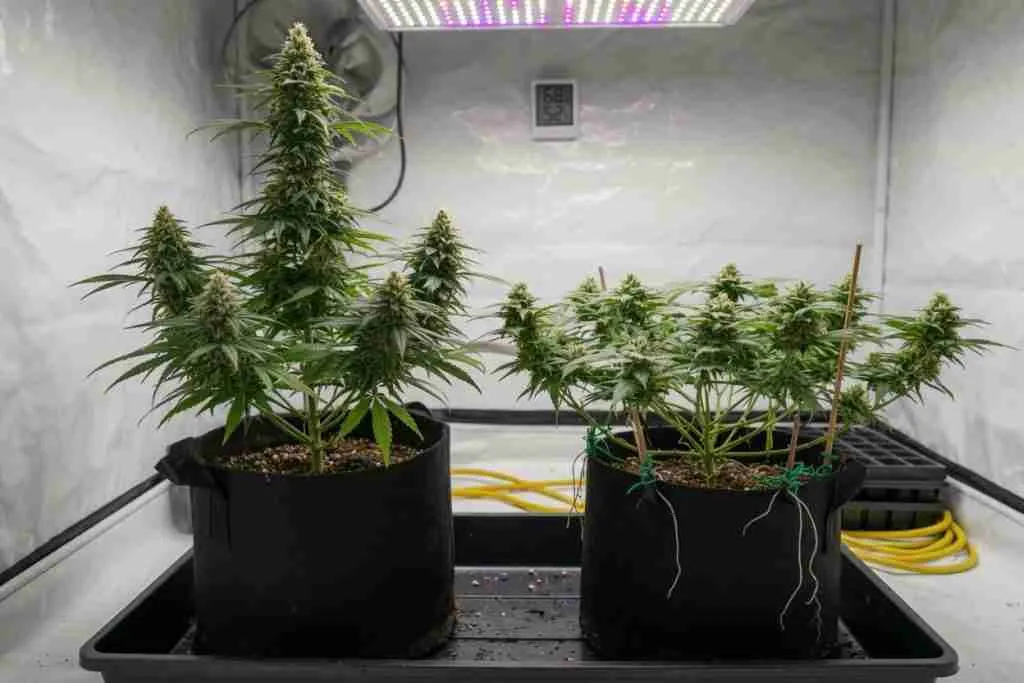
Autos run on a clock. LST is the training that does not steal a week. Start early, bend small, do not top unless the plant is a monster. By the time pistils show, you should be adjusting, not wrestling. More auto-specific notes: LST on autoflowers.
Photoperiods give you time. Veg until the footprint is full, last big tie about a week before 12/12, then let stretch happen. Stretch can add 50–100 percent height depending on genetics. A flat veg canopy that looks “too short” often finishes perfect. Flip math: photoperiod cannabis seeds explained and flowering stage.
LST Into a Screen (SCROG)

A net is LST with a grid. Install it while you can still reach the pot. Tuck tips under squares as they grow. Stop tucking when stretch ends, then let colas stand. One plant in a 2×2 or 3×3 with LST plus a net will beat four untrained Christmas trees in the same box if the light is even. Tent size still matters: buying a grow tent.
Flower: Stop Wrestling, Start Supporting
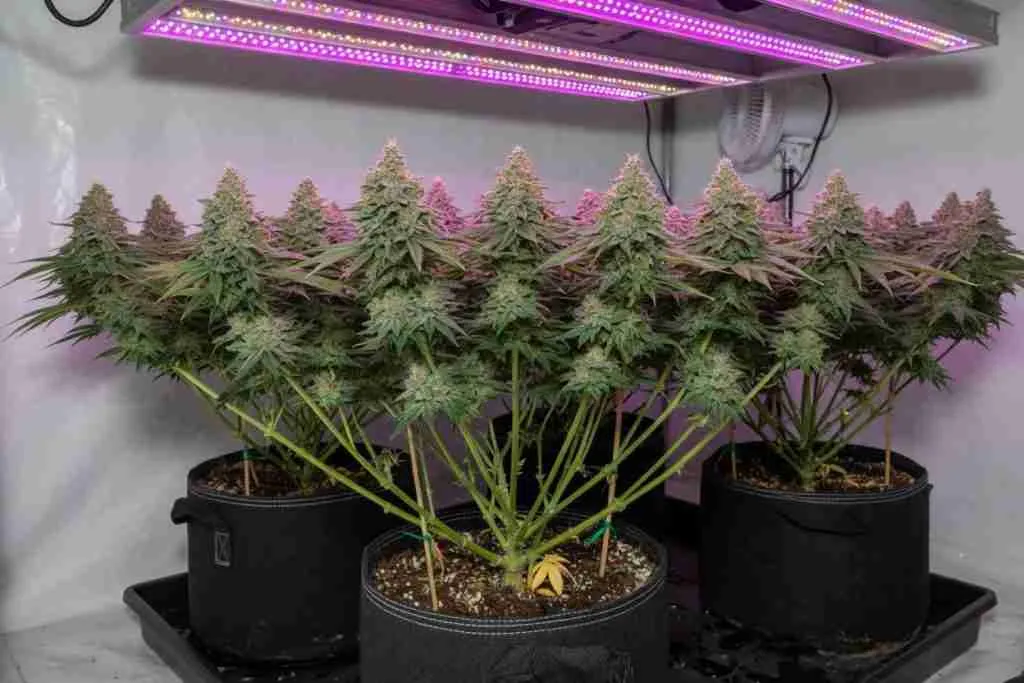
Once buds fatten, stems get brittle. You are done training. You are holding weight. Yo-yo ties, a net, or bamboo. Bending a swollen cola sideways in week six is how you fold a harvest. Light defoliation at flip — a few fan leaves that shade sites — is optional. LST works without stripping the plant bald. Branch strength: strengthen cannabis branches and stems.
Mistakes That Make LST Look Pointless
- Starting on a woody stem and snapping it, then blaming the method.
- Thin string that cuts in as the stem swells.
- One bend in week two, then never touching it again while the top races back up.
- Training a thirsty, stretching seedling instead of lowering the light.
- Heavy topping plus hard LST on an auto the same day.
- Filling the tent so tight that “even canopy” means no airflow. Environment: best growing environment.
Worked example. One photoperiod in a 3-gallon fabric pot under a 150W LED. Node 4, you bend the top to the rim. Two days later the laterals are up. You tie three of them out. Every other day you knock the tallest back to the table. Week of flip you have eight tips in a circle, none more than a finger taller than the rest. Stretch lifts them together. Harvest is eight similar spears, not one club and a bunch of larf. That is LST doing its job.
What Not to Stack on the Same Day
Do not top, LST hard, transplant, and change the light height in one sitting. Pick the training. Let the plant tell you it accepted it. New growth that is the same size and color as yesterday is the green light. Clawed, twisted, or stalled tips mean you stacked stress. Autos will not give you a do-over week.
Do not LST a plant you just soaked in oil for mites. Soft, wet tissue tears. Pest first, or training first, not both dripping. Same with a heavy defoliation. Leaves help the stem recover from a bend. Strip later if you must.
A Veg Timeline That Matches Real Plants
Week 1 from sprout: leave it. Cotyledons and the first true leaves are not a training project. Get the light close enough that it does not stretch into a noodle.
Week 2–3, about 3–4 nodes: first gentle lean if the stem is thick enough to hold a loop. If it still feels like a thread, wait three days.
Week 3–5: this is the work. Laterals come up. You tie them out. You knock the new tallest tip back into the plane. Holes around the pot are already there so you are not drilling over a wet tray at night.
Week 5–7 photoperiod: fill the footprint. Last big rearrange a week before flip. Autos will already be showing pistils in here. Stop the hard pulls. Only tuck what is shading a neighbor.
The snake method from the original page is just a long first bend. You walk the main stem around the rim as it grows so one plant coils instead of standing up. It uses a lot of rim holes. It works in a small pot when you refuse to top. Check the inside of the coil for dead air and leaves sitting on soil.
A Simple LST Week in Veg
- Water, then look from above.
- Whatever is tallest, bend it into an open hole in the canopy.
- Loose loop. Check yesterday’s ties for bite marks.
- Leave it. Tips will hook up. That is the plant, not a failure.
- Repeat until the footprint is full, then flip or let the auto go.
Start with seeds you can actually finish in the space: cannabis seeds. A 9-footer in a closet without LST is a headache you chose.
After You Flatten It, Move the Light
A Christmas tree had one tip in the sweet spot. A table has eight. If you leave the LED where it was, the new tops are now farther from the diodes than the old king cola was. Drop the light or raise the output so PPFD on the new canopy matches what that single top used to get. Then watch for tacoing. LST does not replace a dim lamp. It just stops you wasting the one you have on empty air around a pole.
Airflow changes too. A dense pancake needs a fan across the top, not only at the floor. Wet, still centers get mildew. You opened the plant. Keep it open.
Outdoor LST Is a Different Bet
The sun moves. A tall outdoor plant still gets light on the sides. LST still helps you keep a patio plant under a fence line, or spread a plant so wind does not snap one giant top. The yield jump is smaller than indoors because you are not fighting a fixed LED. Use softer ties. Rain swells stems fast. Check after storms. Do not LST a plant that is already woody in July and expect it to lie down like a seedling.
Defoliation Is Not LST
Pulling fan leaves is a separate job. LST works with the leaves on. At flip, some growers strip a few leaves that sit on sites. That is fine. Balding a plant because a forum said “week 3 defol” while you are also tying every branch is how you stall it. One change at a time. See how the canopy looks from the light’s point of view, not from a mood.
Why “50 Percent More Yield” Is a Maybe
The original page said LST can increase harvest by as much as 50 percent. Sometimes a badly shaded plant really does jump that hard once you put eight tops in the light. Sometimes you already had a decent canopy and LST just makes it neater. The honest number is this: more of the plant sits in the high-PPFD zone, so more of the harvest is top bud instead of larf. If the tent was overcrowded, LST cannot invent photons. If the mix is a swamp, train after you learn to water.
FAQs
When do I start low-stress training cannabis? When the plant has about 3–5 nodes and the stem still bends. Earlier if it is already stretching into the light. Later if it is still a weak seedling.
Do I have to top first? No. Topping makes spreading easier on photoperiods. LST alone works, especially on autos.
Can I LST in flower? Small tucks in early stretch. Not after stems lignify and buds gain weight.
What if I break a branch? Tape it if it is hanging on. It usually heals. Next bend is smaller.
Does LST increase yield? It increases the share of bud that sits in the strong light. Same lamp, more useful canopy. That is the yield. It will not save a dim tent or a drowned pot.
String or coated wire? Coated wire, Velcro, or pipe cleaners. String cuts.
How many tops should I have? The original target on this page was 7–8 mains at flip. A tiny tent might want 4. A 5-gallon pot under a bigger LED can hold more if they are not stacked. Count sites you can actually light, not sites you can tie.
Do fabric pots work? Yes. Use the grommets as anchors. Do not cinch a tie through the fabric so hard it collapses the wall. A cane inside the pot still works if the grommets are in the wrong place.
A trained plant in veg looks busy from above and short from the side. You should see soil in the middle, not a knot of stems. New growth should be the same color as before the bend. If it claws or yellows after a session, you bent a thirsty plant or you girdled it. Water, loosen, wait.
A fan across the canopy while you LST does double duty. The stems thicken as they flex. Ties hold the shape. Together you get a short plant that does not flop in week five. That is the same idea as training for stronger branches, just without waiting until everything is already tall.
Low-stress training cannabis is a daily nudge, not a stunt. Bend the tall one. Tie it loose. Keep the table flat until flower does the rest.