Indoor Cannabis Growers Guide


Originally published 9 September 2022. Updated 1 October 2026.
This indoor cannabis growers guide is the order of work for a tent in a real house. You match the plant count to the law and the floor, then the light, the air, and the seed. A catalog photo of a 4×8 room does not help a spare bedroom. The pages that rank for this search in 2026 all teach the same practical pieces: tent size, true LED watts, a climate table by stage, and a dark period you can actually keep. Those are the pieces below. The strain name comes after the room exists.
The indoor cannabis growers guide starts with the room
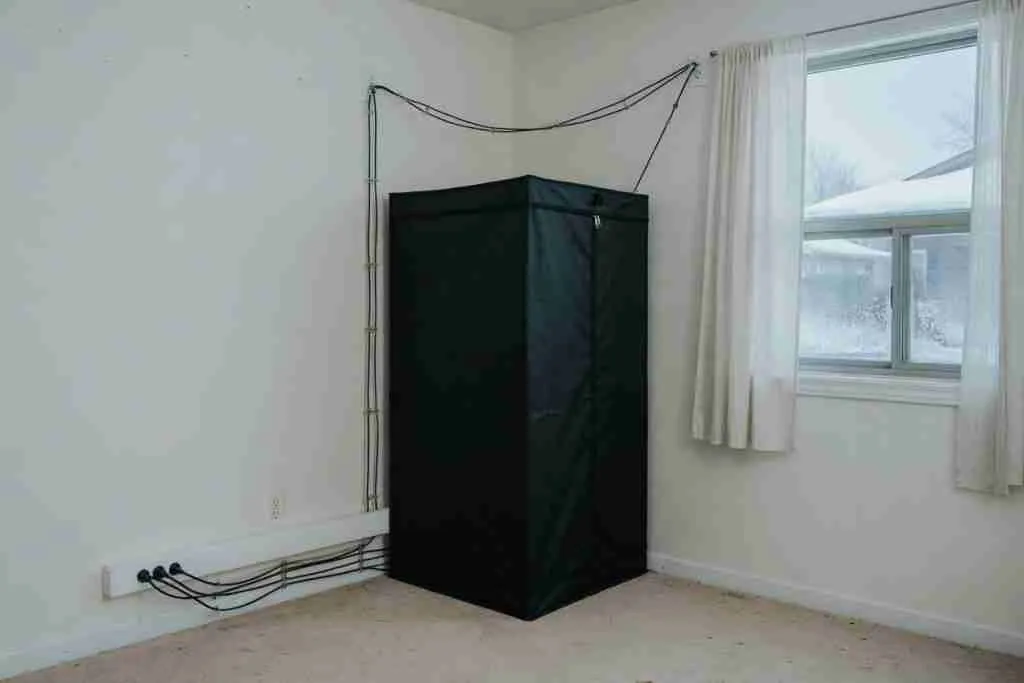
Indoors you replace the sun, the season, and the wind. The marijuana plant does not know it is in a tent. It knows how many hours of light it got, how warm the leaves are, and whether the air around the buds is wet. Get those three wrong and the seed was never the problem.
In Canada the recreational cap is four plants per household, not four per adult who happens to live there. That line is Cannabis Act section 12. Quebec still does not allow recreational planting, including a seed in a pot. The Quebec seed page is the local version, and the age there is 21. Manitoba, since 1 May 2025, allows up to four plants and they have to be indoors, locked away from anyone under 19. Start with the Manitoba page if that is your house. Alberta’s age is 18. Most other provinces use 19. In public, dried marijuana possession is 30 grams, and one seed counts as one gram, so a pocket of packs is not a walk to the store. The Canada ordering guide holds the provincial map and the registration note.
A registration that lets you grow more than four has to be in hand before the extra plants, and the plants have to be at the site named on it. You cannot sell the harvest. The shop sells seeds. It does not issue that paperwork. A 5-pack matches a recreational household. A larger pack matches the count on the certificate.
If you are in the United States, do not borrow the Canadian four. Some states allow a home garden. Some allow it only for patients. Recreational home grow is not allowed in Washington. Idaho is a zero-plant state. Open the 2026 state-by-state guide and the US seed hub before you plan a tent. This page teaches the horticulture for a room you are allowed to run. It is not permission in a state that says zero.
Put the tent where you can reach the zipper, empty a saucer, and hear a fan at night. A cold outside wall in a Canadian January will fight the heater. An upstairs closet in July will fight you the other way. Cords stay off the floor. A spilled pot will find them if you leave them in a puddle path. Add up the light, the exhaust, and a dehumidifier before they share one power bar. A typical 15-amp household circuit wants the continuous load kept near 1,400 watts. A space heater on that same bar is how people trip breakers and start worse problems. If the panel work makes you hesitate, call an electrician. This is not a wiring course.
Size the tent to the plants

Buy the floor you can fill, not the floor that looks serious in a photo. One mature photoperiod plant, grown with a little training, wants about a 2×2 footprint. Four plants in 19-litre pots are a 4×4. That 4×4 is the Canadian household tent: four plants, one light, one exhaust. A 4×8 is a second project. It is also more heat, more humidity, and more weed than a first legal run needs to prove.
| Tent | Floor | First-run plants | LED draw in flower |
|---|---|---|---|
| 2×2 | 4 sq ft | 1 | about 120–160 W |
| 2×4 | 8 sq ft | 2 | about 240–320 W |
| 3×3 | 9 sq ft | 2, or 3 kept short | about 270–360 W |
| 4×4 | 16 sq ft | 4 | about 480–650 W |
Height is the number people skip. You need the pot, the plant after it stretches, the light, and a gap of air under the filter. A tent under about 160 cm (a bit over 5 feet) gets tight the week you flip a photoperiod, because many plants stretch to nearly double in the first three weeks of flower. Measure the ceiling before you measure the catalog. The grow tent guide goes further on canvas, poles, and ports. The 2026 gear notes cover the newer controllers if you want that later. You do not need them to finish run one.
A crowded tent is a humidity problem

Six plants in a 4×4 look efficient in week three. In week eight of flower they are one wet canopy with no path for air. That is the usual way a legal four-plant tent still grows mold. Leave a hand between pots. If the leaves from one plant lie on the leaves of the next, you are already past the count that tent can dry.
A net does not add floor space

A trellis spreads tops into the light you already own. It does not turn a 2×2 into a 4×4. Bend stems while they are still flexible, in veg, and stop heavy bending once flowers are stacking. A snapped main stem in week two of flower is a rescue, not a technique. Training is optional on a first run. An even canopy is not. If one cola is touching the LED and the lower buds are in shade, the light is being wasted.
Light: real watts, not the number on the box

LED is the default in a home tent. It runs cooler than the old high-pressure sodium lamps and you can dim it, which matters more than a brand speech. Plan on about 30 to 40 watts of actual wall draw per square foot of flowering canopy. The watts in the table above are that math. A sticker that says 2000W on a fixture that pulls 100W at the plug is advertising. Read the draw.
PPFD is how much usable light lands on the leaves, in µmol/m²/s. You do not need a lab. You need the bands. Seedlings sit around 200 to 400. Veg sits around 400 to 600. Flower, in a normal room without added CO2, sits around 600 to 900. Past about 1,000 without extra CO2 you are paying to bleach tips. A phone lux app is not a PAR meter. It is how people cook a seedling and still think the room looks bright. If the fixture dims, start seedlings low and raise the output as the canopy fills. Hanging height is not one number for every lamp. If the tops pale and canoe upward, the light is too close or too strong. If the stems stretch and fall over, it is too far or too dim.
Photoperiod weed runs 18 hours on and 6 off while you are building the plant. You flower it by switching to 12 on and 12 off. The dark half has to be dark. A power-bar LED, a window, or a zipper that does not close is enough to keep some plants from flowering cleanly. Put the timer on the light, not on your memory. Autos do not wait for that flip. They flower by age, so leave them on 18/6 the whole way. Photoperiod seeds and how autoflowers work split that choice. The flowering control guide is the long version of the flip. Use it when you are ready to change the clock, not instead of owning a timer.
Air has to leave, and the smell with it
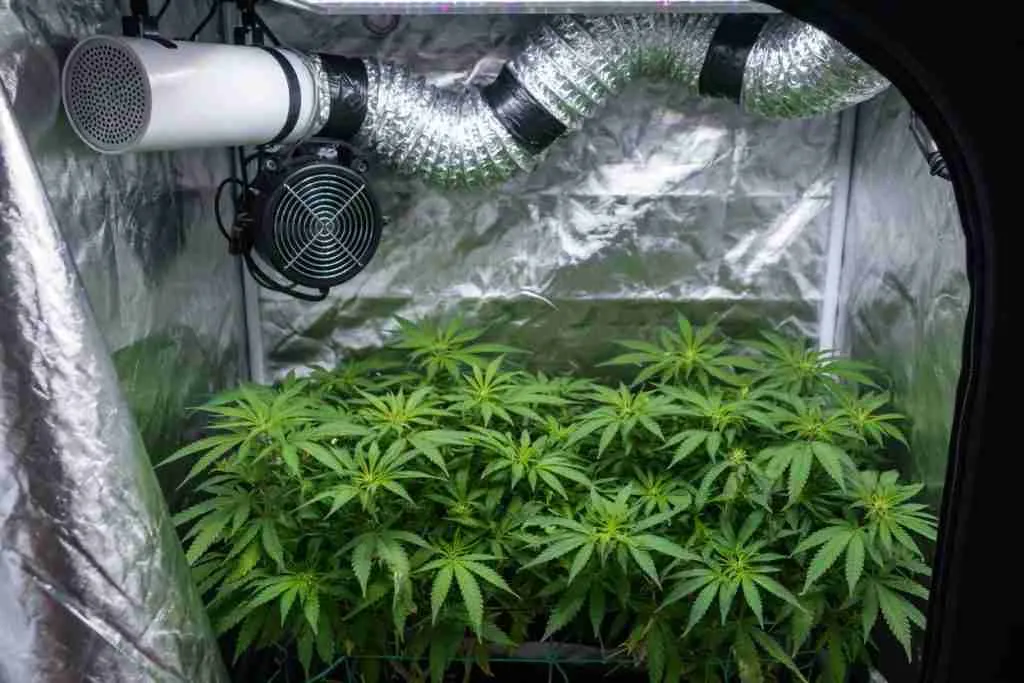
A sealed tent with a bright LED becomes a warm, wet box by the afternoon. Size the exhaust so the volume of the tent can change about once a minute, then allow extra for a carbon filter and every bend in the duct. A 2×2 or 2×4 usually lives with a 4-inch fan. A 4×4 wants a 6-inch fan. The filter is what keeps flowering marijuana from announcing the hallway. Hang it so the duct run is short. A long, crushed duct steals the airflow you paid for.
The exhaust is not the breeze on the leaves. A small clip fan moves air across the canopy so stems get stronger and wet air does not sit inside the buds. Point it across the tops, not straight down one cola like a hair dryer. Intake can be a passive vent on a small tent. If the walls suck in hard, the exhaust is stronger than the opening. Open another port.
Smell control fails in the last month, not on day one. Replace a filter that no longer catches the odor. Do not “air the tent out” by leaving the door open while the lights are off on a 12/12 crop. You just gave the plants a light leak and the rest of the house the smell.
Temperature and humidity by stage

Hang a thermometer-hygrometer at canopy height, not on the outside wall of the tent. You are measuring the air the leaves feel. Lights-on targets are enough for a first run. Lights-off can sit a few degrees cooler. A Canadian house in January is dry, and seedlings stall when the air pulls them flat. The same house in July is humid, and late flower plus wet air is how bud rot starts. Exhaust helps. It does not replace a dehumidifier once the flowers are dense.
| Stage | Light | Lights on | Humidity | PPFD |
|---|---|---|---|---|
| Seedling | 18/6 | 22–26°C | 65–75% | 200–400 |
| Veg | 18/6 | 22–28°C | 55–70% | 400–600 |
| Early flower | 12/12 | 21–26°C | 45–55% | 600–800 |
| Late flower | 12/12 | 18–24°C | 40–50% | 600–900 |
Those Celsius bands sit roughly from the high 60s to the low 80s Fahrenheit with the lights on. Autos stay on 18/6 through flower. Use the flower humidity row anyway. Their buds rot at the same humidity as a photoperiod’s buds. If you want the physics check, vapour-pressure deficit around 0.8 to 1.2 kPa in veg and 1.2 to 1.6 kPa in flower is the band these temperatures and humidities are aiming at. Steady beats perfect. A tent that swings from 18°C to 30°C every afternoon will not hit a chart you printed.
Older versions of this article ran veg humidity down near 45% and late flower near 30%. That is drier than a seedling or a vegging plant wants, and it is why so many first runs looked crispy in a heated Canadian room. Drop the humidity as flowers form. Do not start there.
Soil, coco, pots, and water

Soil is the simpler first medium if the bag is a real potting mix that drains, not mud from the yard and not a “hot” compost that burns a sprout. Water pH for soil wants about 6.0 to 6.8. Coco wants about 5.6 to 6.2, and coco is not soil: you feed it earlier because the fibre holds water, not a pantry of nutrients. If the pH pen has not been checked against a buffer, do not trust the number on it. Yellow leaves have a long list of causes. Wrong pH is the boring one that shows up first. The seedling yellowing guide is the diagnostic when the color goes off.
Fabric pots dry more evenly than a sealed nursery pot and they are harder to drown. The photo above is an ordinary indoor pot from the original shoot, including a small sprout sitting in wet mix. That sprout is not the goal. Lift the pot. If it is heavy, wait. Water when the top inch is dry and the pot has lightened, then water until a little runs out the bottom, and empty the saucer. A seedling in constant mud stalls, then falls over. The watering guide is the longer version. Hydroponics is a different system, with a reservoir to keep cool and a pH that moves every day. Use the hydroponic growers guide if that is the plan. Do not start there because a forum said soil is slow.
Seeds that match the tent

Feminized photoperiod seeds are the default for a first indoor tent. Nearly every seed is a female, so you are not spending half the floor on males, and you choose the week you flip. That is how you keep a plant short enough for the ceiling you measured. Autoflowers finish on a clock, which helps if you will not manage a dark period, and they punish a late mistake because you cannot give them two more weeks of veg. Regular seed is a breeding project. It is a poor way to fill four legal spots if you have nowhere to move a male.
Buy the height, not the loudest photo. A long-flowering sativa hybrid in a short 2×2 is a fight. A compact plant in a 4×4 is four pots and a calmer harvest. A 5-pack covers four plants and one seed that does not pop. The feminized packs page is the room-sized version of that choice, and the feminized shelf is where the named packs sit. Firm, darker, mottled shells are what you want in the hand. Pale green and cracked seeds are a gamble.
Seedling and veg build the plant you flower

Germination is warmth and moisture, not a soak that drowns the seed. Plant shallow once the root tip shows, or sow straight into the final pot if you would rather not transplant an auto. The germination guide has the methods. A seedling lives on the cotyledons first. A full flower nutrient dose in week one burns it. High humidity, gentle light, and a pot that is not a swamp will do more than a bottle.
Veg is 18/6 and time. Photoperiod plants can veg for three weeks or for two months. The length is how you fit the tent. Flip when the plant is about half the final height you have room for, because the stretch is still coming. Autos do not give you that lever, so their pot and their light have to be right early. The seedling stage and the vegetative stage guides cover day-to-day growth. Use them when the plant is in that stage. Do not try to memorize every week before the seed is in the pot.
From sprout to a dried jar, a photoperiod run is often four to six months, and most of the swing is how long you choose to veg. A typical auto is closer to 10 to 14 weeks from sprout, and the clock does not pause because the tent was cold in week two. Cold early weeks cost you more on an auto than on a photoperiod you can simply veg longer.
Flower is twelve hours of real dark

After the flip, leave the timer alone. Opening the tent for a long look during the dark period is a light leak with your face behind it. Check plants in the first or last hour of lights-on. Stretch comes first. Buds come after. Support branches before they fall onto the pot rim. Flower nutrients are heavier in phosphorus and potassium than a veg feed, and you still raise the dose in steps. A burnt tip is information. Doubling the bottle is not the fix.
Most photoperiod flower runs take about 8 to 11 weeks after the flip. The seed listing is a hint, not a calendar you harvest by. The flowering stage guide walks the weeks. Humidity comes down as the flowers tighten. If the tent smells sweet and the stems are still stretching, you are early. If the white pistils have mostly darkened and the resin has gone cloudy, you are in the window.
Read the crystals, not the orange hairs

This photo has been on the guide for years, and the label is aimed at the wrong part. The red marks land on orange pistils. Those hairs show that the flower is female and that it has been flowering for a while. They are not the harvest clock. The trichomes are the tiny mushroom-shaped heads on the sugar leaves and the bracts. You need a cheap jeweller’s loupe or a phone macro that can actually resolve them. Harvest when most heads are cloudy and some have turned amber. Clear heads are early. Mostly amber is a heavier, sleepier result, and you traded brightness to get there. The harvest timing guide stays with that decision longer than this page should.
A ripe cola is still on the plant

A finished cola is swollen, frosty, and still attached. Sugar leaves frost up before the inner bracts do, so check the bud itself, not only the sun leaf sticking out. If the lower buds are airy and the top is done, the canopy was uneven. Note it for the next run. Do not leave the plant up an extra month hoping the bottom will catch the top.
Dry slow, then jar
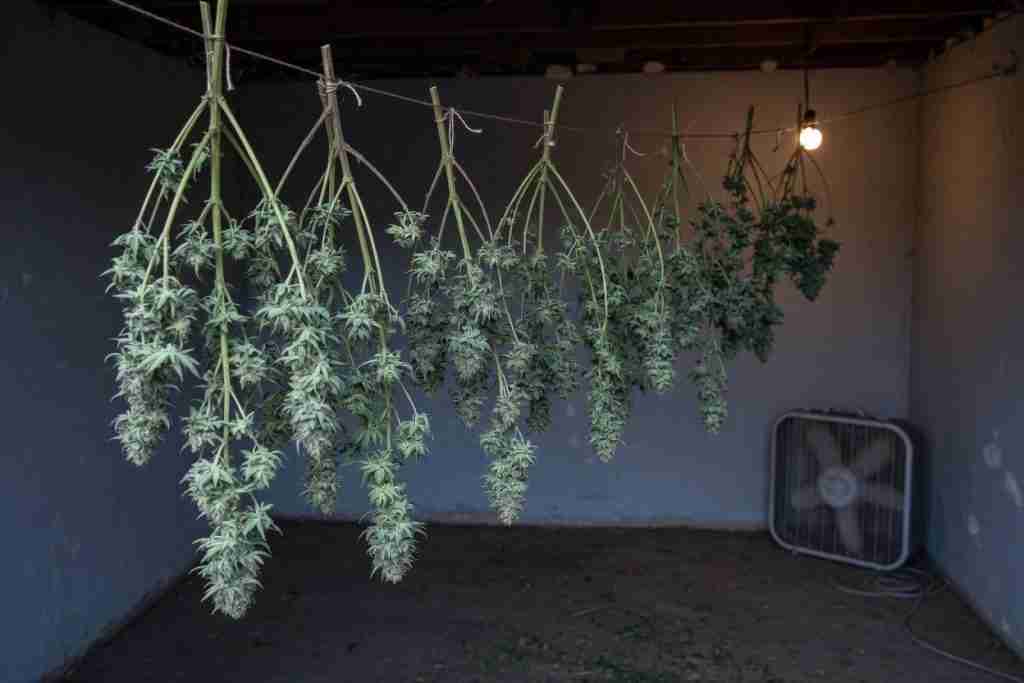
Cut whole branches and hang them in the dark, cool, with air moving in the room and not blasting the buds. You are done hanging when the small stems snap instead of bend. That often takes about a week, longer in a damp room, shorter if you hang the plants over a heat vent and ruin them. Then jars, filled loosely, opened a few minutes a day for the first week. Wet weed back in a sealed jar smells like grass and can mold. Hay smell is a dry that went too fast and too warm. Neither one was the seed.
Pests show up when the leaves go dusty

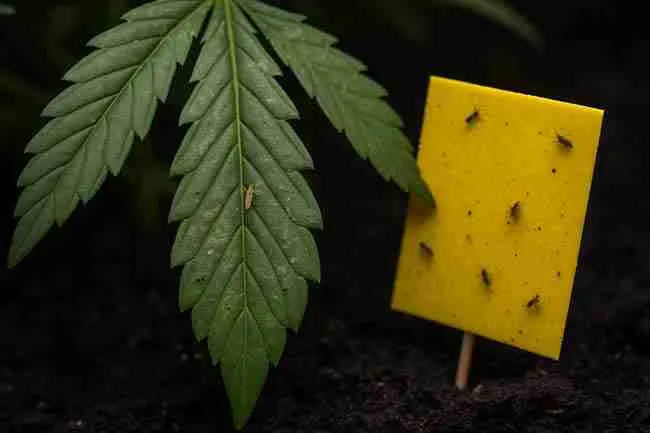
Silvery speckles and tiny dark dots on a leaf are often thrips. The photo is that damage, not a healthy “mature” leaf. Catch it while it is a few leaves, not after the canopy looks sandblasted. New plants, clones, and a houseplant you carried past the tent are the usual way they arrive. The thrips guide is the close-up version. Keep the tent floor clear of dead leaves. A dirty room is not a style. It is habitat.
Bud rot starts inside the cola

Brown, mushy flower inside a cola, with the outside still green, is bud rot. The leaf yellowing around it comes second. Cut the spoiled flower out with a margin of healthy tissue, and do not compost it beside the tent. Lower the humidity. Stop wetting flowers. Spread the plants. A crowded 4×4 in a humid August is the common Canadian version of this loss. The bud rot guide goes further. Misting buds to “raise humidity” in late flower is how the problem starts, not how it ends.
What to buy first
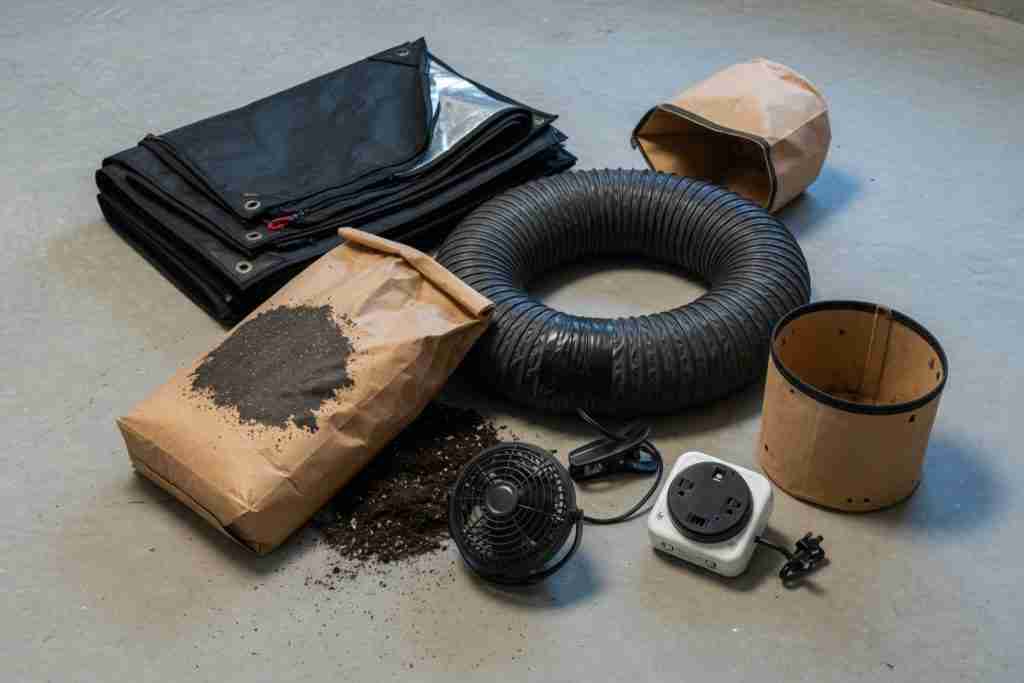
Buy in this order, and stop when the tent can run for a week with no plants in it. If the timer, the fan, and the temperature are not boringly steady, a seed will not fix that.
- A tent you can zip dark, tall enough for the pot, the stretch, and the light.
- A dimmable LED sized to the floor, in real wall watts.
- Exhaust, carbon filter, short duct, and one clip fan.
- A timer on the light.
- A thermometer-hygrometer at canopy height.
- Fabric pots and a medium you understand. A pH pen if you are in coco, and honestly if you are in soil too.
- Seeds after the tent exists, not a month before you have a place to put them.
Skip added CO2, a second tent, and a nutrient line with sixteen bottles. A simple veg feed and a simple flower feed, used at half strength until the plant asks for more, will finish the run. Dehumidifier next, if late flower will not stay under about 55% humidity. Humidifier first, if winter seedlings are crisping in a dry house.
Set the tent, the light, and the dark period before you argue about strain names. Then pop the pack that fits four plants, or the certificate you actually hold. Questions about orders, ages, and what a pack contains are on the seed FAQ. The shelf is the store.