How to Identify Early Damage to Cannabis Leaves


Early Damage to Cannabis Leaves is the first small mark you can still name before the plant looks wrecked. You walk in with a mug, the room smells like damp soil, and one fan is off while the rest still look fine. That single leaf is the whole lesson. Color, spots, and shape only help after you say where the mark sits. A bottle poured in a panic writes a second problem over the first one, and then you can’t tell them apart.
Early Damage to Marijuana Leaves is that same quiet start, and Early Damage to Weed Leaves is the curl or the speckle you almost walk past. Call it whatever you call it at the kitchen table. The plant doesn’t care about the nickname. It cares which leaf went first, how fast the mark moved, and whether the next new leaf copies it. If you only remember a color from a photo on your phone, you’ll treat three different problems as one.
A tent in Newfoundland and Labrador can stay cool and damp, so a lower leaf stays wet and a spot has time to sit. A room in Colorado can run dry and bright, so the leaf nearest the lamp cooks while the bottom still looks ordinary. You still read the location first. In Canada the home rule is four plants per household, and a seedling counts as one of them. Quebec prohibits recreational home growing. Manitoba has allowed only indoor plants since 1 May 2025. This page doesn’t invent a plant count for any other place.
This page owns the early read. The nutrient deficiency page owns the feeding fix. The pH page owns the drink the roots can use. The watering page owns the lift test. If the plant is already failing from the tip or from the soil line, use the top-down page or the bottom-up page. Do not stuff those jobs into one afternoon.
Early Damage to Cannabis Leaves starts on one leaf

Start with the plant, not the internet. Stand at the pot and look from the soil upward. A whole plant that hangs like wet laundry is a different story from one pale pair at the tip. Even droop, on every leaf at once, usually means water. One mark, on one age of leaf, usually means food, light, or a pest that has only begun. Well, that split saves you from pouring food onto a plant that is already drowning.
Touch the pot before you name the leaf. A heavy pot that still shines on top is wet. A light pot, with soil pulling from the wall of the fabric, is dry. You don’t need a gadget for that. Lift it. If you can’t tell, water is the first suspect and the watering page is the next stop. Food comes after you know the roots can breathe. A leaf problem that began in a swamp will not clear because you added a bottle.
Then ask how old the marked leaf is. A new leaf at the tip is still building. A wide middle fan has been working. A big fan on the pot was the first one the plant made. The seedling page owns the first sets. The vegetative page owns the stretch. The flowering page owns the late fade, when lower fans give up on purpose. If you treat that fade as an emergency, you’ll feed a plant that is supposed to slow down.
Say the top pair goes lemon and every older fan stays deep green. That is a top story. Say the bottom fan goes pale and the tip stays rich. That is a bottom story. Say only the leaves kissing the lamp go white, and the shaded leaves stay green. That is a light story, even if the color looks like a food story in a photo. Location beats the color you remember from last time.
New leaves and old leaves tell different stories

The plant can move some minerals. It can’t move all of them. When nitrogen, magnesium, potassium, or phosphorus runs short, the plant pulls those minerals out of older leaves and sends them to the new tip. The old leaf shows the hole. The new leaf still looks fed. That is why a mobile shortage shows up low, on leaves that have been around. People call this the plant robbing the bottom to pay the top. The picture is right enough to use.
Iron, calcium, and sulfur don’t travel back out once the plant has parked them. A shortage shows on leaves being built right now. Old fans can look perfect while the new tip looks pale, spotted, or twisted. If you treat a new-leaf problem like a yellow bottom, you’ll miss. However, one photo is not a verdict. A second sign should agree before you change the bottle. A pale tip plus green veins is a stronger iron hint than a pale tip alone. A yellow bottom plus yellow veins is a stronger nitrogen hint than a yellow bottom alone.
Utah State University Extension keeps a plain hemp chart of where those marks tend to sit. It is a field note, not a shopping list, and it is not a spray recipe. Read it as a map, then watch your own next leaf: Utah State University Extension nutrient notes. Don’t copy a dose off a chart onto a plant you have not watched. Your second sign matters more than a stranger’s photo.
A sugar leaf is not the fan you judge
A sugar leaf is the small leaf stuck in the flower. It can yellow or thin while the bud finishes, and that can be ordinary. A fan is the big working leaf. Judge the fan. A diagnosis taken off one sugar leaf chases a fade the flowering page already expected.
Oh, and a purple stem by itself is a weak clue. Some plants throw purple stems when the nights run cool, or simply because the parents did. A dark dull fan plus slow growth plus a cold pot is a stronger phosphorus hint than a pretty stem on an otherwise green plant. Do not let a color you like in a photo talk you into a bottle.
Color is a map if you read where it sits

Color is useful after location. A wash of yellow over a whole older leaf, veins included, climbing from the floor, is the classic nitrogen look. The plant is spending old leaves to keep the tip green. In late flower that spend is part of finishing. Early in flower, or in the middle of veg, the same look means the plant is short, or the roots cannot take what you already gave. Check the drink on the pH page before you triple the feed. A plant that cannot use the food will look hungry with a full pot.
Yellow between green veins, starting on older fans, is the magnesium look. The ribs stay green and the tissue between them goes gold. People mix this up with nitrogen all the time. Nitrogen takes the whole leaf, veins and all. Magnesium leaves the veins behind like green roads on a yellow map. If you see that map low on the plant, you’re not looking at iron. Iron paints the same kind of map on the new tip, not on the old floor. Same colors, opposite end of the plant. That’s the trick that keeps you from swapping the bottles.
Brown spots on twisted new growth get called calcium so often that the word has gotten sloppy. Calcium trouble does love new leaves, odd spots, and a hook at the tip. It’s also the name people reach for when they are scared. Are the old leaves clean, and did the spots show on leaves that opened this week? If the speckles are on a mature green fan and you can find a fine web or a moving dot, you are in a pest story. The next section is the one you want.
Tips that crisp on leaves of every age are the strong-feed look. The very end goes tan, then brown, and it doesn’t care if the leaf is old or new. Edges that burn on older leaves, while the center stays greener, lean toward potassium. A dark, dull, slow leaf, with the bottom affected first, leans toward phosphorus, especially if the pot has been cold. None of those reads is a license to mix three products tonight. The nutrient page walks you through the bottle after the leaf has told you which family you are in.
Light has a color too, and it cheats. Bleach that sits only on the leaves closest to the lamp, with the lower plant still green, is the lamp. Heat joins it when those same leaves fold up. If the entire top is collapsing and the damage is not limited to the brightest leaves, stop guessing and use the top-down page. If the plant is browning from the soil upward and the top is the last green thing, use the bottom-up page. This page stops at the early mark. Those pages own a plant that is already on the way down.
Spots are not the same as a fade

A fade is a wash. The leaf changes color across a wide area, and the change has a soft edge. A spot is a dot with a border. You can point at it. That sounds fussy until you have called a mite problem a magnesium problem for a week. Magnesium gold spreads between veins. Mite stipple is a crowd of tiny pale dots on a leaf that is still mostly green. The dots don’t follow the veins like a painted map. They look poked.
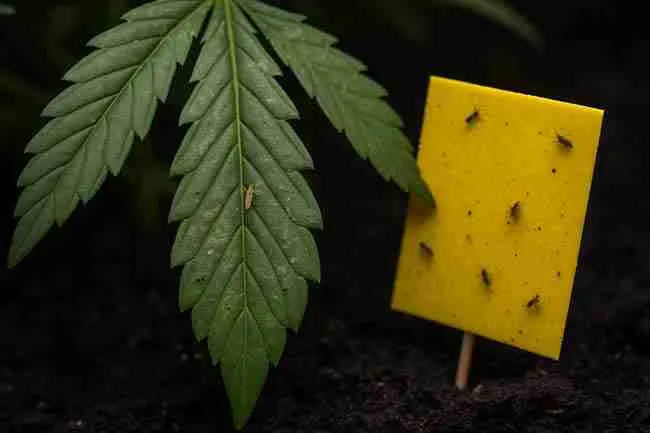
Look under the leaf, not only at the pretty top. Pests hide on the underside, along the rib. A little silk between fingers of the leaf is a spider-mite clue, and the spider mite page owns what you do next. Silver streaks and black pin specks lean toward thrips, and the thrips page owns that trail. This page only teaches you to notice the trail before you reach for plant food. Food doesn’t remove a bug. It can make a soft, juicy leaf even easier to eat.
A round tan spot with a darker ring, sitting on a lower leaf that never quite dries, is a different mark again. That is a leaf-spot look, common where air is still and leaves rest on each other. White dust you can wipe with a finger is not that ring. White dust is the powdery mildew page. Brown mush inside a flower, with a leaf that was only the warning, is the bud rot page. Do not wait on a notebook line if the brown is in the bud. Name it the day you see it. A leaf spot and a rotten flower are not the same emergency, and neither one is a magnesium fade.
Bugs leave a trail you can see
Food problems tend to be even. The same age of leaf, on both sides of the plant, changes in the same way. Bug problems tend to be messy. One branch is speckled. The branch across the tent is clean. The marks cluster near a door, a clone you brought in, or the leaf that touches the wall. Hey, that mess is good news. It tells you to stop arguing about bottles.
Tap a suspect leaf over a pale sheet of paper. Movers on the paper are a pest, even if you can’t name the species yet. Webbing is a pest. A trail of pale scratches with black dots is a pest. You don’t sit on those for a week while you “see if it spreads.” It will. The one-change wait later in this article is for color and shape when you can’t see a creature. If you can see the creature, or the silk, you leave this page and you open the mite page or the thrips page today.
Shape changes while the leaf is still green

A leaf can be the wrong shape and still be green. Edges that fold up like a taco, especially nearest the lamp, are the heat look. A gentle lift in the afternoon, with the leaf lying back down overnight, can be an ordinary reach toward the light. A hard roll that stays, with dry pale edges, is the lamp, the room, or both. Raise the lamp or ease the heat, and don’t also change the feed that same morning.
Droop is a shape too. If every leaf hangs, new and old, you’re in water, not in a mineral chart. A heavy pot plus a hang means too much water. A light pot plus the same hang means thirst. Both belong to the watering page, because the lift and the saucer are that job. Refuse to call a hang a deficiency. Food poured onto a plant that is sitting wet makes the hang worse, and the yellow that follows is not proof the plant was hungry. It needed air at the root.
Twist is the third shape, and it loves new growth. A new leaf that opens crinkled, with spots, belongs in the calcium conversation you already had, after you have ruled out a pest. A new leaf that opens thin and pale, with green veins and a normal outline, belongs in the iron conversation. Shape plus place plus color. You need all three. One of them, alone, is how people buy the wrong bottle.
Claw, curl, and a canoe are three different bends

Claw means the tips bend down. The leaf often looks dark and shiny, almost plastic, and the plant can look too green rather than hungry. That shows up when nitrogen is heavy, or when the roots stay wet and the plant keeps eating anyway. Dark and clawed is not a plant that is thriving. Ease the feed or let the pot dry. Don’t do both, plus a new lamp, on the same evening. You won’t know which move mattered.
Curl upward is the taco you already met. It points at heat and light. A canoe is the third bend: the edges roll in along the length so the leaf looks like a little boat. The canoe leaf page owns that bend. Do not mash claw, taco, and canoe into one word called curl. Down, up, and rolled lengthwise point three different ways.
Change one thing, then wait

The notebook is the tool, not the bottle. Before you touch the lamp, the feed, or the watering can, you write five lines. Then you change one thing. Then you leave the plant alone long enough for a new leaf to open. The leaf that is already marked will usually stay marked. Brown tissue doesn’t paint itself green. If you stare at the scar, you’ll think nothing worked, and you’ll change three more things. Watch the leaf that opens after the change. That leaf is the grade.
However, waiting is not the right move for every mark. If you tapped a leaf and something moved, you don’t wait. If you found silk, you don’t wait. If a flower is browning from the inside, you don’t wait. Those are the exceptions, and they are the ones that cost people a crop when they treat every problem like a slow mineral story. Color and shape, with no creature and no rot in the bud, can wait for one new leaf. A bug or a rotten flower cannot.
Pick the single change that matches the note. Move the lamp, or let the pot dry, or ease the feed. Do not do the other two “just in case.” Just in case is how a small mark becomes a salted pot. The sibling pages own the how. This page only keeps you from doing all of them before a new leaf can answer.
What you write down before you touch anything
These are the specifications of a note worth having. Five lines, in ordinary words, taken while you are still at the pot. If you can’t fill a line, write “not sure” instead of inventing a tidy answer.
- Which leaf: the newest tip, a middle fan, a bottom fan, or a small leaf in the flower.
- Color: the whole leaf, only between the veins, only the edge, only the tip, or a spot with a border.
- Shape: flat, folded up, clawed down, rolled like a boat, or twisted as it opens.
- Speed: overnight, a few days, or only on the side that faces the lamp or a wet wall.
- Match: the leaf on the other side of the plant looks the same, or it does not.
Add the pot in one extra phrase if you want, heavy or light, and whether the room felt hot at the leaves. That is enough. A novel will not diagnose the plant better than those lines. What the lines do is stop you from remembering a yellow bottom as a yellow top after you have slept on it.
Pros and cons of changing one thing
Changing one thing feels slow. It is still the way you learn the plant instead of collecting a cupboard of half-used bottles.
- Pro: you can tell what helped, because only one thing moved.
- Pro: you don’t stack a salt problem on top of a water problem.
- Pro: the next new leaf is a clean test, instead of a scar you keep reopening.
- Con: a fast pest keeps eating if you misread silk as a mineral and you wait.
- Con: the old leaf stays ugly, so the wait feels like nothing happened.
- Con: if two things are truly wrong, one change fixes only half, and you have to wait again.
The cons are real. They are also smaller than the mess of changing the lamp, the feed, the water, and the pot on the same night. You can survive a second wait. You can’t unscramble four changes. If the exception applies, a bug or rot in the flower, you skip the wait on purpose. That’s not cheating the method. That’s using the method on the problem it was built for.
A dead leaf does not turn green again

Once a patch is brown and crisp, that patch is done. The plant will not send green back into it. You can feed perfectly for a month and that fan will still look like toast. People take the toast as proof that the fix failed. It is proof that you are grading the wrong leaf. Grade the leaf that opens after you changed the one thing. If the new leaf is flat, the right color, and free of fresh spots, you caught the mark in time. If the new leaf copies the old mark, your read was wrong, or the one change was not enough, and you write a new note before you touch anything else.
A fully dead fan lying on a flower can stay wet and invite a different problem. Pluck that one dead fan. Don’t strip every leaf that is a little pale. A pale leaf may still be working. A brown leaf is not. A few gold fans under fat, healthy flowers are a finish, and the flowering page owns that fade. Gold fans under a stalling plant are a warning, and the bottom-up page owns that slide. Same color. Different plant.
Tomorrow you read the five lines, then you look at the leaf that was not there yesterday. Leave the scar alone. A clean new leaf means you keep the room as it is. A new leaf that copies the old mark means you write a fresh note before the next single change. You identify the mark while it is still one leaf, and you let the next leaf tell you if you were right.