Cannabis Seedling Stage of Growth


Originally published 25 November 2022. Updated 1 October 2026.
This is the first article in our growing-cannabis series. Germination is the seed waking up. The cannabis seedling stage of growth starts when that sprout breaks the surface. It ends when you have three or four sets of true, serrated leaves and the plant is putting on size you can see from one day to the next. Most marijuana and weed seedlings spend two to three weeks here. Some finish in ten to fourteen days when the room is honest. Some stall past three weeks because the cup stays wet or a bottle came out too soon.
If the seed has not cracked yet, start on cannabis seed germination. The hour-by-hour diary lives on cannabis seedlings day by day. This page is the stage itself: light, cups, water, food, damping-off, and the moment you stop treating it like a baby. Named feminized packs in the cannabis seeds store run about four dollars CAD a seed. Mixed feminized is closer to a dollar. That money is wasted if you drown the first week.
Overwatering and early feeding kill more seedlings than a dark room. A dark room makes them stretch. A soaked cup with a full-strength bottle makes them die. The setup list, if you still need one, is 15 steps to give cannabis plants the best start possible. After the hatch, you are on this page.

That photo is a seedling just breaking a rockwool cube. The shell may still be on. Leave it. The plant will shrug it off. Pulling it often rips the cotyledons, and those two round leaves are the only pantry the seedling has on day one.
What the Cannabis Seedling Stage Actually Is
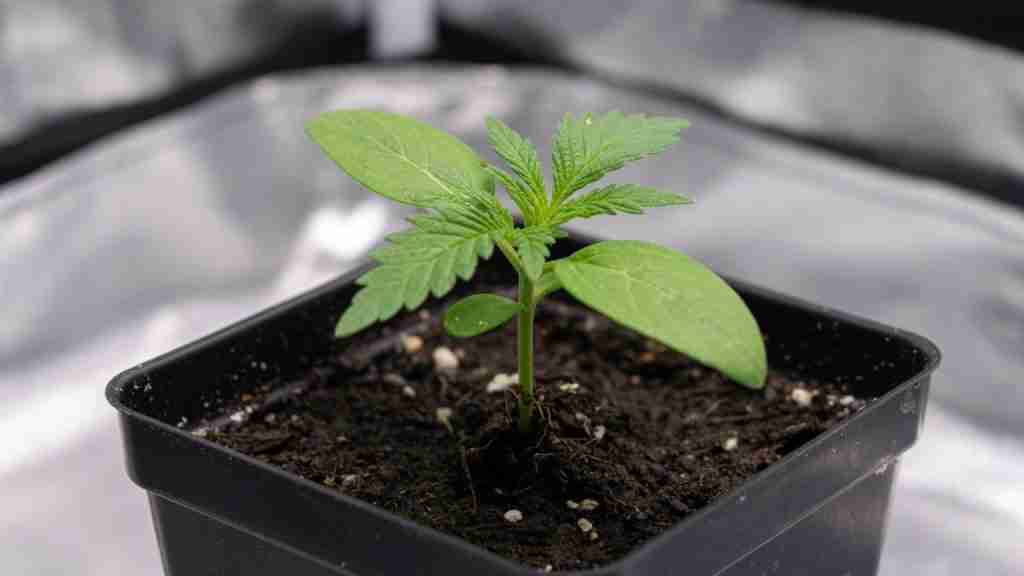
The cannabis seedling stage is the stretch of time after the sprout is up, while the plant is still living off the seed plus a tiny root system. Cotyledons open. A pair of single-finger true leaves follows. Then a set of three. Then a set of five. When you have three or four of those true sets, internodes stay short, and the plant is growing faster than it was on day four, you are leaving the seedling stage and walking into veg. Photoperiods then wait for you to flip. Autos do not wait. Flower is later, on growing cannabis flowering stage of growth.
A seedling is a different job from a small veg plant. It has almost no buffer. The cup holds a handful of mix. Roots are a thread. You water in tablespoons. You keep humidity up because those tiny leaves leak water faster than the roots can replace it. You keep the light close enough that the stem stays stocky, and far enough that the leaves do not cook. Ranked pages in 2026 still argue about the start and the end of this stage. Some old copy, including our first version of this article, treated the first true leaves as the finish line. That is a milestone. Veg starts when the plant is visibly working every day, with several true sets on the stem.
The veg write-up is cannabis vegetative stage. Stay here until the plant earns that page.
Cotyledons vs True Leaves

Cotyledons are the round, smooth seed leaves. They came packed in the seed. They are not marijuana fan leaves. They photosynthesize a little, and they spend the food the seed stored. They often look pale at first, then green. Later they yellow and drop once true leaves take over. That yellowing of old cotyledons is normal. A whole seedling going lime, spotting, or burning at the tips is a different story, and that one lives on cannabis seedling yellowing.
True leaves are serrated. The first pair is often one blade each, like a skinny spear. The next set is usually three fingers. Then five. Some plants skip a count. Wait for the next node before you decide the plant is broken. A healthy seedling holds those leaves out, not folded, and the stem under them is thick enough that a small fan does not knock it over.
If a seedling never makes real true leaves, or the growing tip is missing, you are looking at a damaged taproot or a dud. It may sit for a week and then move. It may never catch the others. You can wait, or you can pull it and start another seed. A four-plant household does not have room for a plant that will still be two inches at week five.
How Long the Seedling Stage Lasts
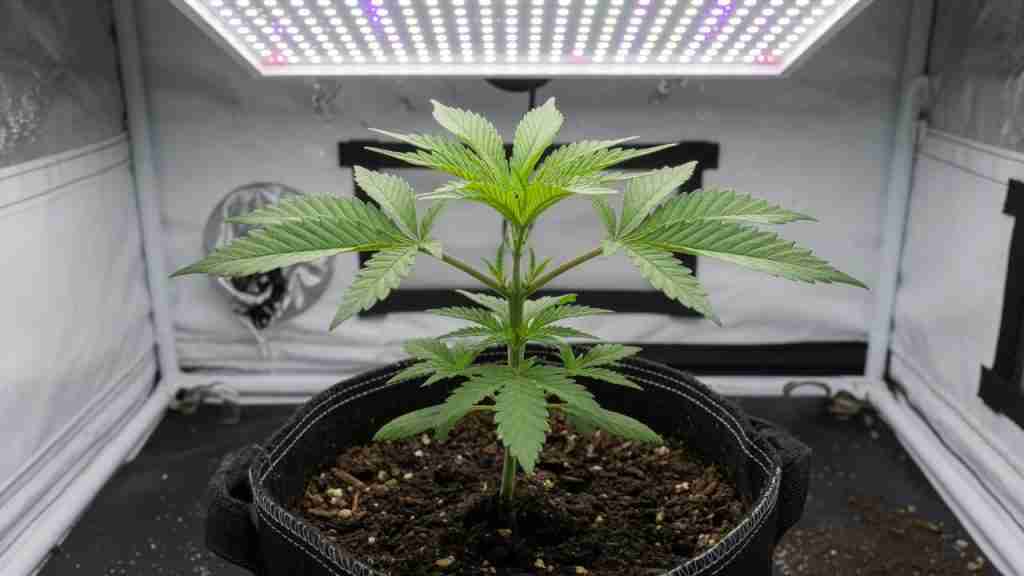
Two to three weeks is the honest clock for most indoor weed seedlings, counted from the day the sprout breaks the surface. That is about ten to twenty-one days. Warm rooms with a close, gentle light and a cup that actually dries can be done in ten to fourteen. Cool rooms, a wet plug, or a light hanging in the rafters push you past three weeks. The calendar is a map. The plant is the clock.
Week one looks slow on top. That is roots. Cotyledons open, the stem thickens a little, and the first true pair shows. If you water every morning because you are nervous, you steal the oxygen those roots need. Week two is the first real leaves, usually a three-finger set, and the plant starts to look like cannabis. Week three is five-finger leaves, a second or third true set, and a stem that can take a gentle breeze. When new growth is obvious every day, you are leaving the seedling stage.
The day-by-day page still has the diary if you want to match photos to a date. This article will not reprint Day 1 through Day 10. Repeating that sibling here just makes two thin pages. Use that diary for pictures. Use this page for the decisions: how wet, how bright, how far, when to feed, when to move the cup.
Breaking the medium itself is a germination leftover. After a soak or a paper towel, most viable seeds push the cotyledons through in three to five days. Planting depth still matters: too deep and the sprout spends its energy in the dark. If nothing shows after a week in a warm, moist cup, that seed likely died in the mix.
Light, Temperature, and Humidity
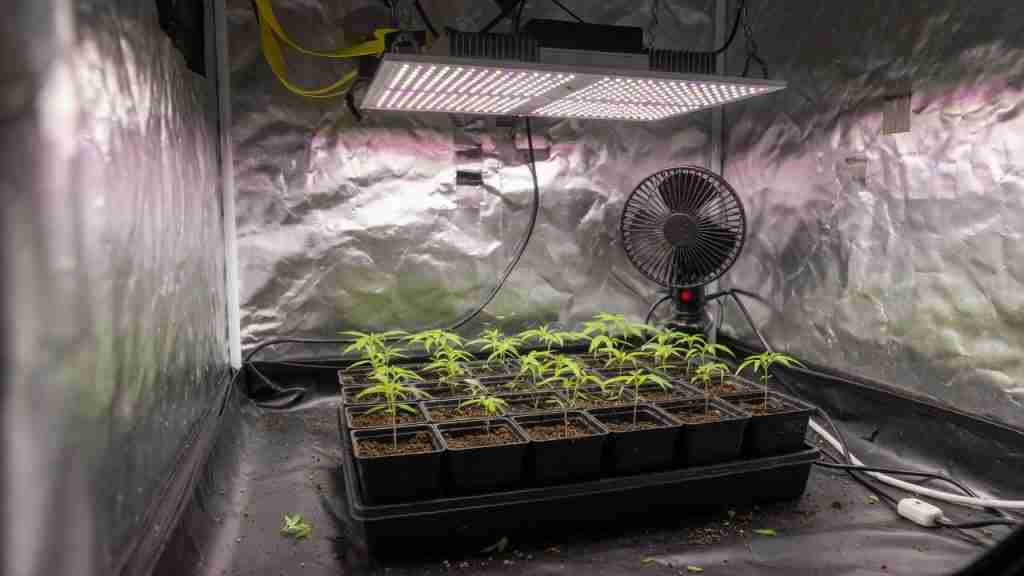
As soon as you see cotyledons, they need light. The seed opened in the dark. The seedling lives in the light. Indoor photoperiods run 18 hours on and 6 off through this stage. Autos can live on 18/6 or 20/4; pick one and keep it. A windowsill that goes dim at 4 p.m. in November will stretch a marijuana seedling overnight.
Aim 70 to 78 F at canopy, about 21 to 26 C. Night can drop a few degrees. A 10 F crash every lights-off slows the plant and invites damping-off. Humidity belongs at 60 to 70 percent while the leaves are still small. Older copy on this URL said 45 to 50 percent, which is a veg number. Tiny leaves leak water. Dry air plus a small root mass is a wilt even when the cup is wet. A humidity dome or a tray lid helps the first few days. Crack it on day two or three. Pull it once true leaves are working, or you will cook a greenhouse for fungus.
Light intensity for week one is gentle. Think 200 to 400 PPFD at the leaf, not a flower map. A bar LED that is happy at 12 inches in flower often wants 18 to 24 inches over a seedling, or a dimmer at 25 to 40 percent. If the stem is racing and the internodes look like a ladder, the light is too weak or too far. If the leaves taco, bleach, or feel crispy at the edges, it is too close or too hot. Climate for the whole indoor run is the indoor cannabis growers guide.
A clip fan on low, aimed past the cups, is enough. You want the leaves to flutter, not slap. Still, wet air at the soil line is how damping-off starts. A sealed closet with a dome and no fan is a Petri dish.
Stretching, Bending, and Light Distance

Those soil-tray seedlings are reaching. The internodes are long, the stems are thin, and they will flop if the light stays that far away. Lower the bar. Add a second cheap LED if you only have a corner lamp. A seedling that already bent can be stood up with a toothpick and a loose tie, or with a little extra mix mounded against the stem. Do that once. Keep burying a stretching plant and you will rot the stem. The dedicated fix is keep cannabis seedling from bending.
A stretchy seedling in a bright tent is often too warm at the canopy, or the mix is too wet and the plant is hunting air. Check the meter before you buy another light. A stretchy seedling on a windowsill is the window. Move it under a real lamp.
Water, Cups, and the Wet-Dry Cycle
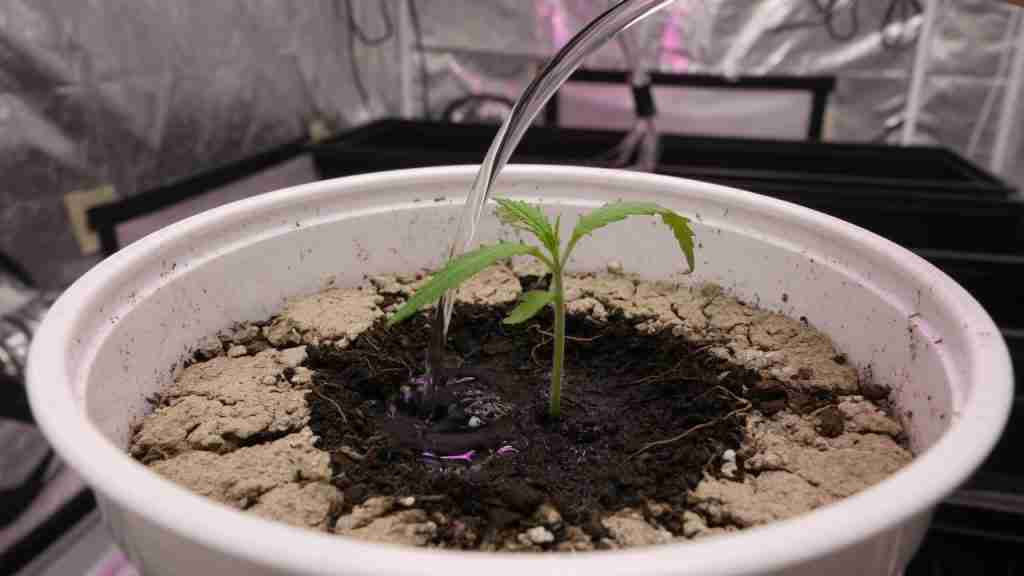
The cup is the trap. A five-gallon pot of wet soil around a one-inch seedling stays cold and anaerobic for a week. Roots sit in a swamp. Fungus gnats move in. The plant droops, you water again, and it dies. Start in a small cup, a starter cell, a rockwool cube, or a fabric pint. The mix should dry enough in two to three days that you actually need to water. If it is still heavy on day four, the container is too big or you poured too much.
Water a ring around the stem, not a flood from a can. Tablespoons. The outer mix can stay a little drier than the root ball. Lift the cup. Light means water. Heavy means wait. A droop in wet mix is overwatering. A droop in a light, dry cup is thirst. Those two look similar at a glance and they get opposite treatments. The longer watering write-up is water cannabis plants. Pot choice for the rest of the run is growing cannabis in containers.
pH sits in the same bands you will use later: soil about 6.0 to 7.0, coco and rockwool about 5.5 to 6.5, with a sweet spot near 5.8 to 6.2 in the inert mixes. You do not need a chemistry lab in week one. You do need to stop pouring raw tap at 8.2 into a cube. The pH page is pH for growing cannabis.
Room-temperature water. Ice-cold well water shocks a seedling. Standing water in the tray under the cups is a second swamp. Empty it.
Medium: Soil, Coco, and Rockwool

Pick a sterile, airy start. Seedling mix, a light peat blend, rinsed coco, or a soaked and pH’d rockwool cube all work. Hot “cannabis soil” loaded with dry amendments burns a seedling. The seed already has food. A light mix that drains, then a bigger pot of the real soil later, is kinder than starting in a hot bag.
Soil starting mix is the beginner default. It holds a little pantry. You often get through the whole seedling stage on water. Coco is a sponge with almost no food. You will feed a dilute solution earlier, sometimes as soon as cotyledons are green, at a quarter of the bottle’s veg dose or less. Rockwool is sterile and holds air if you do not leave it sitting in a puddle. It has no pantry at all, and it comes in acidic. Soak it, pH it, then treat it like hydro. Bags for the veg pot are on the best soil for growing cannabis seeds.
Whatever you pick, keep it the same from cube to first transplant if you can. Jumping a rockwool seedling into a soaking peat cup and then into coco in ten days is three wet-dry clocks. The plant spends that time adapting instead of growing.
When Seedlings Need Food
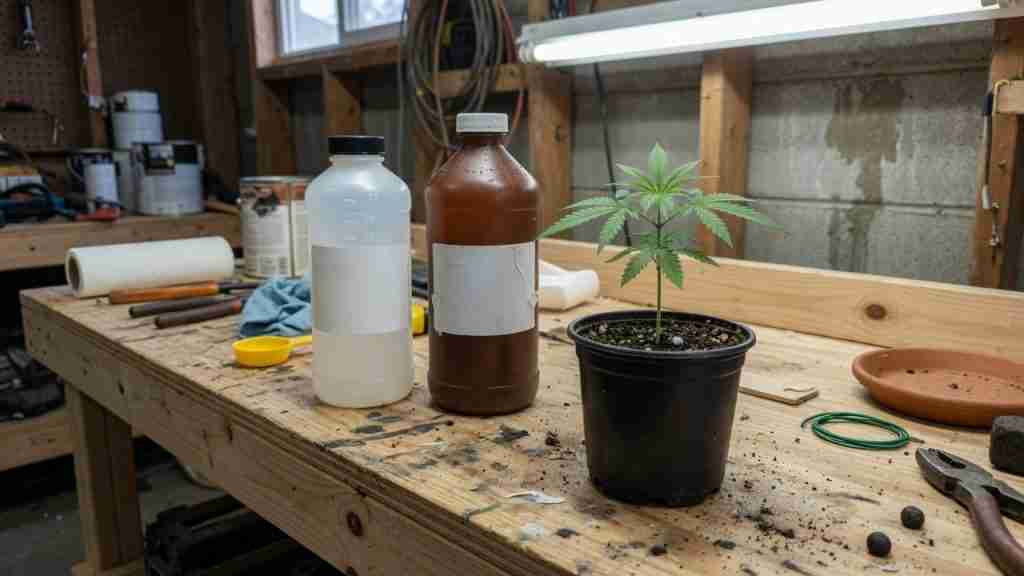
Leave the bottles on the shelf in week one. The seed fed the cotyledons. Extra nitrogen on a one-inch plant burns the tip and stalls the root. In soil, wait until you have three or four nodes, or you are into week three, then start at a quarter dose of a mild grow formula. In coco and rockwool the pantry is empty, so a very dilute feed after the cotyledons are green is fair. Still a quarter, often less. If the runoff is already dark and salty, you overdid it.
Kelp, B1, and bottled “seedling tonic” are optional. They are not a substitute for light, a dry-down, and the right temperature. We used to talk about Superthrive in this article as if it were a growth cheat. It is a bottle. It will not save a soaked cup. It will not replace a real lamp. If you use a tonic, use it weak, once, and then watch the plant instead of the label.
Pale new growth with a wet, cold cup is overwatering. Pale new growth in a light, dry, inert mix after two weeks can be hunger. Feed the second one. Dry the first one. Do not feed both just in case.
Airflow and Damping-Off

Damping-off is the pinch at the soil line. The stem looks water-soaked or thread-thin right where it meets the mix. The top falls over. By the time it is on its side, the plant is gone. Cool, still, wet media is the setup. A sealed dome on day six is the setup. Dirty trays and leftover mix from a failed round are the setup.
Prevention is the whole game. Fresh, sterile start. Cups that dry in two or three days. A fan that moves air across the surface. Dome cracked, then off. Water in the morning so the surface can dry under lights. Do not mist the stems for fun. Once a seedling has that pinch, pull it so it does not sit rotting next to the others. The longer fight, including what the fungus actually is, lives on damping off in cannabis seedlings. This page stops at the grower moves.
A seedling that flops with a thick, healthy stem and dry mix is a stretch problem. Stake it. A seedling that flops with a pinched, translucent stem in wet mix is damping-off. Do not stake that one. You will just hold a corpse upright.
Transplanting When the Roots Ask
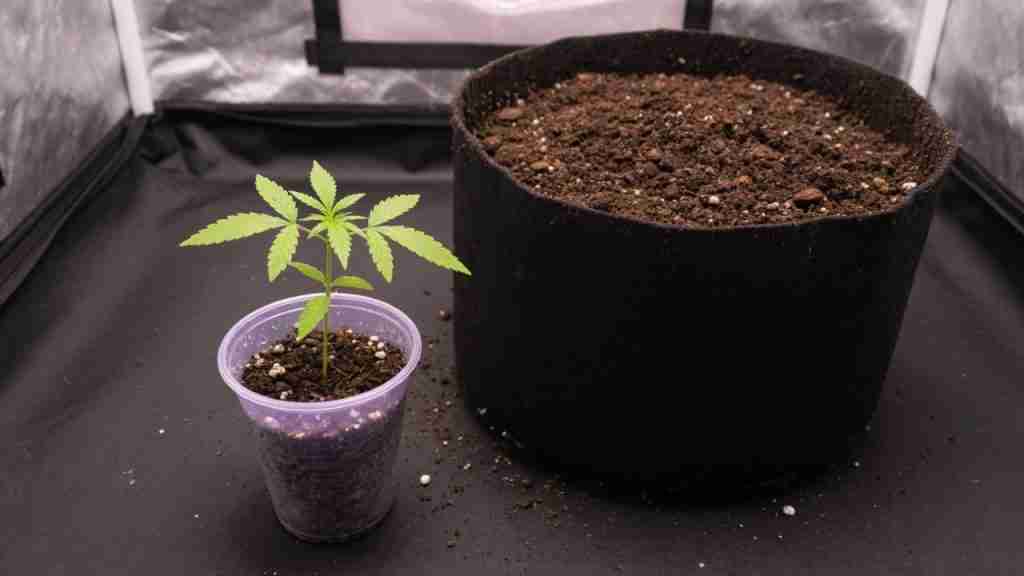
Move the plant when the cup dries in a day, when white roots show at the drain holes, or when the seedling is clearly outgrowing the cell. That is often the end of week two or the start of week three. It is not a calendar appointment. A plant that is still tiny in a wet cup does not need a bigger swamp. A plant that is drinking daily in a solo cup does.
Step up one size. Cup to a one- or three-gallon fabric pot is a normal indoor jump. Cup straight into a 20-litre bag of wet soil puts a teaspoon of roots in a bucket of water. Water the new pot around the old root ball, then let it find the edges. Keep the same mix family if you can. Pre-wet the new pot so you are not flooding a dry peat brick around a wet cube.
Handle the stem as little as possible. Scoop from underneath. If the cube tears, plant the tear. Do not tease rockwool roots out “to help them.” They do not need your help. After the move, give the plant a day of slightly milder light. Then put the lamp back. Transplant shock that lasts a week is usually a wet new pot, not the move itself.
Autos in the Seedling Stage
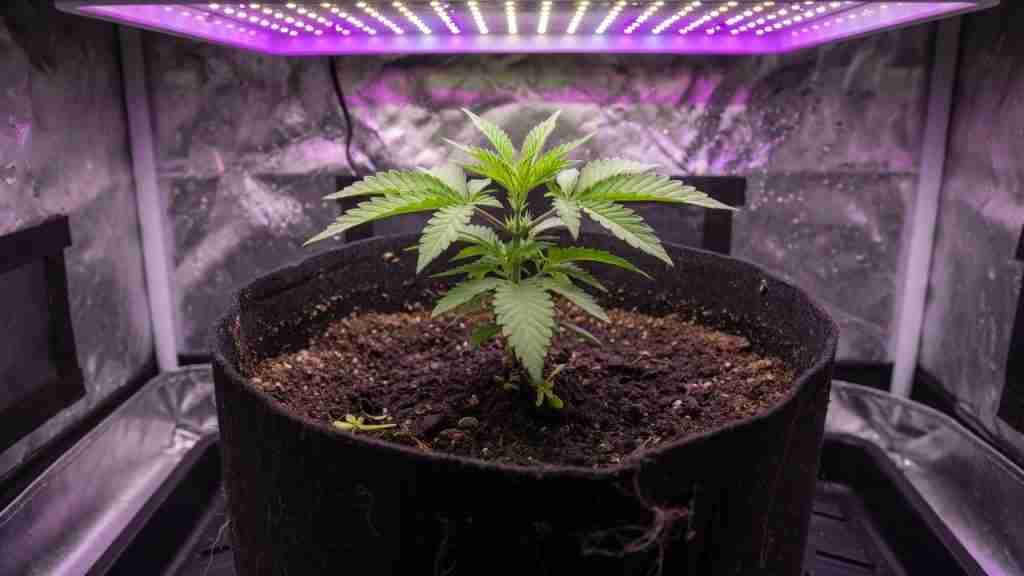
An autoflower uses the same seedling clock. Cotyledons, true leaves, two to three weeks. The fuse is shorter. That seedling stretch is a third of the plant’s life. A photoperiod can sit in a cup an extra week and still veg for a month. An auto that stalls in a soaked solo cup until day 21 is already thinking about flowers. You get a tiny weed plant and a tiny harvest.
Start autos in the pot they will finish in if you can water a small root mass in a larger volume, or move them once, early, while the roots are still a ball you can pop out clean. Do not top an auto in the seedling stage. Low-stress bending waits until the stem is actually strong. The grow-out is grow autoflowering cannabis plants.
Light stays on 18/6 or 20/4 the whole auto run. You do not “flip” an auto. The seedling still wants that 200 to 400 PPFD start. Ramping intensity as true leaves stack is fine. Blasting flower-level light on day three is how you bleach a plant that cannot yet drink.
What a Healthy Seedling Looks Like

Stocky. Green. Leaves held out. Internodes short enough that you do not see a lot of naked stem. Cotyledons still there in week one, maybe fading in week two. New growth a little lighter than old growth is normal. The stem is round and firm, not translucent. A gentle fan makes the plant shiver, not collapse.
Height in week two is often two to four inches. Some cultivars sit shorter. A six-inch thread with two leaves is stretch, even if it is “tall.” Colour should be a living green, not lime and not black-green. Black-green with clawed tips is usually feed or a hot mix. Lime with wet soil is usually roots drowning.
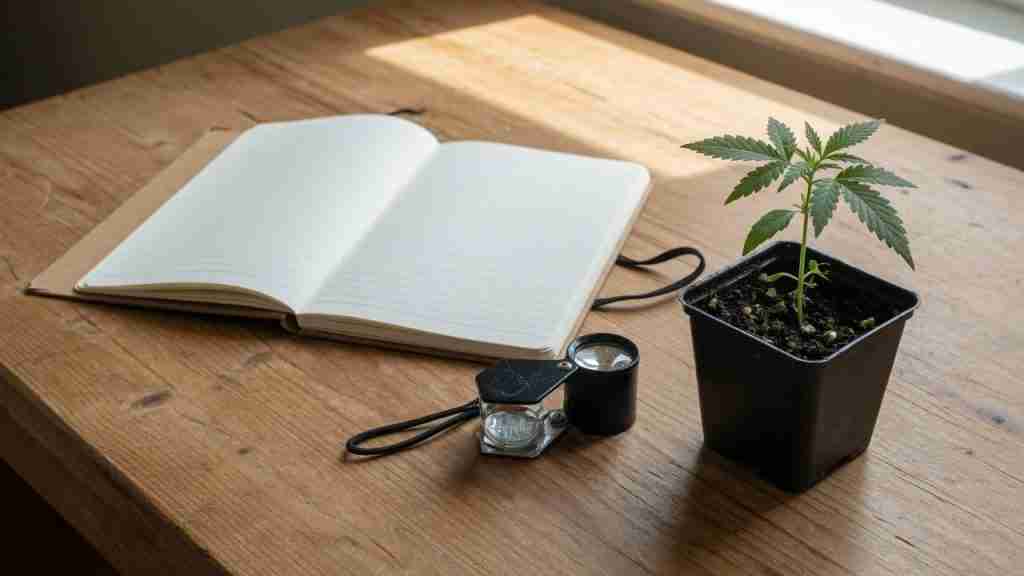
Slow top growth in the first five days is roots working. That is healthy. Slow top growth at day fourteen, with the same two cotyledons and no true leaves, is a problem. Check water, heat, and the growing tip with a loupe. If the tip is brown or gone, start another seed.
Problems That Kill Seedlings
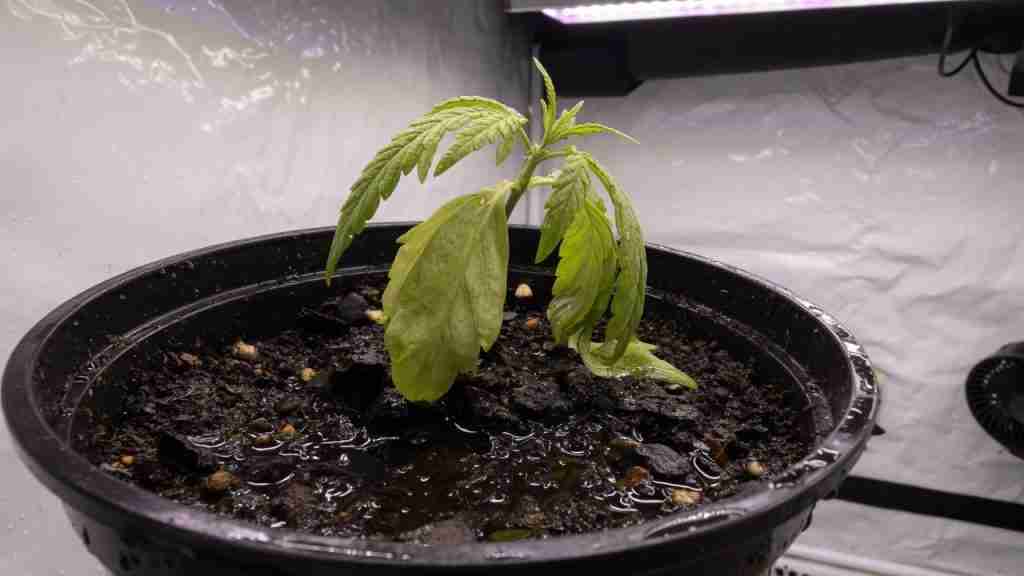
Overwatering is the main killer. The photo is the look: leaves hanging, mix dark and shiny, no air in the cup. Stop watering. Aim a fan at the surface. If the pot is huge, you may have to wait days. Next time, use a smaller cup.
Early bottles are the second killer. Burnt tips, crispy edges, a white crust on the mix. Flush with pH’d water until the runoff is milder, then wait. You cannot un-burn a leaf. You can stop making new burn.
Stretch is the third. It rarely kills on its own. It makes a weak stem that then damps off or snaps. Lower the light. The bending page covers the salvage.
Damping-off is fast. Pinch, fall, gone. Pull it. Dry the rest. Do not “treat” a pinched stem with more water.
Heat and cold sit under all of this. A seedling on a heat mat at 90 F cooks. A seedling on a basement floor at 60 F stalls and damps. Keep the cup in the same 70 to 78 F band as the leaves. A cold windowsill at night undoes a perfect day.
Stunted after germination, with missing cotyledons or a crushed tip, is wait-or-pull. Some of those plants catch up. Many do not. If you have extra seeds, start a replacement on day five instead of nursing a stump until week three. Yellowing that is not old cotyledons going away belongs on the yellowing article, not on a bigger bottle.
Questions Growers Still Ask
When do cannabis seedlings need light? The hour the cotyledons show. Before that, the seed is germinating. After that, darkness only makes a skinny stem.
How long does the cannabis seedling stage take? Two to three weeks from the sprout, until three or four sets of true leaves and visible daily growth. Then you are in veg, which is the next article in this series.
When do I feed? Soil: often week three, quarter dose, after several true sets. Coco and rockwool: a weak feed once cotyledons are green. Full veg bottles in week one are how you write a yellowing post.
What humidity do marijuana seedlings want? About 60 to 70 percent until the plant is drinking like a veg plant. Then you can walk it down. 45 percent is too dry for a one-inch weed seedling.
When do I transplant? When the cup is drying daily or roots show at the holes. Size up one step. A bigger pot is not a growth cheat if you cannot dry it.
Can I keep the dome on? For a few days. Crack it. Then take it off. A dome in week two is a humidity crutch that turns into damping-off.
Why is week one so slow? Roots. Watch the cup weight and the stem thickness, not Instagram height.
Once the plant is stacking true leaves every couple of days, you are done with the seedling stage. Veg is the next article in this series. Flower is later. The seed you started with still has to be a seed worth growing. That is the store. The plant in front of you still has to survive the cup. That is this page.