Growing Cannabis Outdoors: Timing, Mulch, and Finishing Before Frost

Growing cannabis outdoors is older than tents and timers. The plant ran wild for millions of years before anyone bought a carbon filter. Soil, a hole, a watering can, and the sun. Clouds still water for free. That does not mean you throw a seed in April and hope. Frost, streetlights, slugs, and September rain still wreck crops. This page is how you actually finish a plant outside.

Why Grow Cannabis Outdoors
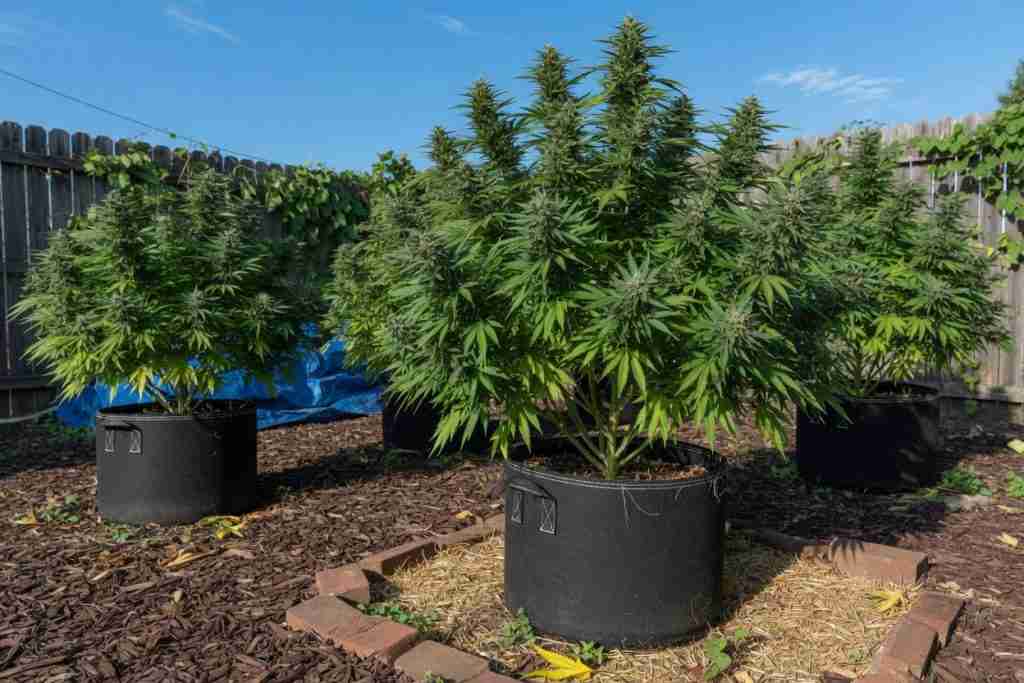
Old-school growers still say the best flower is grown in the sun. We believe that. Indoors you fake a season. Outdoors the plant gets a full spectrum it did not evolve under a blurple bar. Roots can run. The bill is dirt and water, not kilowatts. Compare the indoor job: indoor cannabis growers guide.
The trade is control. You do not pick the rain. You do not pick the first frost. You pick the seed, the spot, and whether you start indoors so slugs do not eat a two-inch plant in one night. Nature is generous. It is not careful.
Pick Seeds That Finish Before Your Frost
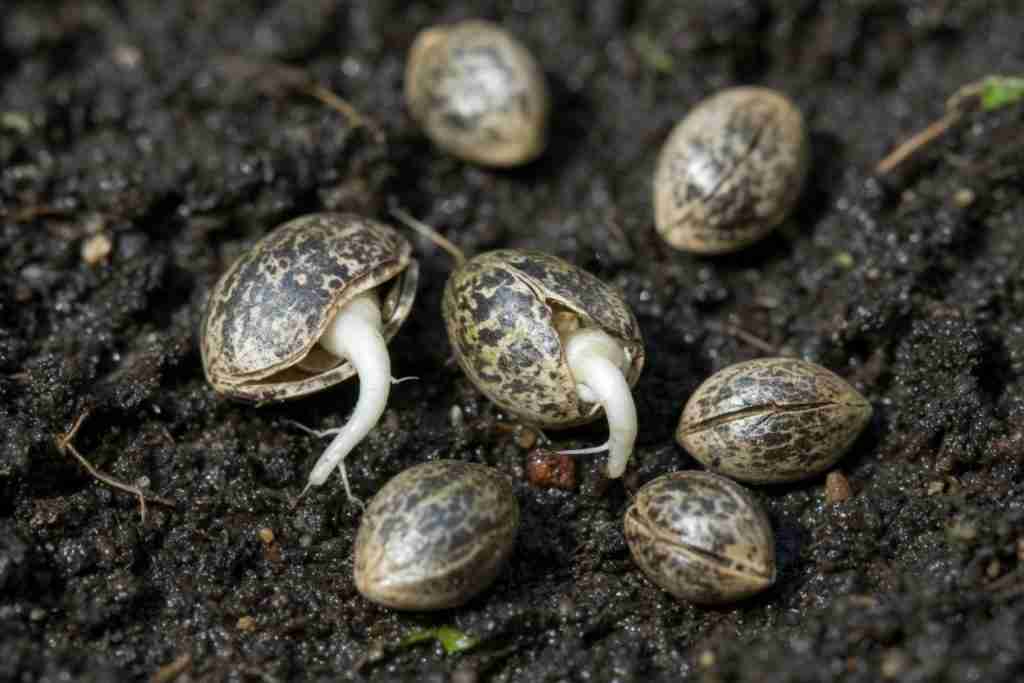
If your season dies in mid-October, do not buy a 12-week sativa that wants November. Frost will kill it with empty flowers. Match the seed to the yard: how to pick cannabis seeds and best cannabis seeds for outdoor growing.
Photoperiods veg all summer and flip when nights get long, usually late August into September in the north. They can get huge. They also finish in the wet. Autos flower on age, often 9–11 weeks from seed, so you can harvest before the worst fall rain. Short season, mountains, Atlantic Canada, Upper Midwest: autos or fast photos. Long dry fall: photoperiods that pack weight. How photos think: photoperiod cannabis seeds explained. Shop: cannabis seeds.
Buy feminized if you want flower, not a pollen problem. Regular seed is about half male. One male in your yard, or the neighbor’s, seeds every cola downwind. Pull males the week they show sacs if you ran regular. Breeding is a different job: when to choose regular cannabis seeds. What a live seed looks like: what good cannabis seeds look like. Autos come from ruderalis timing: ruderalis cannabis seeds.
We grow outdoor plants from seed, not clones, when they go in the ground. A seed makes a taproot that goes looking for water. A clone never grew that taproot. In a pot it matters less. The root hits plastic either way. Clones: how to clone cannabis.
Site, Sun, and Streetlights
You need a spot with real sun. Six to eight hours of direct light is the floor. Twelve is better. South-facing, not a north fence. Easy water. Not a swamp after rain. Zone and date math: planting cannabis outdoors in North America.
A plant against a white wall gets bounce. A plant under a maple gets a pretty photo and larf. Watch the spot at 9 a.m., noon, and 4 p.m. before you dig. Afternoon shade in a heat zone can be a gift. All-day shade is a different crop. Water access matters when a 50-gallon pot drinks in July. If you will not drag a hose, do not plant at the back of the lot.
June sun is not September sun. The tree that left a gap in June can shade the whole bed when the sun sits lower. Walk the spot in late summer if you can, or watch where the 3 p.m. shadow falls in August. Flower wants that light more than veg did. A south-facing wall still helps then. A maple does not.
Streetlights and porch floods do almost nothing in veg. They wreck flower. Photoperiods need a long, dark night to flip and stay in bloom. Eleven to thirteen hours of uninterrupted dark is the band we use. A sodium streetlamp on the cola all night is a light leak you cannot tape. Move the plant, hang a shade, or do not grow photos there.
Keep plants off the road even where it is legal. Thieves still exist. A camera pointed at the garden is boring and useful. Motion lights that face away from the plants, so they do not become the streetlight problem you just solved.
Soil, Holes, and What We Put in Them
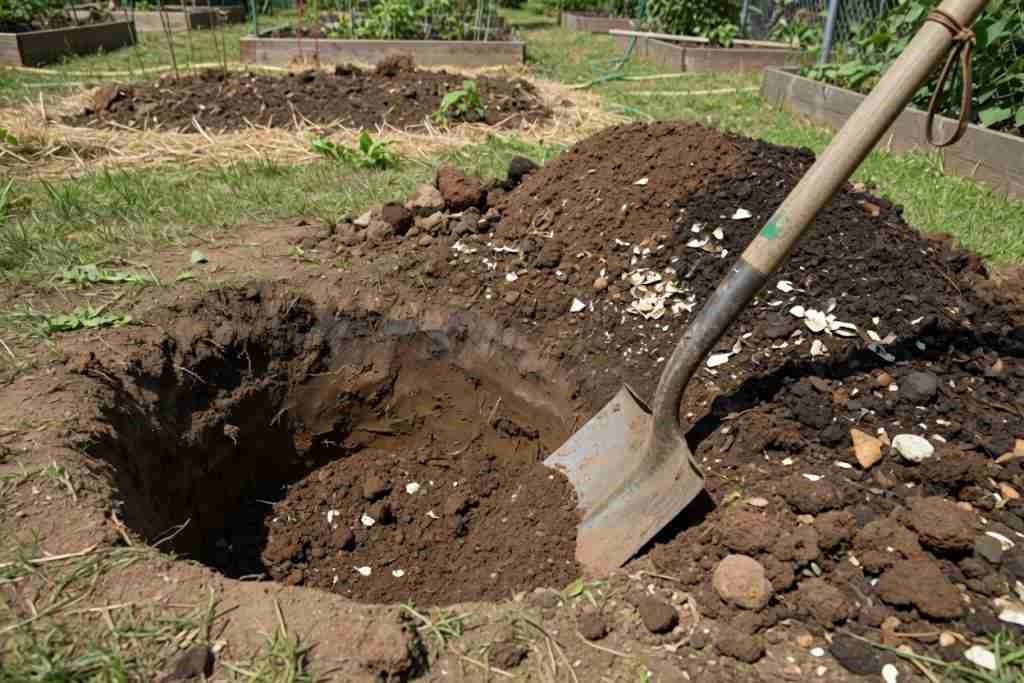
In-ground: dig a real hole and loosen the sides. Heavy clay holds water and kills roots. Mix native dirt with compost and something that drains. You are not filling a teacup. Outdoor plants get big.
Aim for soil around 6.0 to 7.0. A cheap county extension test beats guessing from a YouTube mix. Clay: compost and crushed rock so water leaves. Sand: compost so it holds a drink. Dig about two feet wide and two feet deep, and break the walls so roots do not hit a clay bowl. Space plants four to six feet. Leaves that knit into one wet tent in September are how bud rot starts.
What we like in the hole, mixed well, not dumped as a salty cake:
- Calcium: crushed eggshell, oyster, lobster, or snail shell.
- Horse, sheep, or cow manure mixed in. Run water through it. It can be salty.
- Chicken manure for a nitrogen kick at the start. Easy to burn. Go light.
- Bat guano. Slow food for the summer.
- Small crushed rock for air and a home for fungi and bacteria.
Organic programs outdoors are how we feed soil, not a DWC bucket. How to mix without wrecking the plant: organic marijuana fertilizer.
Pots Big Enough for a Summer Bush
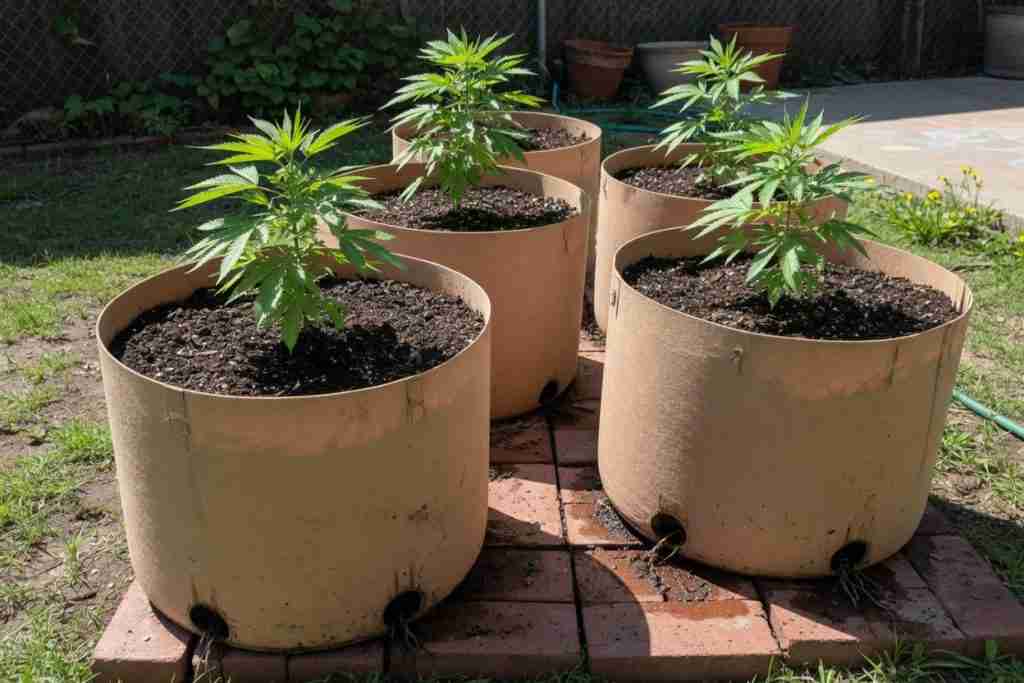
Outdoor marijuana in pots can become a shrub. 50-gallon fabric pots are not a joke. Drainage has to work. Standing water after rain is root rot. Elevate fabric pots so they are not sitting in a puddle. Black plastic in full sun cooks roots. Fabric is kinder. Prep the mix the same as a hole. Yield still follows light and genetics: increase cannabis yields.
A 5-gallon leftover from a tent is a daily watering chore in July. Fifteen gallon is a start. Thirty to fifty is a real outdoor pot. Raised beds sit between pots and in-ground: more soil than a bag, still drain, you can walk around them. Lift fabric onto bricks so a storm does not sit them in a puddle. If the pot is light when you bump it, water. If it is heavy and the leaves claw, wait.
Start Indoors, Then Harden Off
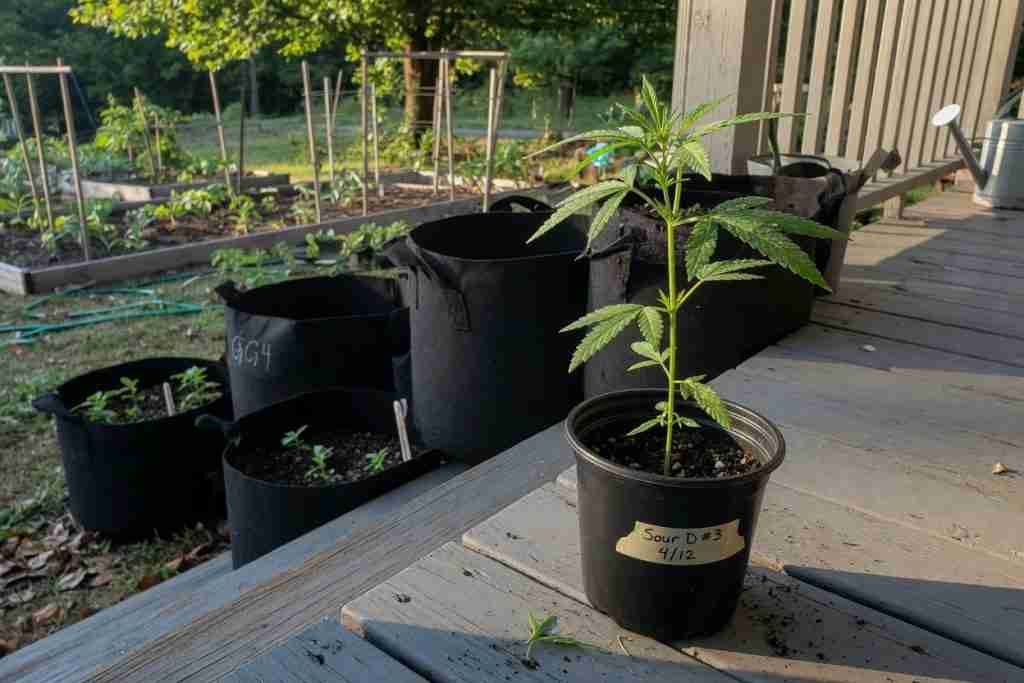
Start seeds inside before the season. You get a head start and you skip the night slugs chew a seedling to a stub. Slugs and snails love young plants. Direct sow works. We still start indoors in spring. Germination and first weeks: seedling stage and seedlings day by day.
A buddy of mine put six sprouts in the garden in early May because the afternoon felt like summer. Morning was 38 F. Slugs finished two. The rest sat purple and sulked for two weeks. The indoor cups he forgot on the porch and brought out after the long weekend caught up and passed them. Timing is not toughness. It is arithmetic with frost.
Do not take a tent plant into noon sun. That is a burn. Harden off: shade or porch for a few days, then morning sun, then longer, nights inside until lows stay above about 50 F (10 C). Transplant after the last frost, not on the average last frost if your yard still ices. Most of the northern US and Canada is late May into June. South is earlier. Count back 4–6 weeks for the indoor start. Transplant detail: transplanting cannabis seedlings.
A week of hardening looks like this. Day 1–2: an hour of morning light, then back in. Day 3–4: a few hours, still skip the 11 a.m. to 2 p.m. blast. Day 5–7: most of the day if nights are kind. If a leaf whites out, you rushed it. Soil in a small pot gets colder than the air. Stick a finger in the outdoor mix in the morning. If it is ice-box cold compared with the indoor cup, wait. Roots hate that shock more than the leaves do.
Mulch. Then Mulch Again.

Mulching is covering the soil, in the ground or in the pot. It is the outdoor job new growers skip every year. Cover the roots. Bacteria and fungi live under that layer and break food down so it washes into the soil. Shade keeps the root zone cooler in a heat wave. Moisture lasts longer in a drought, so you water less. Weeds lose. That is four jobs for one layer.
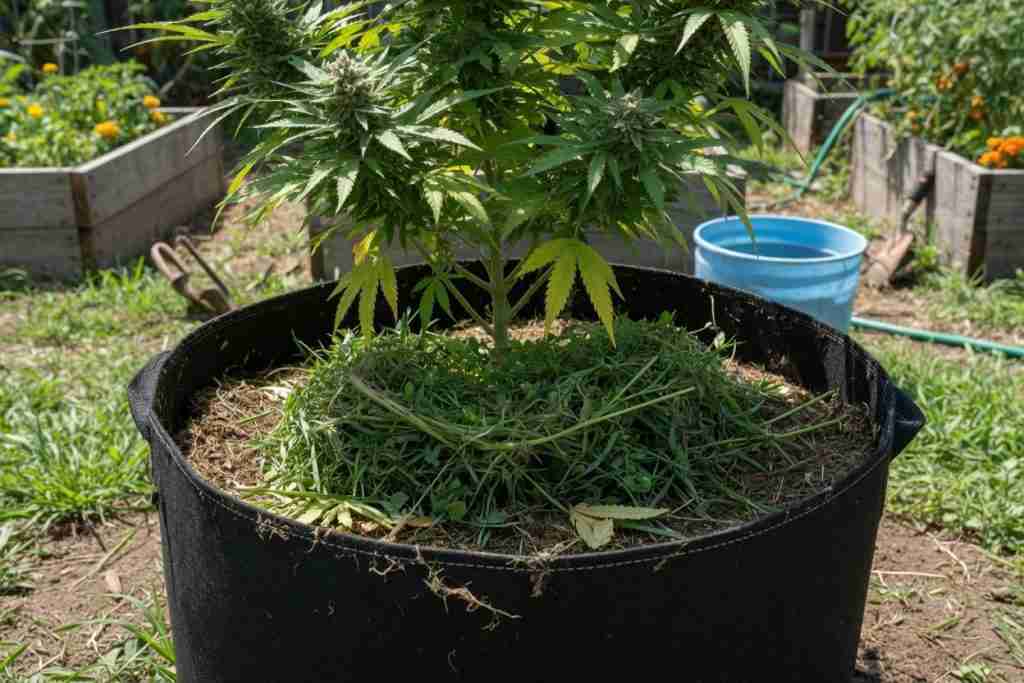
What to mulch with
Paid: hardwood chips or shavings. Stay off pine. It can slow the plant. Free, and what we actually use: lawn grass (recommended, it breaks down into food), used animal bedding, chicken-coop bedding if it is not hot fresh, broken-down cardboard around the plant. Lay it 1–2 inches thick, out from the stem, about five feet in the ground or across the pot. Leave a little gap at the stalk so you are not rotting the collar. Add more when it disappears.
Cover crops instead of a dead layer
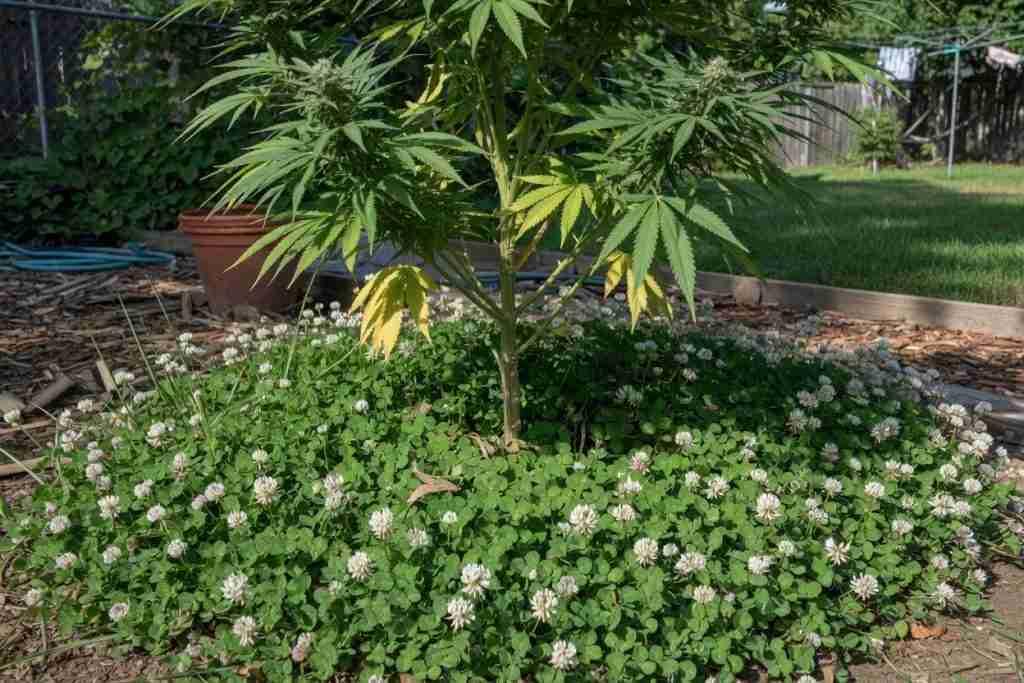
You can grow a living mulch. Clover, mustard, rye, oats, beans. Beans fix nitrogen and you can eat them. Weeds are not a cover crop. They steal. Keep clover low so it does not climb into the canopy and hold dew on the flowers. Companion planting: companion planting for cannabis.
The Season: Heat, Short Days, Wind

Northern hemisphere: plants go out mid-April to the end of May depending how far south you are. Biggest veg is June and July. After June 21 the days shorten. When dark hits about 11–13 hours, photoperiods flip, often late August into September. That is the plant making seed for next year. Southern hemisphere, flip the calendar.
Worked calendar for a short-season yard (think Ontario, Maritimes, New England, Upper Midwest). Start seeds indoors late March or April. Harden the first two weeks of May. Transplant after Victoria Day or Memorial Day once nights hold. Autos can go in the ground then and be in jars by August, before the wet. Photoperiods veg through June and July, show pistils in August, and you are fighting mold in September. If your first fall frost is late September, a 10-week flower is a gamble. Pick a 7–8 week finish or an auto. Long California or Gulf seasons can laugh at that. Your frost dates are the whole game.
Heat outdoors is not the same as a sealed tent at 95 F. The plant can cool itself if it has water. Days of brutal sun: a shade cloth helps. Fall cold: mature plants take a light frost better than a seedling. Do not bet the harvest on surviving below freezing. Pull before a hard freeze if trichomes are already cloudy.
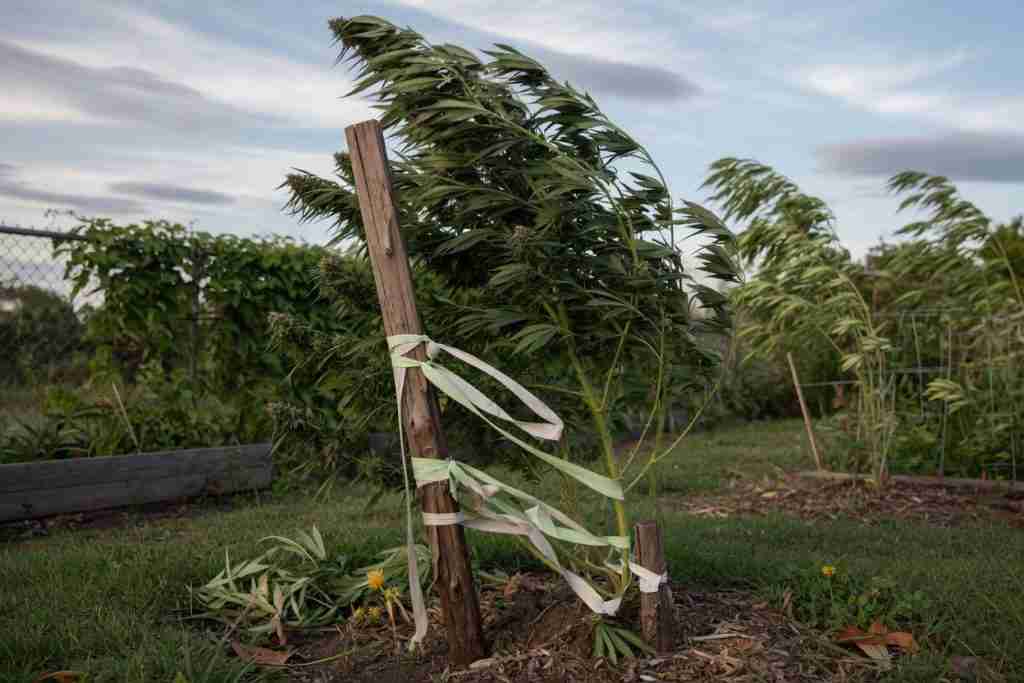
Wind in September with heavy colas snaps limbs and puts the plant on the dirt. Stake early. A wood frame for a monster. Soft ties, not wire into the bark. Build it in July when it looks silly. In October you will not be the neighbor with a broken bush. One post is not a structure. Three or four, a hoop, or a tomato cage that you outgrew in June and replaced with 2x2s. After a storm, walk the garden before coffee. A split limb taped the same day often finishes. A limb left hanging on the ground is rot and ants.
Train in June while the wood is still soft. Top or tie the plant wide so you get a 4–8 foot bush, not a 12-foot pole the September wind snaps. Low-stress training: low-stress training cannabis. Do the work before flower. Bending a cola full of weight in September is how you split a stem.
Watering and Feeding a Plant That Gets Huge
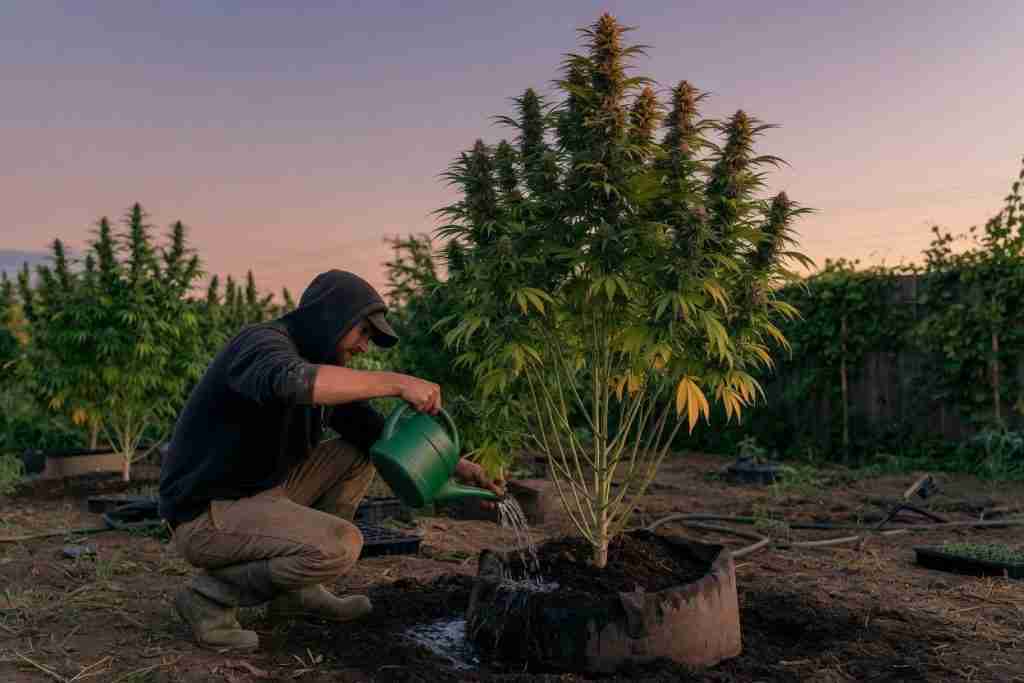
Rainy summers: drainage first. Leaves clawing in is often too wet. Dry summers: droop starts at the bottom. Tops look fine until they do not. Rain barrels help. A few plants: a can. A row: drip. Water the soil, not a shower on the flowers in September. In humid flower, morning is safer so the canopy dries. In a hot dry veg, a deep evening soak pushes roots down. More: how to water cannabis plants.
Finger two inches down. Damp: wait. A plant in a 50-gallon pot in July can drink a lot. A plant in clay in a wet June wants you to leave it alone. Eastern humidity does half the watering. Growers who moved from a dry climate drown plants here. Fabric pots dry faster than in-ground. Check both like they are different animals, because they are.
The hole food runs out. Outdoor plants drink nitrogen all veg to stay green. Top-dress through summer. When days shorten, they want more potassium for flowers. Veg: vegetative stage. Flower: flowering stage.
A bush in August is not a houseplant. If the lower fans fade while the top is racing, it is often hungry, not “done veg.” Scratch the mulch, add compost or a gentle organic top-dress, water it in. Do not dump hot chicken manure on a flowering cola. That is burn and a smell the neighbors will mention. Less in flower, more potassium, still food. Starving a plant in week three of bloom does not make it “finish cleaner.” It makes it small.
Pests, Predators, and Not Spraying the Yard
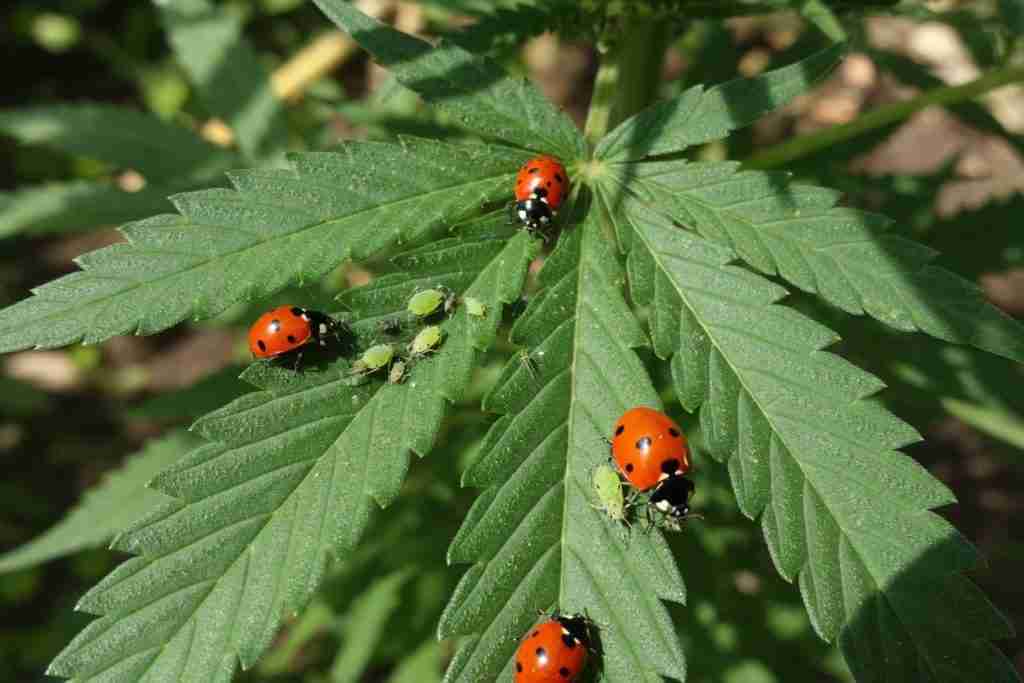
Deer, woodchucks, gophers. Then mites, slugs, grasshoppers. We do not recommend synthetic pesticides outdoors. Diatomaceous earth is a dust. It works until it rains, then you do it again. Ring the stem so crawlers have a bad time. IPM: integrated pest management. Mites: spider mites. Hoppers: grasshoppers. A full outdoor pest and mold list: fungi and pests in outdoor cannabis cultivation.
Deer jump a four-foot fence like it is a suggestion. Eight feet, or a cage over the plant. Hardware cloth buried a few inches stops woodchucks from mining under. A motion sprinkler is cheaper than a chewed cola. Check at dawn. That is when they eat.
Ladybugs and parasitic wasps eat the things you hate. Bring them. Do not nuke the garden and then wonder why the pests came back alone.
Open the Plant Before Flower. Cut Rot When You See It.
Last week of July into early August, pull large fans that shade nodes and strip the underbrush that never sees sun. Air through the plant is how you fight fall mold. Do not strip it bald in week six of flower. Take the interior that stays wet after dew. Leave enough leaf that the plant can still eat light. You are opening a bush, not making a topiary. A plant you can see through in the evening dries faster after rain. That is the point.

Bud rot hits dense, wet colas from the inside. You smell it before you see it. If you see it, cut it now. Take the rotten flower and the neighbors that look fine. Wipe the shears with iso. A light hydrogen peroxide spray on the wound area can help knock spores. Never leave rot on the plant. More: cannabis bud rot.
Prevention is the only good rot plan. Space plants so leaves do not knit into a wet tent. Open the interior before August. Water soil in the morning in flower. Shake dew if you can stand looking like a lunatic. Pull a cola the day a three-day rain is forecast if it is already cloudy. A week early beats a grey bag. Tight indica bricks rot first. Airier structure and early finishers are how wet climates finish at all.
When to Harvest Outdoors
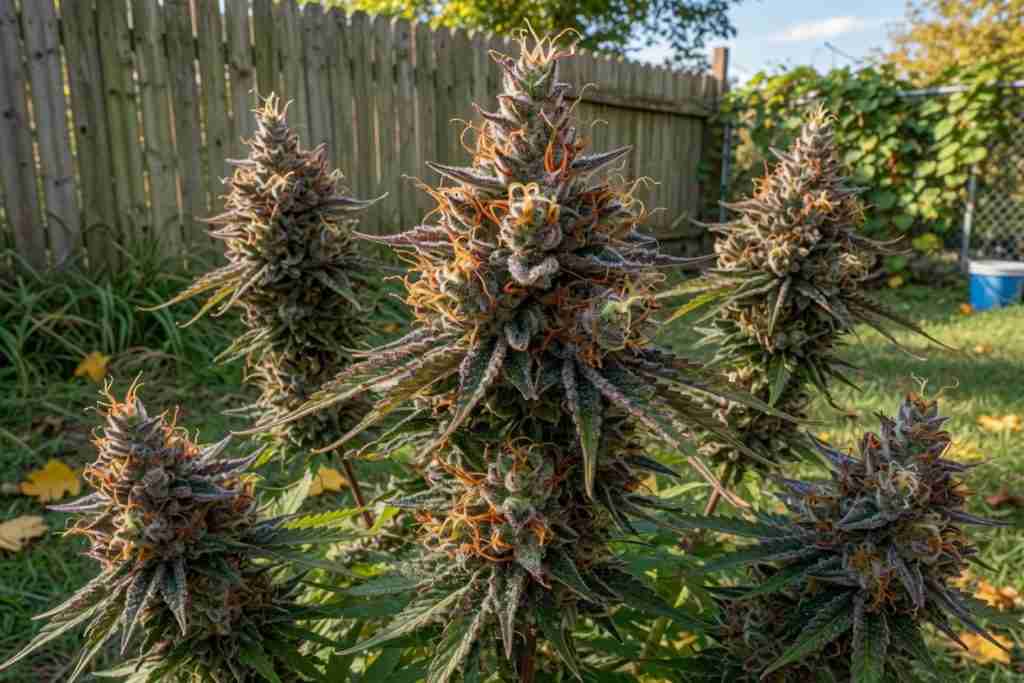
Indoors you flip the timer. Outdoors you get a rough start date and then you use a loupe. Cloudy trichomes, a few amber. If a hard freeze or three days of rain is coming and the heads are already cloudy, take the plant. Rot and frost end the crop. Then trim and dry like you meant it: dry, cure, and store cannabis buds.
Outdoor harvest is messier than a tent chop. You do not have a perfect week. You have a window and weather. Check every few days once pistils brown. Look inside dense tops, not just the pretty sugar leaf. If the middle is brown and smells like a basement, that cola is already gone. Take the rest of the plant if the rest is ready. Partial harvest is allowed. Waiting for the last clear head while rot eats the main cola is how people lose September.
People quote a pound to five pounds for a full-season in-ground plant with sun and a real hole. Backyard 50-gallon pots more often finish 4–12 ounces dried if you actually watered and the seed finished. Autos less. A plant that rots in week six of flower yields zero. Finish date and light beat a fertilizer story.
What You Actually Need
- Pots if you are not in the ground. A shovel if you are.
- A watering can or drip if your summer is dry.
- Soil you would put a tomato in, plus the organics above.
- A sunny spot without a streetlight on the flowers.
- Mulch. Stakes. Scissors. A loupe in September.
A Summer Checklist That Fits on a Fridge
| When | Do this |
|---|---|
| 6 weeks before last frost | Start seeds indoors |
| 2 weeks before transplant | Harden off. Nights inside if cold |
| After last frost, nights 50 F+ | Transplant. Mulch the same day |
| June–July | Water, top-dress, stake before it looks necessary |
| Late July–early Aug | Open the interior. Pull shade leaves |
| August | Watch for flip. No streetlight on photos |
| September | Scout rot every rain. Loupe the tops |
| Before hard frost or a three-day soak | Harvest if trichomes are cloudy |
Legal plant counts are not a growing tip, but they cap the garden. A lot of Canada is four plants. Some US states are the same. Four outdoor bushes is a winter of flower if they finish. Four neglected sticks is a lecture. Size the hole and the water to plants you will actually walk to in September.
FAQs
When do I plant cannabis outdoors? After last frost, nights holding about 50 F, soil warm. Most of the north: late May to early June. Start seeds indoors 4–6 weeks before that.
Autos or photoperiods outdoors? Short, wet, or cold falls: autos or fast photos. Long dry falls: photoperiods if you can hide a bush.
How much sun? At least 6–8 hours direct. More is better. No night lighting on photoperiods.
Ground or pots? Ground grows the biggest if it drains. Pots move, hide, and drain if you size them like you mean it.
Do I need to start indoors? You can sow outside. We still start inside so slugs, late frost, and a 40 F night do not erase week one. Hardening off is not optional if the plant lived under a lamp.
When do outdoor plants flower? Photoperiods when nights get long, often late summer. Autos on their own clock from sprout. Streetlights can stop a photo from flipping.
What kills more plants, frost or mold? Depends. Prairies and mountains: frost. Ontario, Quebec, Maritimes, Eastern US: September humidity. Fast genetics dodge both.
How much does one outdoor plant yield? In-ground with sun: often a pound, sometimes more. A backyard fabric pot: a few ounces to about a pound if it finishes. Rot and a late seed wipe that number out.
What soil pH outdoors? About 6.0 to 7.0. Test once. Lime or sulfur is slower than a bottled pH down you use in a reservoir, so fix the hole before you transplant.
How far apart? Four to six feet for photoperiod bushes. Autos can sit closer. If two plants share one wet canopy in September, you built a mold tent.
Growing cannabis outdoors is still a garden. Start the seed inside, wait out frost, mulch, water the dirt not the buds, open the plant before September, and cut rot the day you find it. The sun does the expensive part. You do the timing.