Grow Lighting for Cannabis: PPFD, LED vs HPS, and Hang Height

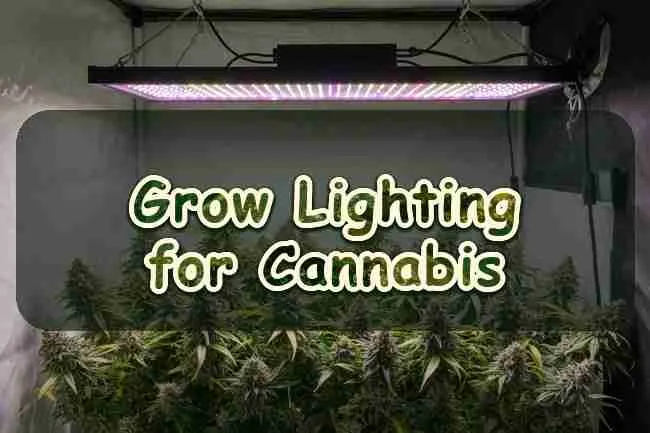
You cannot flower a real plant with a kitchen fluorescent. Cannabis is a light hog. Grow lighting for cannabis is how you replace the sun indoors: enough photons, the right daily dose, and a spectrum the plant can actually use. The old page on this URL walked through spectrum, HID vs LED, hanging height, and lumens. That backbone still matters. What ranking growers measure now is PPFD at the canopy and DLI over the day. Watts and lumens are for the electric bill and your eyeballs. The plant does not care about either.
This page is how to buy and hang grow lighting for cannabis without bleaching the tops or starving the corners. LED is the default in 2026 for most tents. HPS still has a job in a cold garage. You will get stage targets, tent sizes, hang height, heat, and the original spectrum notes. No fluff. Measure, then dim.
What Grow Lighting for Cannabis Is For

Leaves turn light into sugar. That is photosynthesis. Weak light makes stretchy plants, yellow lower fans, and airy buds. A house CFL is not a flower light. You would need a ridiculous stack of them to match one proper LED. If you are growing indoors, the lamp is the crop. Soil and bottles cannot outrun a dark tent. Indoor setup: indoor cannabis growers guide. Tent size: grow tent for cannabis seeds.
Spectrum, intensity, photoperiod, room climate, and the cut all interact. A loud LED in a 90°F tent still makes hay. Light is not a separate hobby from the growing environment.
Forget Lumens. Use PPFD and DLI
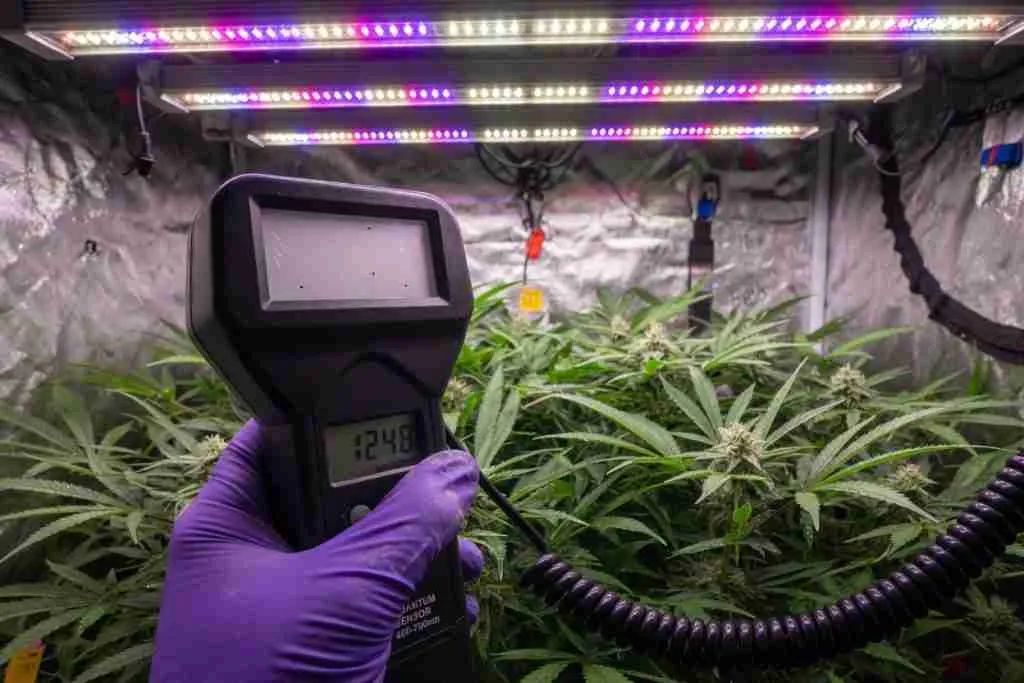
The old page explained lumens because that is what boxes used to print. Lumens measure how bright a light looks to a human eye. Plants use PAR, the 400–700 nm band. PPFD is how many of those photons hit a square meter each second (µmol/m²/s). DLI is the day’s total (mol/m²/day). Formula: DLI = PPFD × hours × 0.0036. A 700 PPFD flower lamp on 12/12 is about 30 DLI. 900 PPFD on 12/12 is about 39. That is the number that tracks yield, not the “1000W equivalent” sticker.
Wattage is what the wall sees. A 300W LED can beat a 600W HPS on usable photons because efficacy is higher (often 2.5–3.1 µmol/J vs about 1.7 for double-ended HPS). Buy a fixture with a real PPFD map, not a cartoon watt claim. Cheap blurple boards still exist. Skip them.
PPFD and DLI by stage
- Seedlings and clones: about 100–300 PPFD, DLI around 6–16. Soft start. They cannot dump heat yet. See seedling stage and how much light cannabis seeds need.
- Veg: about 300–600 PPFD on 18/6, DLI about 20–40. Build structure. Vegetative stage.
- Flower, room air: about 600–900 PPFD on 12/12, DLI about 35–45. Sweet spot for most home tents is near 40 DLI. Flowering stage.
- Flower with added CO₂ and a dialed room: some people push 900–1200 PPFD. Without extra CO₂ and cooling, you bleach tops. CO₂.
Autos still want a high DLI. They usually stay on 18/6 or 20/4 the whole run, so you dim the PPFD a bit so the daily total does not cook them. Photoperiods flip to 12/12: photoperiod cannabis seeds.
Do not trust one reading in the middle. Make a cheap grid. Nine points: four corners, four mid-edges, center, at cola height. Write them down. If the center is 950 and a corner is 420, you do not have a 900 PPFD room. You have a hot middle. Raise the fixture, dim, or add a second bar. Uniformity beats a hero number. Plants in the dark corners fox-tail late and finish light. Plants in the hot spot bleach and canoe.
A buddy of mine ran a “600W” blurple at 8 inches because the listing said hang it close. Week three of flower the tops were white. He thought it was a phosphorus problem. It was 1200 PPFD on a 2×2 with no dimmer. Yikes. Dim first. Then drop the bar an inch at a time if the corners are still hungry.
Spectrum: Blue, Red, and Green

Plants have photoreceptors. Different colors change stretch, stomata, and how compact the internodes sit. Intensity and photoperiod still do more of the heavy lifting than chasing a magic diode. A full-spectrum white LED with some 660 nm red is what most tents should buy. The graph on the box should not be a single blue spike and a single red spike with nothing in between.
Blue (400–500 nm)
Blue is the veg tool. It keeps plants compact, helps roots, chlorophyll, and stomatal opening. Too little blue and you get stretch. You do not need a separate “veg only” blurple lamp if the white LED already has a decent blue share. Dim it for seedlings. Raise it as the plant fills. Trichome-focused spectrum notes: spectrum for trichomes.
Red (600–700 nm)
Red drives a lot of photosynthesis and biomass. All-red without blue makes tall, lanky plants. That is why a flower LED still keeps white/blue diodes. Far-red (beyond 700) can nudge stretch and the Emerson effect. It is a seasoning, not the meal. Do not buy a $90 “IR flower booster” and expect it to replace a dimmer and a meter.
Green (500–600 nm)
Old grower lore said plants bounce green light, so skip it. Lower leaves still use some of it once the top of the canopy has eaten the red and blue. Green also lets you see pests. That is why full-spectrum white beats purple rooms. You can scout mites. More on under-canopy fill: under-canopy and side lighting.
Things to Remember When You Buy a Light
Upfront cost vs what you pay the utility
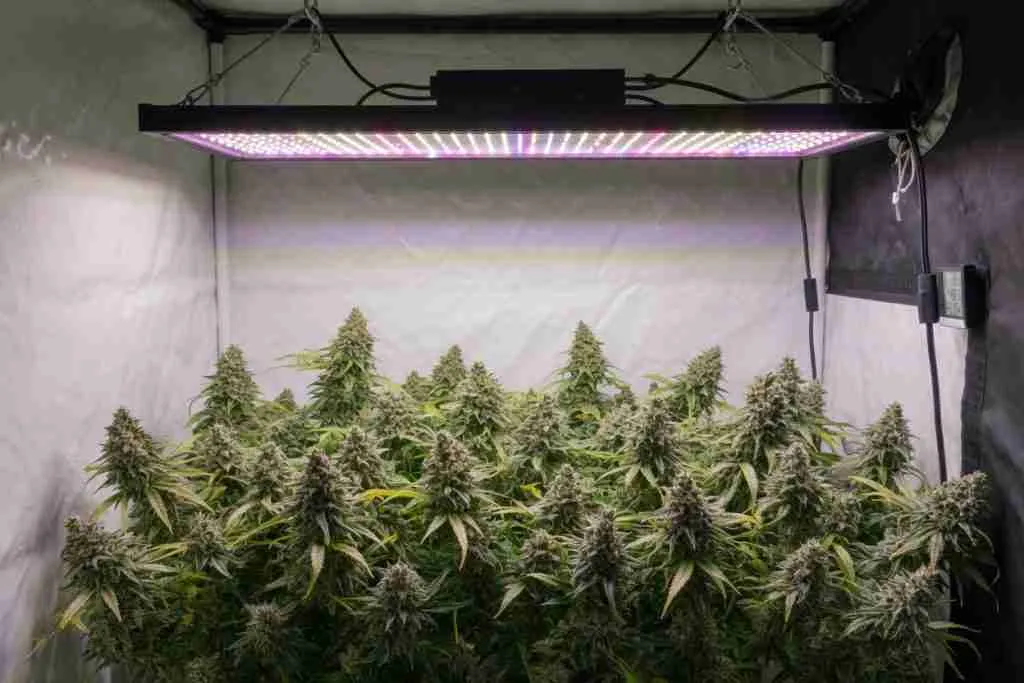
HPS is cheaper on day one. LED is cheaper by grow two or three if you run the room often. A quality 4×4 LED might cost more than a 600W HPS kit and draw 400–600W instead of 600–1000W of heat and ballast waste. If you grow once as a joke, buy used. If you grow every winter, buy photons per joule.
Heat and ventilation in summer
HPS dumps radiant heat at the cola. LED dumps more at the driver and the bars, less as a blast on the leaf. You still need exhaust. A sealed tent with a 480W LED and no fan will taco the tops. Size carbon and duct for the real wattage plus the tent volume: ventilation for a cannabis grow. If leaves canoe, the lamp is too close or the room is too hot: when leaves canoe.
Coverage: match the footprint, not the marketing
A “5×5 light” that is 1248 PPFD in the center and 300 at the corners is a bad 5×5. You want even PPFD, about ±10–15% across the canopy. Bars beat a single cob for that. Tent math for plant counts: 2×2, 3×3, and 4×4 plant counts.
- 2×2 ft: about 100–150W actual LED draw for flower.
- 2×4 or 3×3: about 200–350W.
- 4×4: about 400–600W of real wall draw, not “1000W equivalent.”
- Rule of thumb: 30–40W of quality LED per square foot of flowering canopy. More only if the room can cool it.
Electrical safety is first
Do not load a household circuit past about 80%. The light is not the only thing on that outlet. Fans, dehumidifier, heater. A 15A/120V circuit is 1800W on paper. Stay under 1440W of running gear. Use a proper timer or controller. No cheap power strips melted to the tent floor. Water and electricity still do not date.
Types of Grow Lighting for Cannabis
Fluorescent

CFL and T5 still work for clones and the first days after sprout if that is what you have. They will not flower a plant you care about. Too little PPFD, too much heat per photon on the CFL envelope if you jam it against the leaf. Use them as a nursery, then move to LED. Seedling days: cannabis seedlings day by day.
HPS and metal halide

HPS was the flower standard for decades. Red-heavy, cheap to buy, hot, bulbs fade and get replaced. MH is the old veg companion, bluer. A 600W HPS still grows weed. It also cooks a small tent in July. Keep HPS if the room is a cold garage and you want the heat, or if the fixture is already paid for. Otherwise LED. Other lamp types: lighting technologies in cannabis cultivation.

LED Lighting for Cannabis

This is the default. Full-spectrum bars or a quality quantum board. Less heat at the leaf than HPS, dimmable, long life, no annual bulb swap. You can hang them closer. That is the advantage the old page already had right. The new part: LED also means you must water a little less often and watch VPD, because the plant transpires differently than under a 600W sodium lamp. First LED run, do not copy your HPS feed chart blindly. Expect less stretch in early flower than HPS’s red-heavy blast. If you liked that stretch, train in veg instead of waiting for the lamp to pull internodes.
Switching from HPS to LED is not a one-for-one hang. Same 4×4, a 480W LED can replace a 600–1000W HPS on photons and still run cooler at the leaf. You may need to water 15–25% less often. Cal-Mag that was “required” under HPS is often just leftover habit. Watch the plant. If you needed HPS heat to keep a garage at 75°F in January, keep one sodium lamp or add a heater. Do not freeze the room to save 200W.
Advantages that actually show up in the jar
- More usable photons per watt. Lower bill for the same DLI.
- Even bars. Fewer burnt centers and empty corners.
- Dimmer. Seedlings and veg on one fixture.
- You can see the plants. Scout pests. No purple room.
- Less AC in summer. HPS still wins if you needed that heat in January.

Lighting cycle in the room
Photoperiod veg: 18 hours on, 6 off is the usual. Some people run 16/8 to save power; plants veg, they just veg a bit slower. When you want flowers, 12/12. Dim in veg. Open the dimmer in flower as the plant can take it, not on day one of the flip if the tops already taco. Autos: pick a DLI and a long day, then leave the timer alone. Do not 12/12 an auto unless you like small plants. A light leak in flower on a photoperiod is how you get nanners. Tape the zipper, cover the window, no phone flashlight at 2 a.m. LED drivers that glow in the dark still count as light if they sit in the tent.
Week 1–2 of flower is stretch. Hang with room to spare. If the cola grows into the diodes you will burn resin and the smell dies with it. Raise the bar or supercrop. Do not “let it kiss the light.” That is how you get foxtails and a harsh smoke. If the room cannot take more PPFD, you already have your yield ceiling. More light without more air, water, and CO₂ just makes stressed weed.
How Far Should Grow Lighting Be From the Plants?

Too far and the plant stretches, then falls over in flower. Too close and you bleach the tops. That photo is light burn, not a mystery nitrogen problem. The manufacturer hanging chart is a start. A PAR meter at the leaf is the finish. Manufacturer “24 inches in veg, 18 in flower” is for their PPFD map at full power. If you dim, you can hang closer. If the tent is short, dim instead of frying the cola.
Seedlings
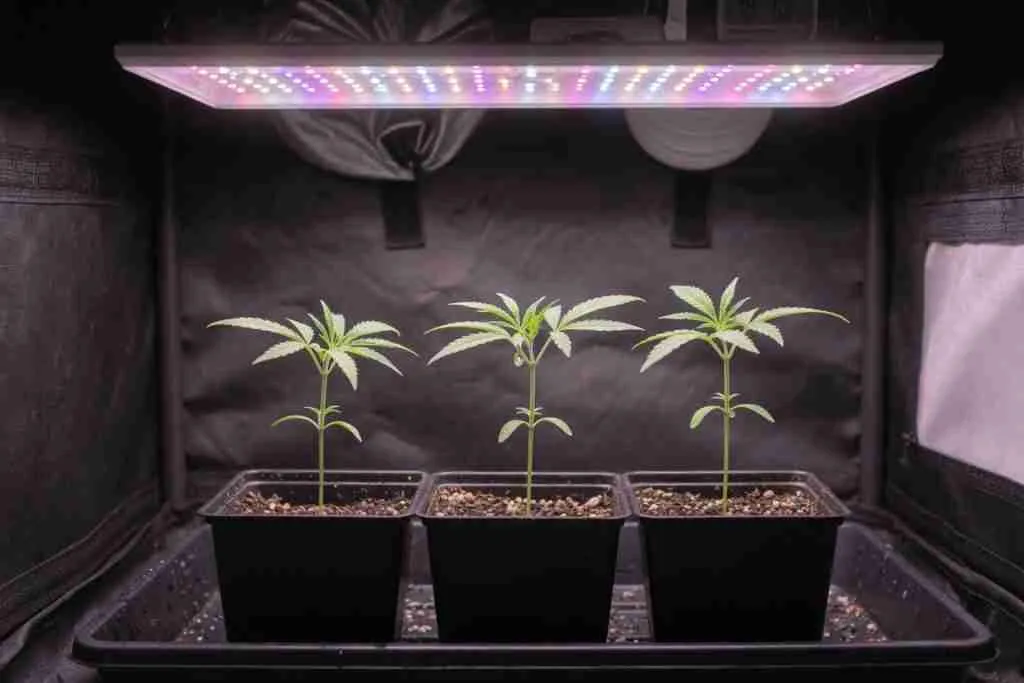
You can put seedlings under the same LED you will flower with if you dim it hard. Too much PPFD plus heat kills a wet seedling faster than darkness. Look for stretch (light too weak or too far) vs taco and bleach (too close or too bright). Raise or dim. Do not do both in a panic every hour.
Veg and flower hang height
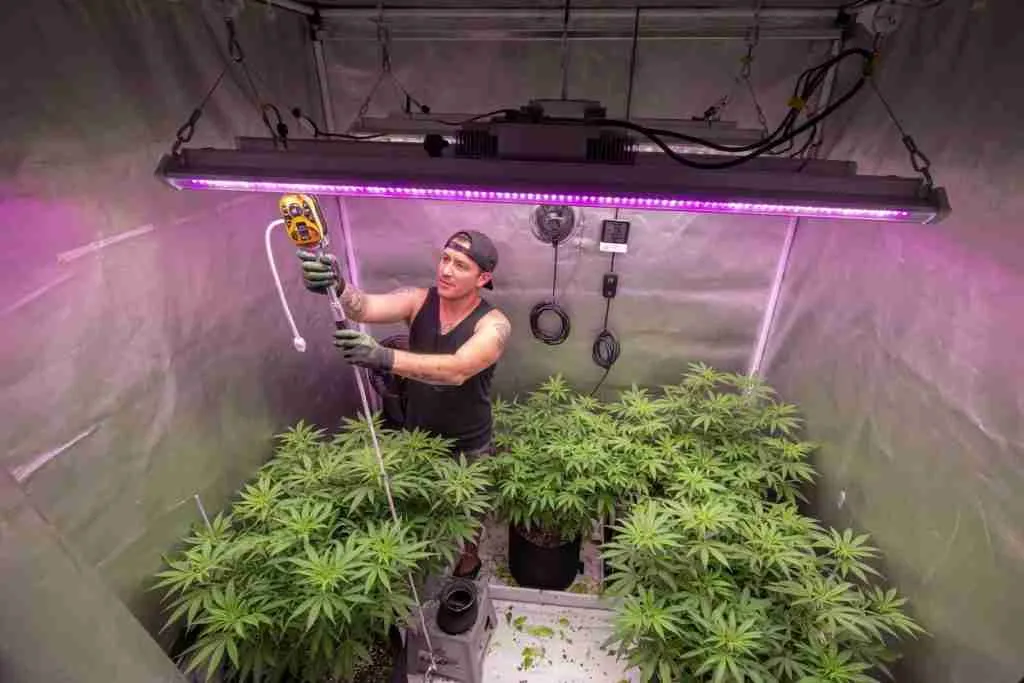
Veg wants even light over the whole bush, not a hot spot. Hang a bit higher and dim less, or hang lower and dim more. Flower: set PPFD at the tops, then check a corner. If the corner is 400 and the center is 1000, raise the bar or add a second fixture. Clawing from light is different from nitrogen claw: leaf curling or clawing. Dying tops from a lamp in the leaf: cannabis plants are dying.
Spacing, Reflective Walls, and How You Hang It

Crowded plants shade each other. Light that never hits a leaf is wasted. Give each plant a footprint the lamp can cover. Two plants fighting under a 2×2 board both lose. Reflective tent walls bounce photons back. That is why a tent beats a dark closet. Mylar or a quality tent liner is enough. Do not paper the room in cheap foil that wrinkles into hot spots.
Hang from ratchets or a bar, level, so the PPFD map matches the floor. A tilted bar burns one side. Keep drivers out of the wet zone if they are detachable. Leave headroom for the plant to stretch in week two of flower. A lamp that starts 14 inches from the cola and ends in the buds is a ladder problem, not a genetics problem. Steel cable and carabiners beat zip ties. Check the hang after you fill the tent with wet pots. The frame sags. Re-level.
Side lighting and under-canopy bars are extra, not a substitute for a flat top map. If the tops are already at 900 PPFD, stuffing a blurple strip in the legs can crisp sugar leaves. Use them when the main lamp is even and the interior of a SCROG is still dark. Most 2×2 and 3×3 home tents do not need a second layer. A 4×4 packed SCROG might.
What Great Grow Lighting Costs
A usable 2×2 LED is often in the low hundreds. A serious 4×4 bar is several hundred. Used HPS kits are cheaper up front and eat that back in power and bulbs. Spend on a dimmable full-spectrum fixture that actually covers your tent, a timer, and if you can, a cheap quantum meter. Skip the $30 “2000W” Amazon panel. That watt number is a lie. If the budget is seeds or light, buy the light. Weak light makes weak flower from good cannabis seeds.
Worked examples, actual wall draw, not marketing watts. A 2×2 with a 100–150W quantum board, dimmed to ~200 PPFD on seedlings, 400 in veg, 700–800 in flower, will finish a plant. A 3×3 wants ~250–350W or the corners die. A 4×4 with one underpowered 200W board is how you get a Christmas tree of larf around a decent center cola. Two bars or one 450–600W bar with a flat map is the difference. Electricity: 480W × 12 hours × 30 days is about 173 kWh for flower. At $0.15/kWh that is about $26 a month for the lamp, not counting fans. HPS at 600W plus ballast waste is more heat and more kWh for the same DLI.
Watch the plant, not the clock on hanging height. If new growth is tight and lime, you are often too close or too bright. If internodes stack like a ladder, you are too far or too dim. Fix light before you buy a new nutrient line. Most “deficiency” pictures on forums under LED are light or pH. The lamp does not replace a wet pot or a 6.8 runoff. It does decide whether the plant can use the rest of the room.
Quick answers
What is the best grow lighting for cannabis in 2026? A full-spectrum LED sized to the tent, dimmable, with a real PPFD map. HPS if you need the heat or the fixture is already paid for.
How many watts do I need? About 30–40W of quality LED draw per square foot of flower canopy. Measure PPFD. Do not trust “equivalent watts.”
How far should the light be? Far enough that tops do not bleach, close enough that corners still hit your target PPFD. Dim and measure. Manufacturer inches are a starting guess.
18/6 or 24/0 in veg? 18/6 is enough for almost everyone. Plants use the dark. 24/0 costs more and does not grow twice as fast.
Do lumens matter? Not for the plant. Use PPFD and DLI. Lumens are how bright the room looks to you.
How do I tell light burn from heat? Light burn is bleached, pale, or crispy new growth right under the diodes, often with the rest of the plant still happy. Heat is taco leaves across the canopy, dry edges, and a tent that smells cooked. Fix heat with exhaust and dim. Fix light burn by raising or dimming even if the thermometer looks fine. LED can burn without feeling like an HPS hot rock.
What spec should I shop? Actual watts, a PPFD map for your tent size, dimmer, and efficacy around 2.5 µmol/J or better if they publish it. Five-year driver warranty beats a fake 2000W name. Samsung or equivalent white diodes plus 660 nm red is the current normal. You do not need a separate veg lamp and flower lamp unless you run two rooms.