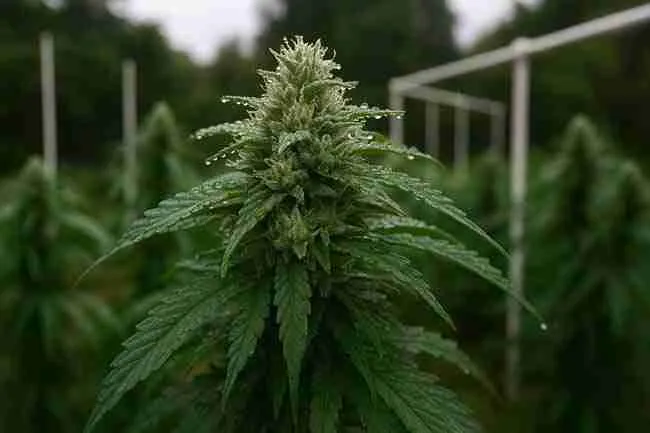
Flushing Cannabis: When Plain Water Helps, and When It Doesn’t


Originally published 24 October 2022. Updated 1 October 2026.
Flushing cannabis is plain water, used on purpose. Growers use that phrase for two jobs that are not the same job. One is the last stretch before harvest, when you stop the bottle and keep watering. The other is a rinse you do on a bad day, when the pot is salty and the leaf tips are burning. The pages that rank for this search mix those two together, then promise white ash and smoother weed if you flood the pot for 14 days. The plant is less impressed than the forum.
Flushing cannabis means plain water, used for two jobs

The photo has been on this guide since the first version. A hose, a pot, runoff heading for the saucer, and dead leaves sitting on the soil. That is a real watering. It is also easy to copy badly. Clear the dead leaves off the surface before you pour. They are not mulch. Wet trash against the stem is how rot starts while you are trying to be careful.
A pre-harvest flush, on a salt-fed plant, is your normal watering rhythm with nutrients left out of the jug. You still pH the water. You still water until a little runs out the bottom, roughly a tenth to a fifth of what you poured, and you still empty the saucer. Then you wait until the pot lightens. Doing that scene every morning for two weeks is not a flush. It is drowning. Roots that sit in soup stop eating, and the buds stall while you watch the fan leaves go pale and feel productive.
A corrective flush is the heavy one, and you do it once. Burnt tips that keep marching inward, dark clawed leaves, or runoff that meters far hotter than the water you mixed are a salty root zone. Pour pH-adjusted water through the pot until it runs freely. Two or three times the volume of the pot is plenty for one event. Then stop. Let it dry to your usual lightness, and come back with a milder feed than the one that caused the burn. The watering guide is the everyday version of lift-the-pot. This page is the moment you change what is in the water.
A 19 litre fabric pot on a normal schedule usually takes about 1.5 to 2 litres before a thin stream leaves the bottom. Lift it before you pour. A pot that is still heavy from yesterday stays dry today, flush week included. When it is light and the top couple of centimetres have dried, pour slowly from around the stem out to the fabric edge so the whole root ball wets. Stop at that thin stream. Empty the saucer. The next plain-water day uses the same volume, written down, so you are not guessing with a heavier jug because you are nervous. The corrective rinse on that same pot is one pass of about 4 to 6 litres, then nothing until the pot is light again. Three waterings in the same afternoon hold the roots in soup. Salt was the problem you walked in with. Drowning is the one you leave with.
A pre-harvest flush does not raise THC

The old claim is tidy. Nutrients left in the plant make the smoke harsh and the ash black. Starve the plant for the last two weeks and the flowers “use up” those nutrients, so the marijuana tastes clean and the ash goes white. It sounds like chemistry. It is mostly a story.
RX Green Technologies grew Cherry Diesel in coco and flushed matching plants for 0, 7, 10, or 14 days. Yield, THC, and terpenes did not meaningfully change with a longer flush. In a blind smoke test the longer flush was not the one people preferred. Nitrogen, phosphorus, and potassium in the dried flower did not drop the way the story needs them to drop. A 2024 paper in Industrial Crops and Products looked across cultivars and found only small, mixed shifts in cannabinoids and minerals. The crop was not wrecked. It was also not upgraded. A 2025 HortScience trial on high-CBD plants is the warning on the other side: as the flush got longer, nitrogen, phosphorus, and potassium in the tissue fell, and flower weight fell with them. One cultivar made more CBD per gram. The smaller harvest meant less CBD for the space.
Read that as a limit, not as a slogan. A short plain-water finish on a plant you have been feeding from a bottle is cheap housekeeping. It saves fertilizer. It stops you pushing soft new growth the week you meant to finish. It does not put more THC in the cola. Potency was set by the genetics, the light, and whether you chopped while the resin was actually ripe. White ash is a worse scoreboard. It moves with how dry the flower is, how tight the joint is, and how evenly it burns. People lose that argument in the jar, then blame the last week of feed.
Buds do keep ripening while you water with plain water. They swell a little, the pistils darken, the resin heads cloud. They do not put on the weight you failed to build in week four. If the plant is still stretching and throwing white hairs everywhere, you are early, and a flush will not mature it faster. If you need more weed in the jar, you needed a better canopy and a longer veg, not a longer rinse. The flowering stage guide is the week-by-week picture. The harvest timing guide is the chop. This page sits between them.
Time the stop off the bud in front of you, not the week count on the seed pack. Look at the resin on the bracts, not the sugar leaf sticking out, and not the orange hairs alone. Mostly cloudy heads, with some amber if that is the effect you want, means you are in the window. Clear heads mean the flush would start while the flower is still building. A jeweller’s loupe that fogs in the tent is enough. The sparkle you can see without one is real resin. It is not a verdict on clear versus cloudy. Autos use the same cue and a shorter fuse. A 14-day soil flush pasted onto an autoflower that is already cloudy harvests underripe weed. How autoflowers work is the clock they actually run.
Put the loupe on a bract, not on a sugar leaf waving at the camera. A clear head looks like glass. You can see through the middle. A cloudy head looks like frosted glass, and the middle has gone milky. Amber is a tea colour inside that head. An orange pistil lying beside it is a hair, and hairs darken days before the resin is ready. Sugar leaves amber early, so a field of amber on the fingers of the bud will talk you into chopping marijuana that is still clear where it counts. Check one bract low on a side branch and one on the main cola. When those two disagree, the main cola is the harvest you are judging, and the lowers can wait a few days if you are taking the plant in two cuts. One head on one leaf is a bad sample. A phone photo through the loupe is enough to compare tomorrow with today, which is how you stop talking yourself into a finish because the calendar said so.
Soil, coco, and hydro run on different clocks

The two pots in that photo are young on purpose. Dark soil sits next to pale coco, and you can tell them apart before a canopy hides the surface. By the last fortnight people water both the same and then argue about whose chart was right. The medium is why one grower’s “one week” and another grower’s “two weeks” are both sometimes right. Soil holds a pantry. Coco holds less and drains faster. A hydro reservoir holds whatever you poured in this morning and almost nothing else. Using one number for all three is how people either starve a coco plant for a fortnight or “flush” a water-culture bucket by staring at it.
| Setup | Plain water before harvest | The mistake |
|---|---|---|
| Living soil, no bottles | Skip the flood. Water as usual. | Washing a biology you spent months building |
| Soil plus bottled nutrients | About 7 to 14 days, once heads are mostly cloudy | Starting while the buds are still filling |
| Coco | About 5 to 7 days | Treating coco like a heavy soil |
| Hydro reservoir | 1 to 3 days, or one swap to plain water | Leaving warm plain water on the roots for a week |
Coco and a reservoir run out of food because they never stored much of it. A coco plant on bottled nutrients has been eating what arrived in that watering. Take the bottle away for two weeks while the flowers are still filling and the fan leaves dump their green. Soil with compost or a dry amendment still has a pantry after the bottle stops, which is why the same fourteen days looks calm in a soil pot and rough in coco. Hydro is faster again. The roots are sitting in whatever you mixed that morning. A swap to plain water is a day or three of finish, and after that the plant is living on what is stuck to the roots. Warm plain water left in a bucket for a week goes stale, the oxygen drops, and you have traded a feeding question for a root question. If your coco runoff has stayed close to the water you poured in through flower, the finish is the nutrients left out of a normal drink. You already did the leach, a tenth of a pot at a time, all season.
pH does not take the week off because you removed the nutrients. Soil water still wants about 6.0 to 6.8. Coco wants about 5.6 to 6.2. A hydro reservoir wants about 5.8 to 6.2. Plain water from the tap can sit outside those bands, and then the “flush” locks the plant out of whatever is left in the pot. If you have been getting 10 to 20 percent runoff all along, coco is probably not a salt brick on harvest week. A short finish is enough. The hydroponic growers guide covers the reservoir if that is the system. Do not invent a soil routine inside a bucket.
Forty-eight hours of darkness before the chop is a different habit, and it is not a flush. Lights off does not rinse the medium. You can do it or skip it. It is not the step that fixes harsh smoke, and it is not a reason to leave the tent open “to check” and break a 12/12 night on the way there. The room those plants have been living in is the indoor growers guide. Humidity in the last two weeks matters more than the brand on the finishing bottle. Wet flowers in a closed tent is bud rot, and no rinse repairs a brown cola.
Living soil does not get a flood

If you never used a salt fertilizer, there is no salt brick to wash out. Water the way you have been watering. A heavy leach through living soil dumps the soluble food the microbes were metering out, and it does not make the smoke cleaner to compensate. Organic bottles and top-dresses taper themselves if you simply stop adding them. The plant finishes on what is already in the pot. Growers who “flush” a water-only bed because a chart told them to are solving a problem they did not have.
The flush that fixes burnt tips

This is the flush worth doing on a Tuesday in week three, not only in the last fortnight. Tips that crisp and keep advancing are usually too much food, or food the plant cannot take up because the pH or the salt load is wrong. Dark, clawed, overly green leaves lean the same way. A single heavy pass of pH’d water pulls that load down. You are watching the runoff get closer to the water you poured in, not chasing a forum number to the digit.
Then leave it alone. Roots need air after a leach. If you rinse again tomorrow because you are nervous, you trade salt stress for root stress, and the plant yellows for a new reason. When the pot has lightened, feed at half the strength that burned it and watch the new growth. Old burnt tips do not heal. New tips that stay green mean you fixed it. New tips that burn again mean the dose is still high, or the pen you trusted was lying.
Burn, hunger, and lockout ask for different water, and videos collapse them into one rinse. Burn is brown tips that keep moving inward, often with dark, clawed, shiny leaves, and a pot that stays heavy because the plant is drinking less. Hunger is pale leaves from the bottom up, thin new growth, and a pot that goes light on the usual day. Lockout sits between them. The leaves look hungry while the runoff is hotter than the mix you poured, or the runoff pH has left the band for that medium. Burn and that kind of lockout get one leach, then a milder feed once the pot has lightened. The hungry plant gets a normal feed at the right pH. A rinse “just in case” on a pale, underfed plant makes the pale worse, and flower does not hand that week back. A heavier bloom booster in the can the same afternoon puts the salt straight back where you just washed it from.
Molasses is not a flush

Unsulphured molasses shows up in every old flushing thread, including the first draft of this one. In a living soil it is a microbe food. A small amount during the run can be part of that style of growing. It is not a solvent. A spoon of it in the watering can does not pull minerals out of the flowers, and it does not replace plain water on a coco plant you have been hitting with bottled salts. In a hydro reservoir, sugar is food for slime. Leave it out of the finishing week entirely. If you want the smoke to taste like the cultivar, do not finish the grow by flavoring the pot.
Ice water through the pot is a different trick, and it does nothing for ripeness. Cold roots are not a cleaner smoke, and they are a fine way to stall a plant that was two days from done. A bottle marked as a flush agent is usually water with a mild salt or a bit of sugar, sold at a markup. pH-adjusted plain water already does both jobs on this page. The tool worth buying is a pen that still agrees with a buffer after you have used it for a month.
A meter only helps after you check it

pH pens and TDS pens are useful and they drift. Check a pH pen against a buffer before you believe a harvest-week number. TDS and EC pens also disagree with each other depending on the 500 or 700 scale baked into the cheap ones, so a “ppm” from a stranger’s chart may not be your ppm. Use the meter to see direction. Runoff that stays very high after a corrective rinse means the pot is still loaded and one more proper watering, after a dry-down, beats three panics in one afternoon. A screen that cannot sit still in calibration solution is not a diagnosis. It is a battery, a dirty sensor, or a pen that wants replacing.
A fade is finishing. A crash means you started too early.

A useful fade is boring. Lower fan leaves lose green over several days. Upper buds stay frosty and keep their structure. The plant looks like it is spending what it stored, which is what the end of flower looks like even when you never owned a bottle. You do not need every leaf to go bright yellow. You need the flowers to finish.
A crash is the whole plant paling in two or three days, petioles going purple or red in a hurry, buds stopping, sugar leaves crisping. That usually means the plain-water stretch started while the flowers were still packing on, or the medium had nothing in reserve and you treated it like soil. Coco and hydro crash this way. Soil usually will not, unless you started absurdly early. If you see a crash and the resin is still mostly clear, resume a light feed. Pride is a bad reason to hold the line for another week. The harvest window is the resin, not the bet you made on a calendar.
Yellow at the end is also not automatic proof the flush “worked.” Fan leaves fade because the plant is senescing. They fade from light stress, from a root that stayed wet, and from a real deficiency you caused in week two. Match the picture to the clock. Pale leaves in week three of flower are a problem. Pale lower leaves in the last week, with cloudy heads, are a finish.
Harsh weed is usually the dry

If the jar smells like hay, or the smoke scratches, run the last two weeks of water back through your head after you run the dry. Most of those jars were dried too warm, too fast, or sealed while the stems still bent. A flush does not survive a 30°C closet and a fan pointed at the buds. Hang branches in the dark, cool, with air in the room and not blasting the flowers. Jar them when small stems snap, then open the jars for a few minutes a day in the first week. Wet flower in a sealed jar is the harshness people try to rinse out of the pot a month too late.
The first week of glass is where a fair finish gets the blame. Small stems should snap. If they fold, the flower is still wet, and big stems can keep a little bend after the small ones snap. A jar that clouds or sweats on the glass within an hour was closed too soon. That moisture on the inside of the glass is the warning, not the look of a cure that is going well. Spread those buds back on a rack for another day, out of direct sun, with air in the room. Burping means the lid comes off, you tip the jar so the buds move, and you leave it open a few minutes. A cracked lid on a warm windowsill all afternoon dries the outside of the buds and leaves the middle damp. By the end of that week the jar should smell like the cultivar. A hay smell that stays is chlorophyll that never had time to leave, which is a dry that ran hot or got rushed. Plain water in the last week of flower cannot undo it. The weed you smoke is the flower you dried, and the flush is only the feeding decision that came before the rack.
Chop on the resin, not on the day you decided the flush should end. If the heads are still clear on day 10 of plain water, you started early or the plant is late. Give it the days. If the heads are amber past the point you wanted and the leaves crashed, you waited out of habit. The flush is a feeding decision. The chop is a ripeness decision. They share a week. They are not the same dial.
For a salt-fed soil plant that is already cloudy, a week or two of plain, pH’d water on your normal schedule is a reasonable finish. For coco, keep that closer to a week. For hydro, swap the reservoir near the end and do not invent a fortnight. For living soil, do not flood it because a chart looked official. Skip molasses, skip a “flush agent,” and skip any plan whose proof is the color of the ash. Then dry slowly. That is the part the smoke will actually notice.