Fertilizing Autoflowing Cannabis Plants: Expert Insights and Best Practices

Fertilizing autoflowing cannabis plants means feeding a plant that will flower on age, not on a light flip. You get a short veg, a short recovery window, and a bottle chart written for photoperiods that will burn it. Start at a quarter to half of the label. Water first in a charged mix. Switch the ratio when you see pistils, not when a calendar says week five. Shop seed in the cannabis seeds store. The grow library is on the cannabis cultivation blog.
This page is the jug and the week clock. The longer feeding walkthrough, with soil versus coco jobs and a full strength chart, lives on fertilizing autoflowering cannabis plants. How to grow the plant: grow autoflowering cannabis plants. Seed-to-harvest: growing weed.
Autos Run on Age, Not a Flip
A photoperiod waits for 12/12. An autoflower, the plant people type as autoflowing, starts stacking pistils on its own clock, often in weeks three to five from sprout. If you burn it in week two, it does not veg an extra month while you wait for new leaves. It flowers small. That is why the feed is light. Ruderalis in the background: what is ruderalis cannabis. Photo versus auto: photoperiod vs autoflower.
The bottle chart on a three-part hydro line assumes a plant that can take a hit and then grow out of it. Your marijuana auto cannot. Treat every extra millilitre as a bet against yield. The plant still needs nitrogen while it is making leaf, then more phosphorus and potassium once flowers show. It does not need the full millilitre count on the side of the jug. Nutrition across stages for any cannabis: cannabis nutrition across all stages.
Week Numbers Lie If Pistils Already Show
Charts say week 1 water, week 3 veg, week 5 bloom. That is a typical 70-to-90-day auto. A 60-day auto can throw pistils in week three. A slow one can still be all leaf in week five. Feed the stage you see. Cotyledons and first true leaves: water. Rapid new fans, no hairs: light veg. White pistils at the nodes: start a bloom ratio. Dense flowers, fading fans late: back off. If you follow a week table against a plant that already flowered, you dump nitrogen into bloom and grow leaf in the cola. Flower stage: cannabis flowering stage.
Mix Weaker Than the Bottle Chart
Read the label. Cut it. Quarter strength the first time you feed. Half strength once the plant is drinking and the tips stay clean. Full label on an auto is how you get clawed leaves in a week you cannot get back. If the plant goes lime and the lower fans pale after a few water-only days, step up a little. If the tips bronze, you already went too far. Dump the jug, mix weaker, and water until runoff is closer to what you poured in. You do not “catch up” by doubling the next feed.
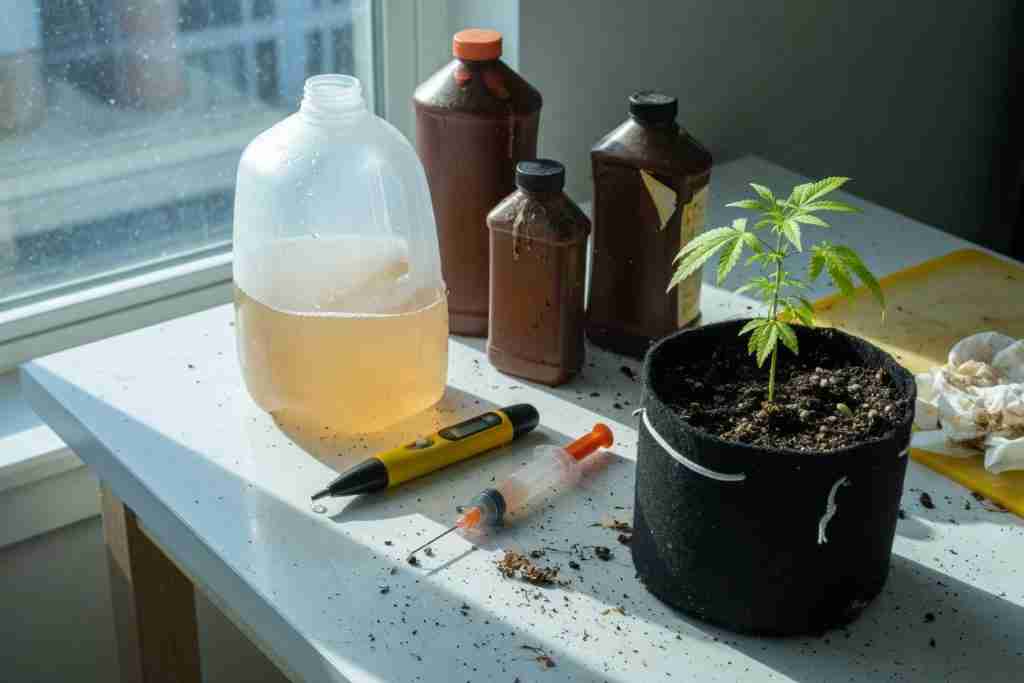
A cheap 1-gallon jug, a syringe, and a pH pen beat a six-bottle line you never measure. Mix in this order: water, base nutes, cal-mag if you use it, then pH. Do not add a bloom booster, a PK spike, a silica, and a carb on day one. One base. Maybe cal-mag in coco under LED. That is a feed. Extra bottles are how salts stack. Advanced stacking: advanced nutrient management.
You Do Not Need Auto-Only Bottles
A bottle that says “autoflower” is usually a milder NPK and a higher price. Photoperiod veg and bloom bottles at quarter to half strength do the same job. Organic dry amendments in a light soil mix do it with fewer jugs. Buy auto-branded nutes if that is what is on the shelf and you will actually measure them. Skip them if you already own a base line. The plant does not read the marketing. It reads salt in the root zone.
How to Mix a Gallon Without Guessing
Fill the jug with tap or RO. If the tap is hard, note it: that water already carries calcium. If it is RO or distilled, you will need cal-mag in coco or the plant will show it. Add the base at a quarter of the veg or bloom number on the chart. Stir. Add cal-mag only if the medium or the water is empty of it. pH last. Write the millilitres on tape on the jug so the next watering is the same mix, not a new guess. Throw leftover mix after a day. A stale jug grows slime and the pH drifts.
Syringes beat capfuls. Caps vary. If the label is millilitres per litre, do the math once on paper and keep that paper. A 4-litre jug at quarter of 4 ml per litre is 4 ml total, not 16. People miss a zero and burn a tent. If you use dry organic, you are not mixing a jug every time. You water plain and let the soil work, then a light tea if the plant goes hungry. Teas that smell like a barn are still food. Do not pour a strong compost tea on a week-two auto in a small pot.
Charged Soil Can Be Too Hot
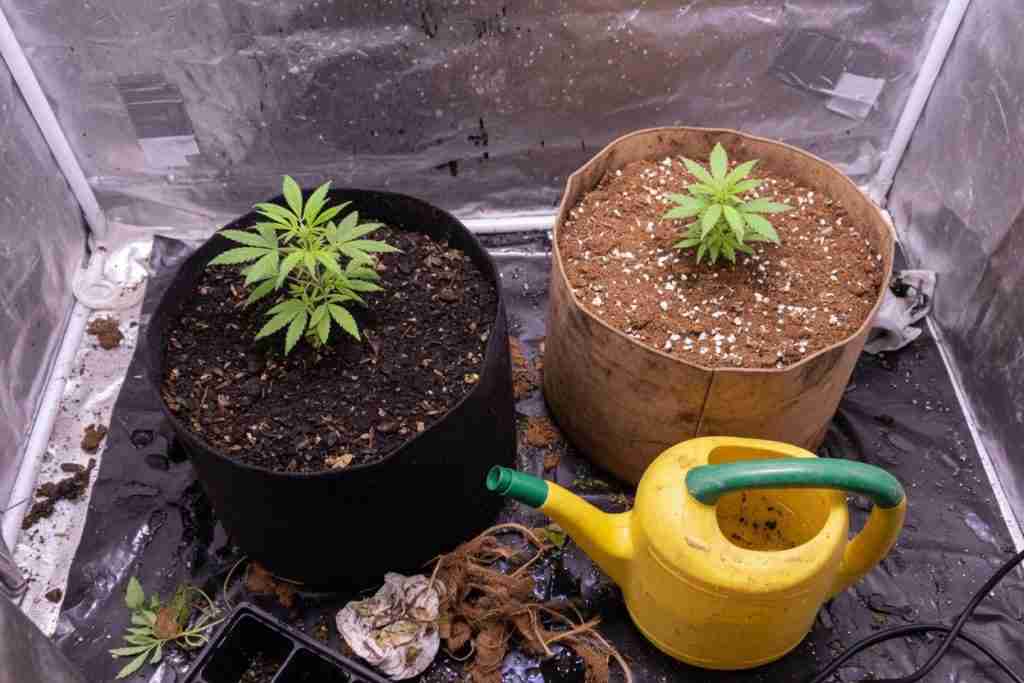
A bag of “hot” potting mix, manure, or slow-release pellets made for patio tomatoes will burn an auto seedling. The mix keeps dumping nitrogen while the plant is still the size of a pencil. You cannot flush a 1-gallon of charged soil fast enough without drowning it. For autos, buy a light potting mix with perlite already in it, or cut a rich bag 50/50 with perlite or coco. Water only until the true leaves are a few sets in. Then a sip of veg, not a full feed. Cheap fill: cheapest grow medium for cannabis. Which medium to pick: best medium to grow cannabis.
A handful of worm castings in a cup is a charge. A gallon of castings in a 3-gallon pot is a meal. Autos live in 2- to 5-gallon pots. They do not need a super-soil recipe built for a 20-gallon photoperiod. If the mix already has food, your first “fertilizer” is water. Castings: worm castings. Other amendments: organic growing amendments.
Coco and Hydro Feed Every Water
Soil holds a charge. You often feed, then water plain, then feed. Coco and hydro are empty. If you water coco with plain tap for a week you starve it, then you panic and dump a strong jug. Feed coco at a light EC every watering, with enough runoff that salts do not sit. Hydro is the same idea with even less buffer. Soil versus hydro: soil vs hydroponic cannabis. Coco how-to: growing cannabis in coco coir. Hydro box: hydroponic cannabis growers guide.
Cal-mag shows up in coco and under LEDs because the medium has none and the light drives a fast plant. Interveinal yellow on new leaves, rusty spots, weak stems: that is often Ca/Mg, not “needs more bloom.” Add cal-mag at the low end of the bottle before you raise the base. If you already burn tips, cal-mag on top of a hot jug makes it worse. Lockout: cannabis nutrient lockout.
Seedling Weeks: Water, Then a Sip
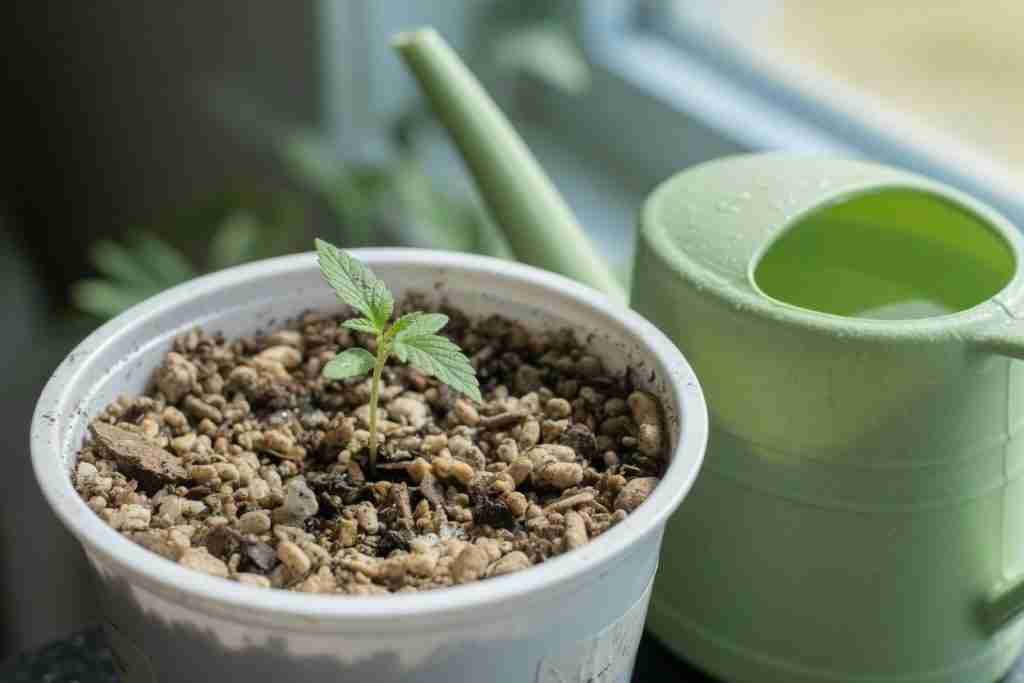
Germinate, drop into a cup or the final pot, and give pH’d water. A seed has food. A charged mix has food. Bottles in week one cook the taproot. Wait until you have a few sets of true leaves and the mix is not still dumping. Then a quarter-strength veg feed, or a weak fish/kelp if you are organic. If the seedling is in inert coco, a very light feed from the start is the exception, not the soil rule. Seedlings: cannabis seedling stage. Watering: water cannabis plants.
Keep the cup small or the final pot airy. A seedling in a 5-gallon of wet peat sits in a cold core. Autos hate a late transplant, so many growers start in the finish pot. That only works if the mix dries in a couple of days, not a week. Wet mix plus a bottle is a double hit. Roots: healthy cannabis roots.
When Pistils Show, Change the Ratio
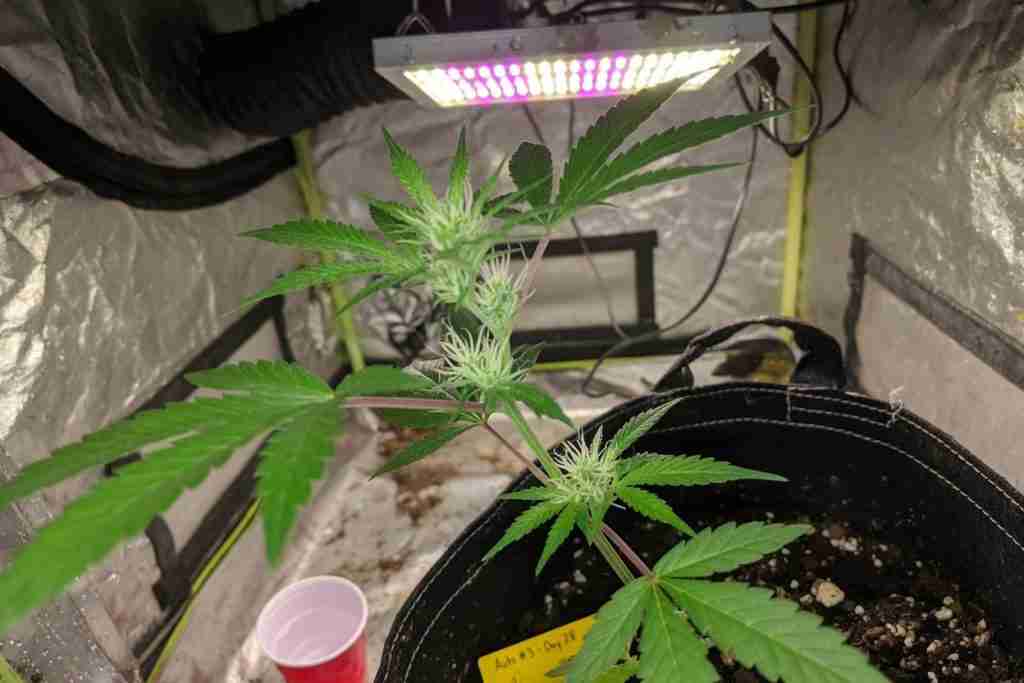
White hairs at the nodes is the switch. Drop nitrogen. Raise phosphorus and potassium. You still need some N or the plant yellows too early and stalls. A bloom bottle at half strength, or a 1-3-2 style ratio, is the usual move. Do not add a PK booster the same week you switch. Give the plant a week on bloom base. If the flowers stack and the tips stay green, you can add a light PK later, once, not every water. Phosphorus: phosphorus nutrition in cannabis. Flower deficiencies: flowering stage nutrient deficiencies.
Autos still stretch after pistils. That stretch wants a little nitrogen. Cutting N to zero on day one of hairs makes a yellow, short plant with airy buds. Taper. Veg: cannabis vegetative stage. Skip foliar bloom sprays unless you already know your room. Flower foliar: foliar feeding cannabis plants in flowering.
Burned Tips Cost More Than Pale Leaves
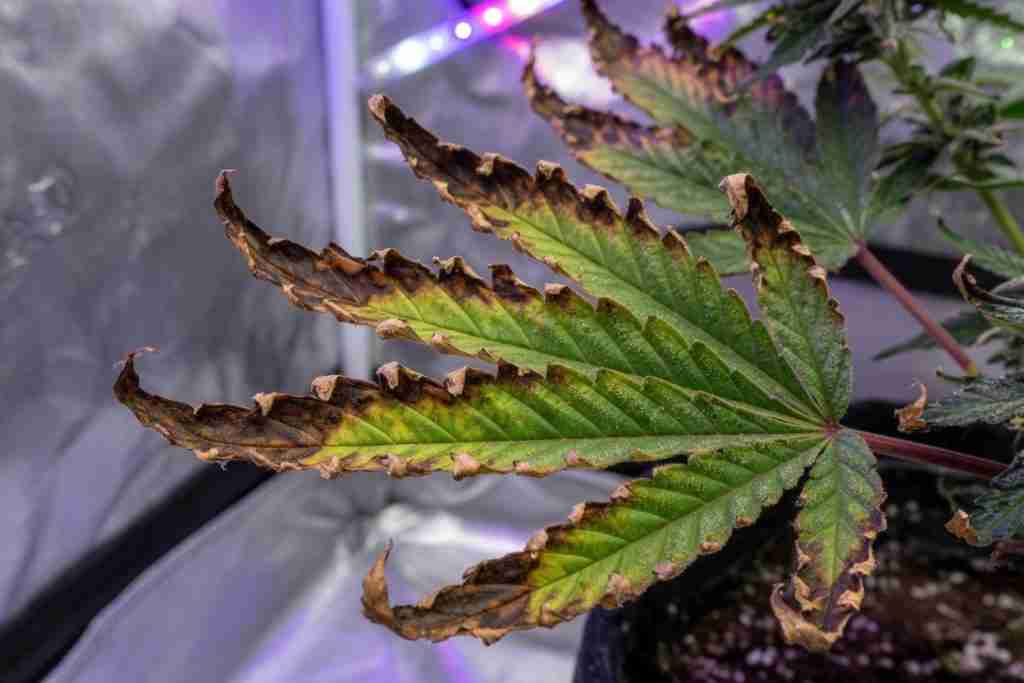
Overfeed on an auto looks like hooked claws, burnt tips, dark shiny leaves, then lockout that looks like a deficiency. You add more bottles. It gets worse. Underfeed looks like lime new growth and older fans fading while the plant is still stretching. Underfeed you can fix with a slightly stronger jug next time. Overfeed you flush, then you wait, and the clock is still running. Default to hungry. A slightly pale auto that finishes is a jar. A burnt auto that stalls in week four is trim. Deficiency pictures: cannabis nutrient deficiency. Clawing: leaf curling or clawing.
If tips are brown, stop feeding. Water to 10 to 20 percent runoff with pH’d water until the runoff EC drops toward your tap, then resume at a quarter of what you were using. Do not strip every fan. The plant needs leaf to finish. Do not transplant to “save” it. That is another stall. Indoor room: indoor cannabis growers guide.
pH and Runoff Are the Real Feed
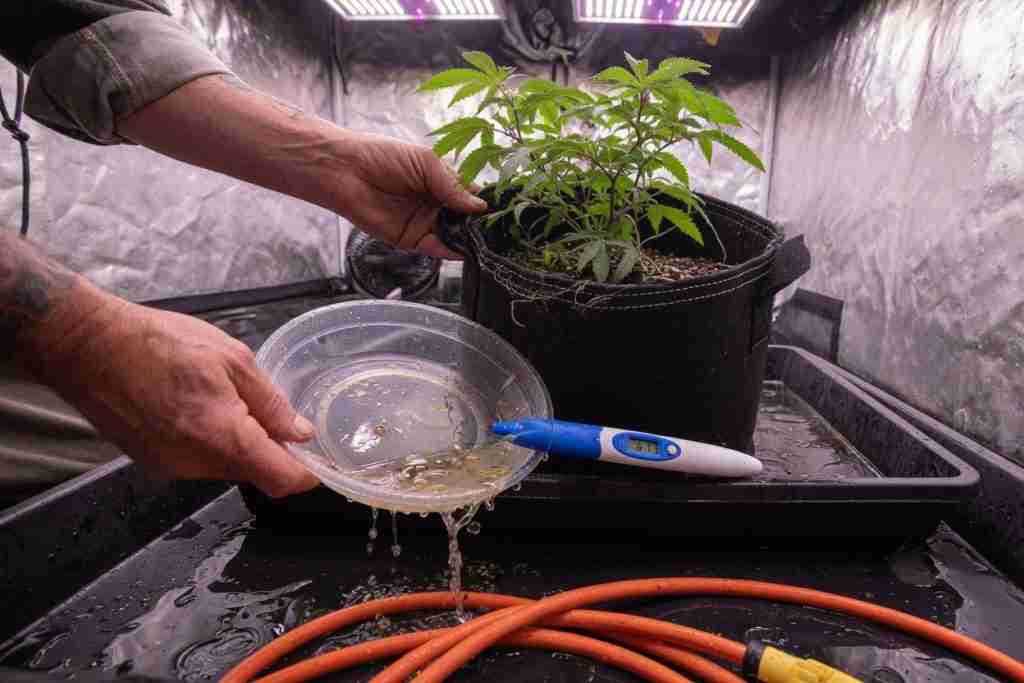
Soil you aim the jug around 6.2 to 6.8. Coco and hydro you hold tighter, about 5.8 to 6.2. If pH is off, the bottle does not matter. The plant sits in food it cannot take. A $15 pen is part of fertilizing autoflowing cannabis plants. Calibrate it. pH the mixed jug, not the tap before nutes. Soil pH deep dive: optimum soil pH for cannabis.
Catch runoff in a saucer, then dump it. Sitting in a puddle is a second feed you did not measure. If runoff EC is a lot higher than what you poured in, the pot is salty: more plain water, weaker next feed. If runoff is much lower and the plant is pale, the pot is empty: feed. In soil, every other watering with nutes is a sane default. In coco, most waterings are feed at a low EC. How often you water still matters more than a fancy ratio. Tent: grow tent for cannabis seeds.
Last Waters Before Chop
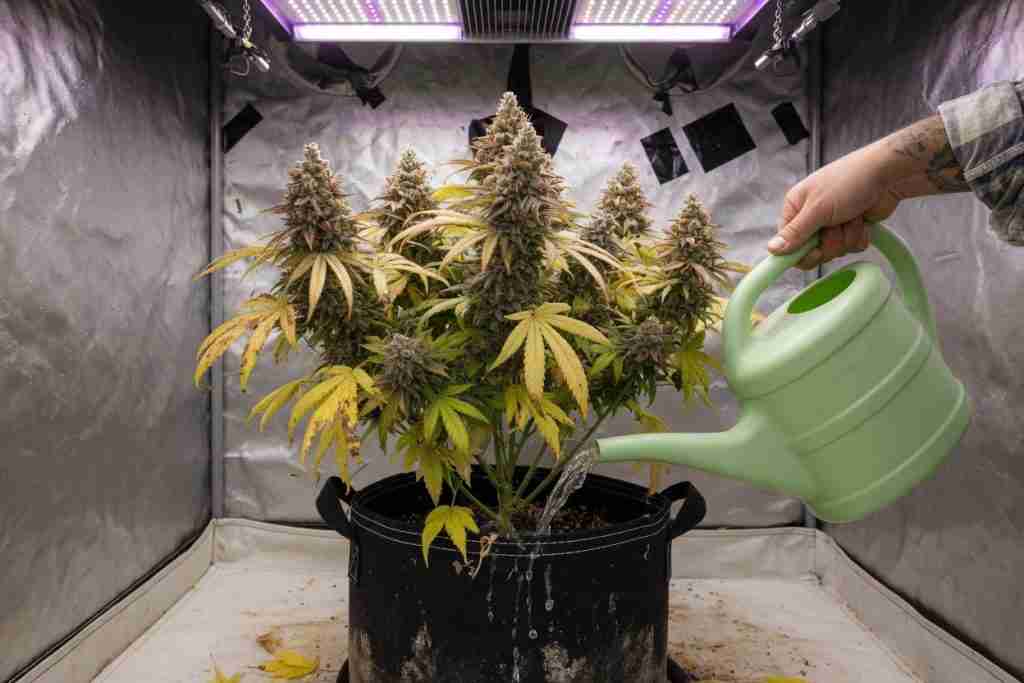
In the last 7 to 10 days, many growers run plain pH’d water so the plant can use what is already in the pot. Fans fade. That fade in late flower is not the same as a starved seedling. Do not dump bloom bottles on yellow fans in week nine of a 10-week auto. You are salting the jar. If you grew in a light organic mix and never bottled, you may only water as usual. If you bottled in coco, a short plain-water run clears the medium. Flushing: flushing cannabis.
Taste in the jar comes from a clean dry and a decent grow, not from a miracle last feed. Keep notes: days from sprout, first pistils, first burnt tip, last feed day, harvest day. Next run you mix the jug from the card, not from a forum chart that assumed a different medium. First-run list: new cannabis growers checklist.
A Working Walkthrough by What You See
Sprout to first true leaves: pH’d water, small sips, let the top dry. Two to four nodes, still no hairs: one light veg feed, then water, then see. If new growth is green and the plant is adding leaf every day, stay there. Do not climb the chart because a forum said week four is “full veg.” When pistils show, swap the bottle to bloom at the same weak strength you already used, not a jump. Mid flower, flowers packing on: hold that mix. If fans are too dark and shiny, skip a feed. If new growth is yellow and the runoff is clean, bump a little. Last week or so: water. That is the whole schedule. The numbers on a seed listing (60 days, 75 days, 90 days) only tell you how long the clock might run. They do not tell you the millilitres.
Outdoor autos follow the same plant cues with more sun and more rain. Rain is a flush you did not plan. After a two-day soak, the pot or bed may be empty of bottle food and still wet. Wait until it dries, then a light feed, not a double to “make up.” In a raised bed of native dirt plus compost, you may never bottle. In fabric pots on a deck, you will, because those pots run out. Do not foliar-feed in midday sun. Do not pour leftover hydro mix around a patio auto and call it organic. The weed in the bed still reads salt.
Two plants in the same tent can want different jugs. One auto throws pistils on day 21. The sister is still all leaf on day 30. Feed them as two plants. A shared reservoir in hydro is the exception: then you mix for the hungrier stage and accept the leafier plant gets bloom a bit early, or you isolate. In soil and coco, two watering cans is easier than one burnt keeper. If you only have one jug, mix to the plant with pistils and give the vegging sister a shorter pour of the same weak bloom, or a separate weak veg. Do not average a strong mix “for both.”
What “Less Is More” Looks Like in the Room
A healthy auto in mid veg is medium green, not black-green. Petioles are not red from stress alone, though some genetics run red anyway. Tips are clean. The pot dries on a rhythm you can predict. Runoff does not smell like a battery. In flower the plant still makes some leaf, the flowers gain weight, and lower fans fade slowly, not overnight. If you are topping bottles every other day and the plant looks “fed,” you are usually over. If you water on a timer with a strong mix because you are at work, buy a weaker mix, not a bigger pump. The expert move on fertilizing autoflowing cannabis plants is a boring jug you can repeat.
Light hours change how hard the plant drinks. An auto under 18 hours of LED uses more water, and more of a light mix, than the same plant under 12. That is not a reason to raise EC. It is a reason to water more often at the same weak strength. Heat in a small tent does the same: dry pots, same millilitres per litre. If the room is cool and the pot stays wet, you feed less often, still at the same mix. Strength and frequency are two knobs. Turn frequency with the pot. Turn strength only when the leaf tells you. A first marijuana auto in a 3-gallon under a modest LED is a quarter-strength plant until it proves it wants more. Write that on the jug so you do not “help” it at 2 a.m. with extra millilitres from a second bottle.
Fertilizing Autoflowing Cannabis Plants FAQ
When should I start feeding an autoflower?
In soil, after a few sets of true leaves, and only if the mix is not already hot. In coco or hydro, a very light feed once the seedling is up. Week-one bottles in rich soil are the usual burn.
How strong should autoflower nutrients be?
Quarter to half of the photoperiod bottle chart. Step up only if the plant stays pale and the tips are clean. Full label is for a plant that can veg out of a mistake. An auto cannot.
Do I need special autoflower fertilizer?
No. Regular cannabis veg and bloom bottles at a weaker mix work. Auto-labeled bottles are milder by design. Measure either one. Do not stack both.
How often do I fertilize autoflowing cannabis plants?
Soil: nutes every other watering is a working default. Coco and hydro: light feed most waterings, with runoff. Always water when the pot is light, not on a fixed weekday.
When do I switch from veg to bloom nutes?
When you see pistils, not when a week table says so. Keep a little nitrogen through early flower stretch. Cut the heavy N once flowers are actually stacking.
Should I use a PK booster on autos?
Only after bloom base is already working, at a low dose, and not every watering. PK on top of a hot coco feed is lockout. Bloom base first.
What pH should I use?
About 6.2 to 6.8 in soil. About 5.8 to 6.2 in coco and hydro. pH the mixed jug. Off pH looks like a deficiency even when the bottle is full.
How do I fix nutrient burn on an auto?
Stop the bottles. Water to runoff until the salt load drops. Resume at a quarter of the old mix. Do not transplant and do not add cal-mag on top of a still-hot pot.