Curing Cannabis in Cold Climates: Slow-Cure Without Mold

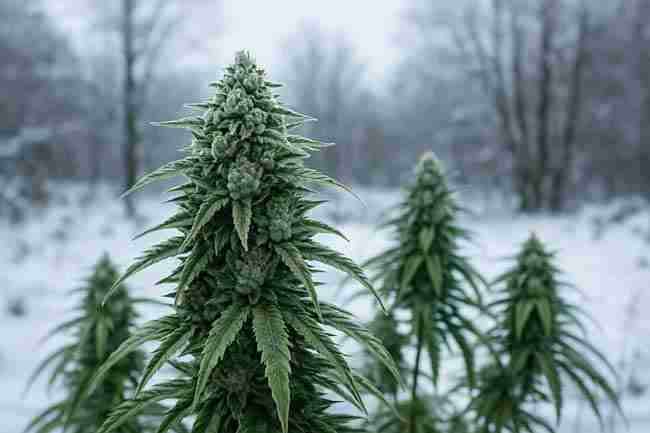
You worked hard to grow your buds. Now you’re staring at cold weather, a chilly room, and those jars… and you’re scared you’ll either dry them to dust or grow fuzz instead of trichomes.
Good. You should take curing seriously.
In a cold place, you can still pull off a perfect cold climate cannabis cure. You just need to control a few simple things: temperature, humidity, time, and airflow. I’ll walk you through it like you’re standing in your drying room with me, step by step, so you can slow cure cannabis without mold and without guesswork.
What Is a Cold Climate Cannabis Cure?
When you cure buds, you’re not just “storing weed.” You’re finishing the job.
A cold climate cannabis cure means you’re curing your buds in a place where the air temperature is low for most of the year—think basements, sheds, spare rooms, garages, or unheated spaces in fall and winter.
You’re trying to:
- Dry them slowly
- Keep them safe from mold
- Protect your terpenes and potency
In warm places, the fight is to keep things cool and not too humid. In cold places, you play a different game:
- Air may be cold and dry → buds over-dry and get harsh.
- Or air may be cold and damp → buds stay too wet and mold creeps in.
A proper cold climate cure hits the sweet spot between those two extremes. That’s why a slow cure cannabis process becomes your best friend.
Why Curing Matters More in Cold Climates
You can rush drying in warm weather and still get something smokable. It won’t be great, but it’ll work.
In a cold climate, though, you’re often working in:
- Half-finished basements
- Drafty closets
- Outdoor sheds with big temperature swings
Because of this, your buds can be:
- Too wet on the inside, even when the outside feels dry
- Too dry and crispy, with no flavor left
- Unevenly cured, where some jars are perfect and others smell like hay or mildew
Curing matters more because the room around your buds keeps changing. Your job is to stabilize their world, even when your weather won’t cooperate.
Ideal Conditions for a Slow Cure Cannabis Process
To get a clean, smooth slow cure cannabis result, you aim for a small “comfort zone” that your buds love.
Target Ranges for a Cold Climate Cannabis Cure
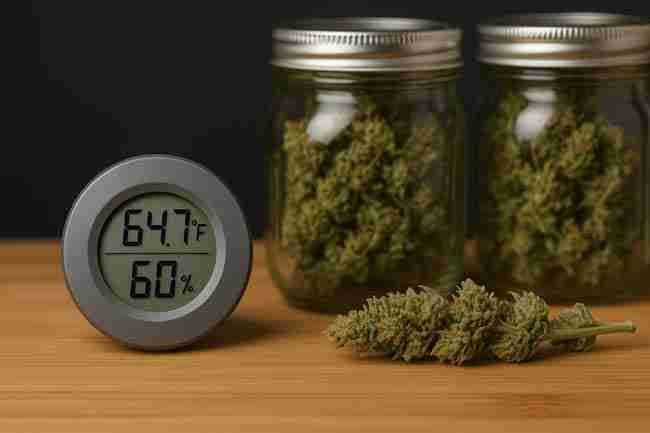
Try to hold your curing space or jars in this range:
- Temperature: 60–68°F (15–20°C)
- Relative Humidity (RH): 58–62%
- Time: Minimum 3–4 weeks, 6–8 weeks is better
Lower than that, and everything slows way down. Higher than that, you invite mold or terpene loss.
Simple Condition Table for Cold Climate Cannabis Cure
| Factor | Target Range | Why It Matters |
|---|---|---|
| Temperature | 60–68°F (15–20°C) | Keeps terpenes safe and prevents harsh, fast drying |
| RH in jars | 58–62% | Ideal water content for smooth smoke and flavor |
| Drying time | 7–14 days | Sets up an even slow cure; not too fast, not too slow |
| Cure length | 3–8 weeks | Lets chlorophyll break down and aromas fully develop |
| Airflow | Gentle, indirect | Prevents stale air and mold without over-drying |
These numbers don’t care if you live in Canada, Alaska, Maine, or some windy mountain valley. The plant doesn’t read your weather report. It “feels”:
- The air around it
- The RH inside the jar
- How often you burp and manage moisture
Curing Room Setup for Cold Climates
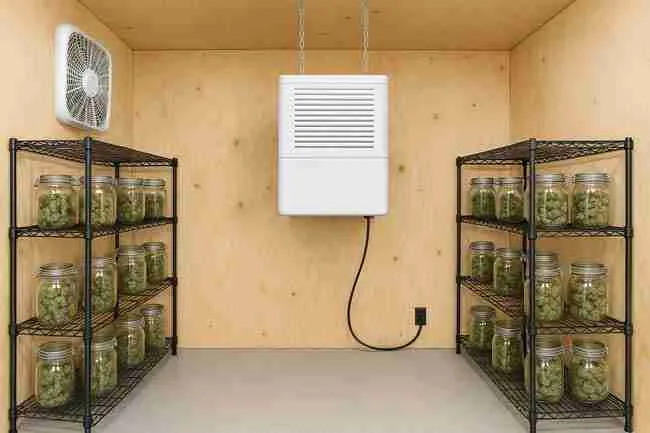
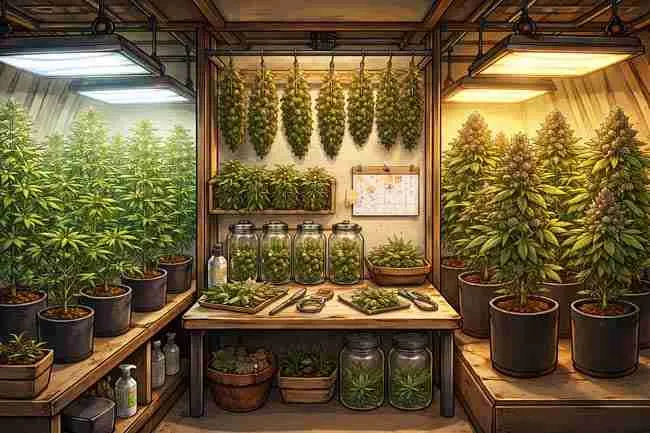
You don’t need a fancy lab. You just need a smart curing room setup that fits your space and the weather you actually have.
Choosing the Right Space
Pick a space that:
- Stays dark (or very dim)
- Has some insulation (no constant freezing drafts)
- Lets you control air a little (door, vent, fan)
Good options:
- A small closet inside your home
- An unfinished basement corner with a curtain or tent
- A small grow tent dedicated to drying and curing
Bad options:
- Unheated sheds that freeze at night
- Rooms with big temperature swings every day
- Places with strong smells (fuel, paint, cooking, laundry)
Basic Heating for a Curing Room Setup
If your room drops under 55°F (13°C) often, your cure slows down too much. To fix that, you can use:
- Small oil-filled radiator heater
- Safe, steady heat
- No direct airflow on the buds
- Ceramic space heater with thermostat
- Use lowest setting
- Point it away from hanging buds or jars
Key rule: Never blow hot air directly on your buds. You want the whole room warm, not one crispy corner.
Humidity Control in Cold Climates
Cold air usually holds less moisture, but basements and coastal areas can still be damp. So you may need to:
- Raise humidity (if air is too dry) with:
- A small humidifier set to 60%
- Open containers of water in the room
- Hanging damp towels (short-term only)
- Lower humidity (if air is too damp) with:
- A dehumidifier set to ~55–60%
- Running a fan on low to move air gently
- Avoiding wet laundry, open water, or damp concrete nearby
Simple Budget Curing Room Setup
If money is tight, here’s a minimal curing room setup you can put together:
- A small closet or corner of a room
- Hangers or a simple clothes rack
- One small fan on low, pointed at a wall (never directly at buds)
- A thermo-hygrometer (cheap digital meter for temp/RH)
- A few cardboard boxes or paper bags for slowing down drying if needed
You’ll tweak humidity with those boxes and your home’s heating system more than with machines. It’s not fancy, but it works.
Advanced Curing Room Setup
If you want to really dial it in:
- Use a small grow tent as a sealed curing space
- Add:
- Inkbird-style temperature controller plugged into a heater
- Humidity controller plugged into a humidifier or dehumidifier
- Oscillating fan inside on low
- Carbon filter (optional) to control smell
This turns your tent into a mini climate-controlled curing room—perfect for a serious cold climate cannabis cure.
Step-by-Step Cold Climate Cannabis Cure
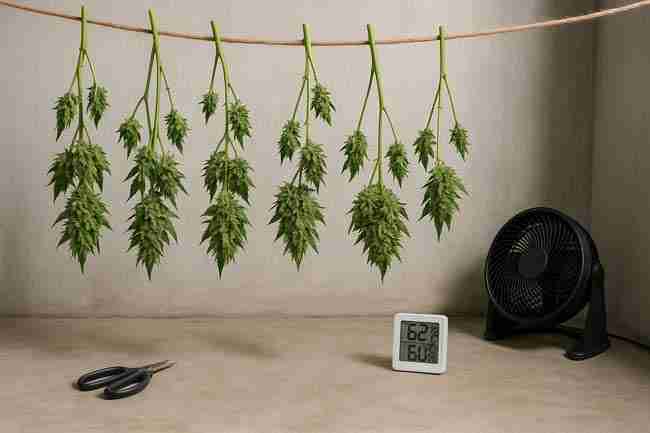
Let’s walk through the whole process from chop to jar.
Step 1: Harvest at the Right Time
- Wait until most trichomes are cloudy with some amber.
- Don’t harvest early just because frost is coming. If you can, bring plants inside or cover them, then harvest when they’re truly ready.
Step 2: Pre-Trim vs Whole-Plant Hang
In cold climates, I usually like whole-plant hanging or leaving more leaves on the branches. That slows drying down.
- If your air is very dry, keep more leaf material on.
- If your air is humid, do a light pre-trim so there’s less moisture.
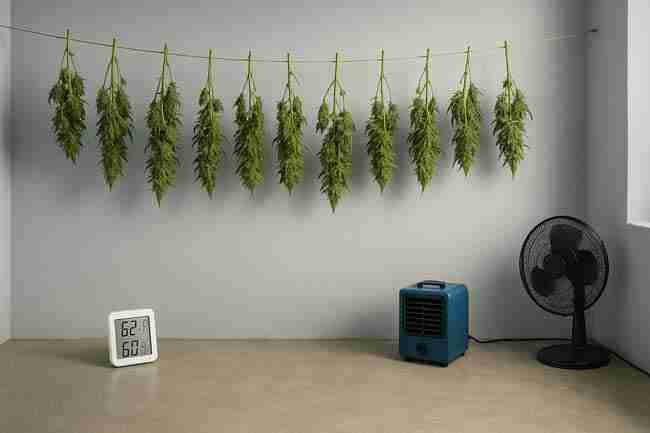
Hang branches or whole plants upside down in your curing room.
Step 3: Drying in a Cold Climate
Aim for 7–14 days of drying. Here’s how you can handle it:
- Hang buds in the dark.
- Keep temperature between 60–65°F (15–18°C).
- Hold room humidity between 55–65% RH.
- Run a fan on low, pointed at a wall, just to move air.
Test a small branch:
- Bend a little twig.
- If it bends and then cracks a bit but doesn’t snap clean off, you’re ready for jars.
- If it’s soft and floppy, it’s still too wet.
Step 4: Jarring Up for Slow Cure Cannabis
Once drying is done:
- Snip buds from branches.
- Put buds into glass jars about 70–80% full (never packed tight).
- Put a small hygrometer inside at least one jar per batch to watch RH.
Inside the jar, you want RH to settle around 58–62%.
If RH is too high (over 67–68%):
- Take buds out and spread them on a tray for 1–2 hours.
- Put them back in jars and re-check after a few hours.
If RH is too low (under 55%):
- Add a small humidity pack (58–62%)
- Or place a tiny piece of fresh fan leaf or small bit of citrus peel for just a few hours, then remove it.
Step 5: Burping Jars in Cold Conditions
For the first 7–10 days:
- Open each jar 1–2 times per day.
- Leave jars open 5–15 minutes in a room with good conditions.
- Gently move the buds around with your hand to release trapped moisture.
After 2–3 weeks:
- Burp jars every 2–3 days.
After 4 weeks:
- Burp jars once a week, or only if RH creeps up.
This is the heart of your slow cure cannabis routine. You’re letting moisture move from the center of each bud to the outside, and then out of the jar in controlled amounts.
Avoiding Mold While You Slow Cure Cannabis
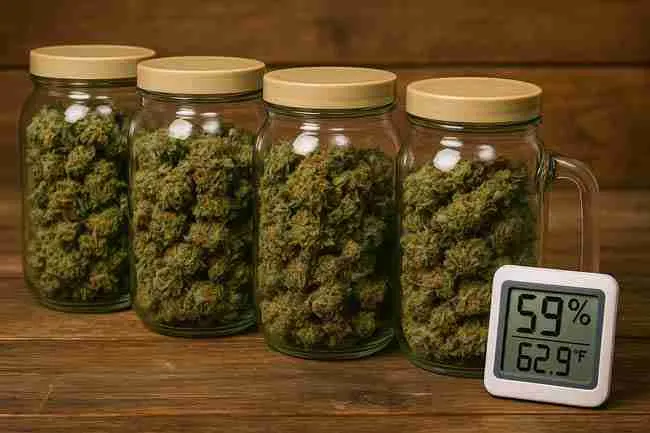
Mold is the one thing that can ruin months of work overnight. In cold climates, mold pops up when things stay cold and wet for too long.
Mold Warning Signs
Watch, smell, and feel your buds carefully:
- Smell:
- Musty, basement-like, or “old socks” odor
- Sour or swampy smell
- Look:
- Fuzzy white, gray, or green patches
- Webby growth deep inside the bud
- Touch:
- Very wet or spongy buds even after long drying
- Jar walls fogging up heavily after a short time closed
If you see mold, throw that bud away. Don’t try to smoke it, cook it, or turn it into extracts.
Simple Mold-Prevention Rules
To keep mold away during your cold climate cannabis cure:
- Don’t jar too early. Stems should have at least a light crack.
- Keep jar RH under 65% once buds are sealed.
- Never leave jars closed for days if they still feel damp.
- Use lots of small jars instead of one big container.
- Keep jars out of cold, damp basements unless you can control the room conditions.
Tools and Specs Checklist for Cold Climate Growers
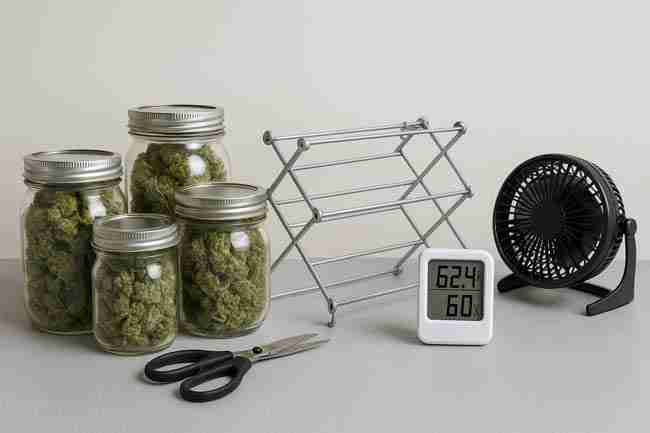
To make your life easier, here’s a simple list of tools that make a huge difference.
Must-Have Tools
- Thermo-hygrometer (temperature + humidity meter)
- Glass jars with airtight lids (Mason jars)
- Small digital hygrometers for jars
- Small fan with adjustable speed
- Scissors or trimmers
- Drying rack or hangers
Nice-to-Have Extras
- Oil-filled space heater with thermostat
- Humidifier (cool mist) for very dry homes
- Dehumidifier for damp basements
- Humidity packs (58–62%)
- Grow tent as a curing chamber
Specification Table for a Solid Curing Setup
| Item | Spec / Target | Notes |
|---|---|---|
| Room temperature | 60–68°F (15–20°C) | Use heater if needed |
| Room humidity | 55–65% during drying | Control with humidifier/dehumidifier |
| Jar humidity (RH) | 58–62% | Watch with mini hygrometers |
| Jar size | 500 ml – 1 L (pint–quart jars) | Easier to control than huge jars |
| Drying time | 7–14 days | Longer side is better for smooth smoke |
| Cure time | 3–8 weeks | Flavor and smoothness keep improving |
| Fan speed | Low, indirect | No direct wind on buds |
Real-Life Example: Turning a Drafty Room into a Curing Space
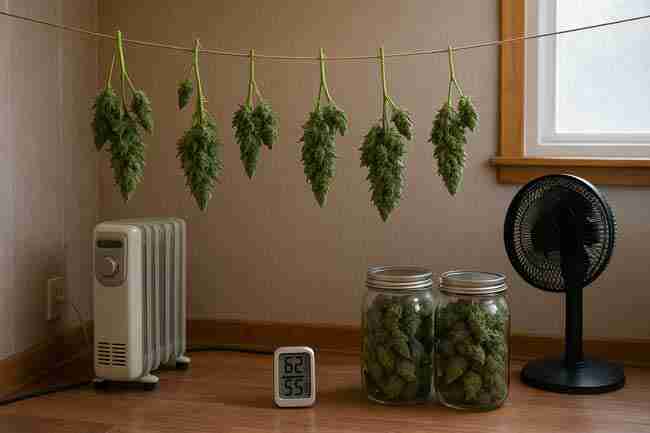
Picture this.
You’ve just harvested a nice run. Outside, it’s cold, windy, and damp. Your only free space is a drafty spare room that drops to 50°F at night.
Here’s how you turn that mess into a workable curing room setup:
- Block drafts
- Use towels at the bottom of the door.
- Close any windows tightly.
- Hang a blanket over a leaky window.
- Add gentle heat
- Put a small oil-filled heater in the corner.
- Set it to keep the room around 62–65°F.
- Control humidity
- Put a thermo-hygrometer in the middle of the room.
- Let it run for a day and see your baseline RH.
- If it’s under 45%, add a humidifier or water containers.
- If it’s over 70%, run a dehumidifier or move to a drier room.
- Hang plants smartly
- Hang branches or whole plants away from the heater.
- Leave space between branches so air can move.
- Use a fan wisely
- Put a fan on low, pointing at the wall or ceiling.
- Let air bounce off surfaces instead of blowing directly on buds.
- Watch daily
- Check temp/RH morning and night.
- Adjust heater or humidifier settings a little at a time.
That’s it. You just turned a sketchy room into a decent environment for a cold climate cannabis cure.
Pros and Cons of a Cold Climate Cannabis Cure
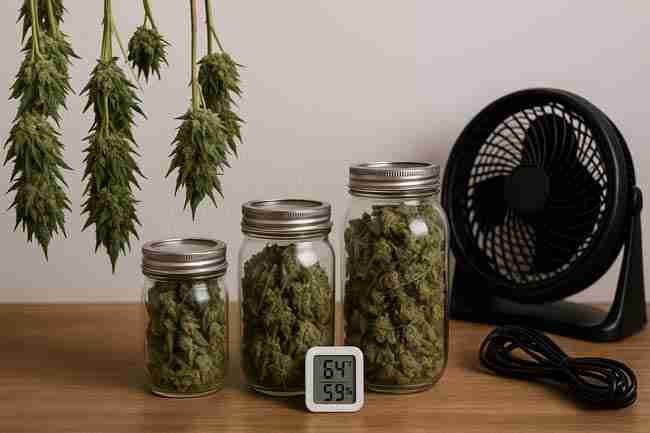
Nothing is perfect, and curing in a cold climate has its ups and downs.
Pros
- Better terpene protection
- Lower temps naturally protect aromas and flavors.
- Less risk of heat damage
- You’re not cooking your terpenes like in hot climates.
- Slower, smoother curing
- With good humidity, your slow cure cannabis process can be excellent.
- Smell control can be easier
- Cold, sealed rooms hold smell better than hot, drafty ones.
Cons
- Risk of over-drying
- Cold, dry air can suck moisture out too fast if you’re not careful.
- Mold in damp basements
- Cold + damp + still air = mold party if you let it.
- More gear sometimes needed
- Heaters, humidifiers, dehumidifiers—depends on your house.
- Temperature swings
- Nights get colder, days warmer; buds don’t like big swings.
Once you understand these pros and cons, you stop fighting the climate blindly and start working with it.
Common Mistakes to Avoid in Cold Climate Curing
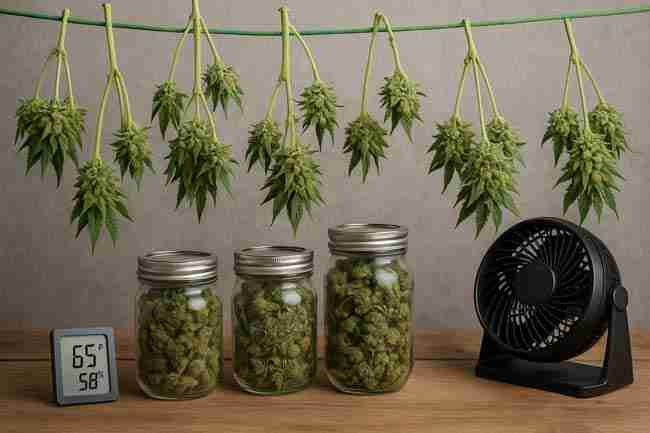
You can avoid most disasters if you don’t fall into these traps:
- Jarring too early
- If stems are still fully bendy, they’re too wet.
- Ignoring humidity in jars
- Guessing instead of reading a hygrometer is how mold sneaks in.
- Using big plastic tubs
- Hard to control moisture; mold can spread quickly.
- Direct heat on buds
- Heaters or vents blowing on buds will overdry them.
- Leaving jars in freezing rooms
- Extreme cold can stall curing and mess with moisture movement.
Quick Action Checklist for Your Cold Climate Cannabis Cure
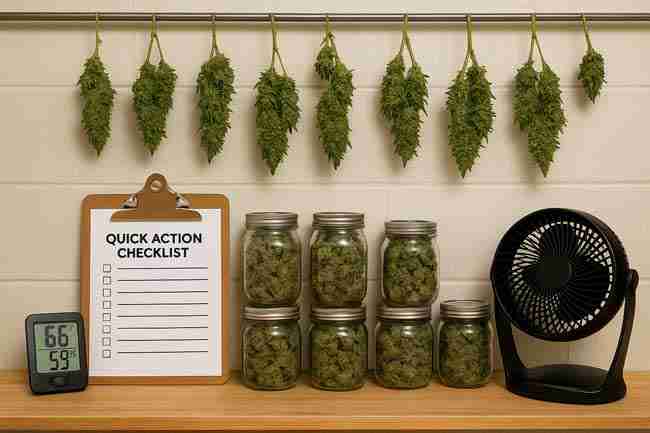
Here’s a simple list you can run through at harvest time:
- Pick a dark, draft-controlled space
- Set up a small heater (if room is under 60°F)
- Put a thermo-hygrometer in the room
- Adjust humidity to 55–65%
- Hang plants with space between branches
- Dry 7–14 days until stems lightly crack
- Jar buds 70–80% full with mini hygrometers
- Keep jar RH at 58–62%
- Burp daily for the first week, then less often
- Cure at least 3–4 weeks, longer if you can
Follow this, and your cold climate cannabis cure will turn out better each run.
FAQ: Cold Climate Cannabis Cure, Slow Cure Cannabis, and Curing Room Setup
How long should a cold climate cannabis cure take?
You should plan for at least 3–4 weeks of curing after drying. In a cold place, a slow cure cannabis process often feels slower, but that’s a good thing. Many growers notice the best flavor and smoothness around 6–8 weeks of curing.
What temperature is too cold for curing cannabis?
Once your room drops below about 55°F (13°C) for long periods, the curing process slows too much. The buds won’t really cure; they’ll just sit there. Try to keep the curing space around 60–68°F with a small heater.
How do I stop mold during a cold climate cannabis cure?
Watch your jar humidity. Use mini hygrometers and keep RH in the jar around 58–62%. If RH climbs above 65–67%, open the jar and let buds air out. Never leave very wet buds sealed for long. Also avoid damp basements unless you control the room with a dehumidifier and gentle airflow.
Is a curing room setup really necessary, or can I just use jars?
You can cure in jars alone, but a smart curing room setup makes everything easier. If your room already sits close to the right temperature and humidity, your jars will be easier to manage, your burping will be simpler, and you’ll have fewer surprises.
Do I need humidity packs for a cold climate cannabis cure?
You don’t have to use them, but they help. In very dry cold climates, buds can lose too much moisture while drying. A 58–62% humidity pack inside the jar helps hold the perfect cure range. Just don’t use them as a band-aid for poor drying; you still need to dry properly.
Can I cure cannabis in a fridge or very cold space?
I don’t recommend curing in a fridge. It’s too cold and too humid in the wrong way, and you get moisture condensation. For a cold climate cannabis cure, it’s better to use a room, closet, or tent with a small heater and normal air rather than a refrigerator.
Final Thoughts: Owning Your Cold Climate Cannabis Cure
Cold weather doesn’t ruin good weed. Bad curing does.
If you control a few simple things—temperature, humidity, time, and airflow—you can run a slow cure cannabis process that beats what many warm-climate growers manage. Your buds will:
- Burn smoother
- Taste stronger
- Hit cleaner
Set up a basic curing room setup, keep your jars in that 58–62% sweet spot, and listen to what your buds are telling you—by smell, by feel, and by how they smoke. Do that, and cold weather becomes an advantage, not a curse.