Cannabis VPD Explained for Home Growers (Without the Math Headache)


You’re standing in your grow room, staring at your hygrometer like it owes you money. Humidity says one thing. Temperature says another. Your plants? They look “fine”… until they suddenly don’t.
That’s where VPD cannabis comes in.
VPD sounds like a lab word, but it’s really just a simple way to answer one question:
“How thirsty is the air, and how hard is it pulling water out of your plant?”
When you get that right, your plants drink, eat, and breathe like they should. When you get it wrong, you get slow growth, burnt tips, crispy edges, droopy leaves, weak stems, mold risk, and all those “What the heck is happening?” moments.
And here’s the good news: you can use vapor pressure deficit cannabis thinking without doing any math. You’ll use targets, simple habits, and a couple of common-sense checks. That’s it.
What VPD Actually Means (In Normal Human Language)

VPD stands for Vapor Pressure Deficit. Don’t let the name spook you.
Think of the air like a sponge:
- Warm air can hold more water.
- Cold air holds less water.
- Humidity (RH%) tells you how “full” that sponge is.
VPD tells you how much “room” is left in that sponge.
- Low VPD = air is already “wet” and full → plant struggles to evaporate water.
- High VPD = air is “dry” and thirsty → plant dumps water fast.
So VPD cannabis is really the balance between:
- temperature
- humidity
- (and ideally) leaf temperature
You don’t need to calculate it. You just need to aim for the right “air thirst” for each growth stage.
What VPD Actually Controls (Transpiration, Calcium Flow, Terpene Retention)
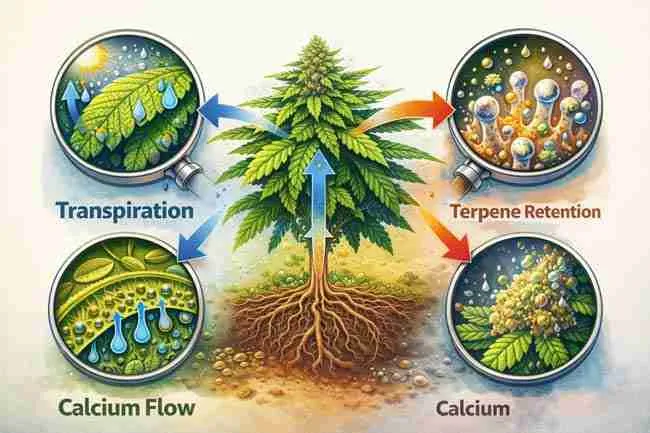
If you only remember one thing, remember this:
VPD controls how your plant moves water. And water movement controls almost everything else.
Transpiration: The Plant’s “Breathing and Drinking” System
Your plant doesn’t have lungs, but it does have tiny pores called stomata. When stomata open:
- water vapor exits the leaf
- fresh CO₂ enters the leaf
- the plant powers growth
If VPD is off, stomata act weird:
- Too low VPD: stomata get lazy, water doesn’t move well, growth slows.
- Too high VPD: stomata clamp shut to avoid dehydration, growth slows again.
So, yeah… both extremes can stall you out.
Calcium Flow: The “Hidden Deficiency” That Isn’t Always a Feeding Problem
Calcium is famous for driving growers nuts because:
- calcium doesn’t move well inside the plant once it’s placed
- it mostly rides with water flow
When your transpiration is weak (often from low VPD), calcium delivery gets sloppy. Then you see:
- twisted new growth
- weird crinkled leaves
- rusty spotting
- tips that look burnt even when you didn’t overfeed
You can throw Cal-Mag at it all day, but if the plant isn’t moving water properly, you’re basically tossing buckets into the wind.
Terpene Retention: Keeping Smell and Flavor From Flying Away
Terpenes are the “aroma molecules,” and many of them are volatile—meaning they can evaporate easier under stress.
When VPD is too high in late flower:
- plants transpire hard
- leaves can dry and crisp
- resin heads can get stressed
- aroma can feel “thin” or sharp instead of rich
That’s why cannabis humidity temperature balance matters so much in flowering. You’re not just growing buds. You’re protecting the finish.
The Big Chain Reaction (This Is the Real Power of VPD Cannabis)
Here’s the domino line you’re actually managing:
VPD → stomata behavior → transpiration → nutrient flow → growth rate + health → bud quality
Once you see it like that, VPD stops being a fancy chart and starts being your steering wheel.
Why RH Charts Lie Without Temperature
A lot of growers chase RH like it’s the holy grail.
“Keep veg at 60% RH.”
“Flower at 45% RH.”
“Seedlings at 70% RH.”
Sounds tidy. Sounds easy. And it’s half true… which is the worst kind of true.
Because humidity by itself doesn’t tell you what the air is doing.
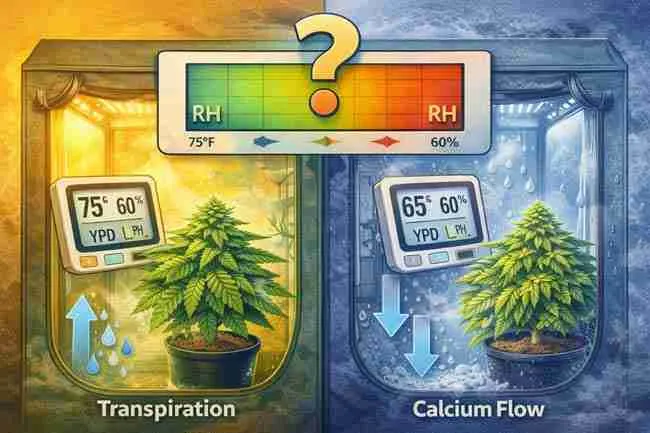
The Same RH Can Be Gentle or Brutal
Picture this:
- Room A: 75°F (24°C) and 60% RH
- Room B: 65°F (18°C) and 60% RH
Same humidity number. Totally different reality.
Warm air at 60% RH can still be thirsty. Cooler air at 60% RH can feel clammy and stagnant.
That’s why “RH-only” charts lie. They ignore temperature. And cannabis does not ignore temperature.
Your Plant Feels Leaf Temperature, Not Just Room Temperature
Here’s the sneaky part: your leaf surface often runs:
- 1–3°F cooler than the air under strong LED lighting (sometimes more, depending on airflow)
- or warmer if airflow is poor and leaves trap heat
So two grows with the same room readings can have different plant behavior. That’s why growers who “do everything right” still get problems.
The Fix: Use VPD Cannabis Targets, Not RH Rules
You can still use RH goals, but you tie them to temperature on purpose.
Instead of saying:
- “I want 60% RH”
You say:
- “I want a VPD range for veg, so my RH depends on my temperature.”
That mindset stops you from chasing numbers like a dog chasing a car.
Simple VPD Targets by Growth Stage (No Math, No Stress)

You want targets you can actually use while you’re busy. So here you go.
Important: These are practical home-grow targets, not “perfect lab” targets. You can run a little outside these ranges and still crush it.
Quick Rules Before the Table
- Seedlings/clones like lower VPD (gentler air) because roots are weak.
- Veg likes mid VPD because plants can drink and grow fast.
- Flower likes slightly higher VPD early to prevent mold, then a bit gentler late to protect quality.
And remember: airflow matters. If airflow is poor, high humidity becomes dangerous fast.
VPD Cannabis Target Table (By Stage)
| Growth Stage | Typical Temp Range | Typical RH Range (to match stage) | Simple VPD Target Range (kPa) | What it “Feels Like” to the Plant |
|---|---|---|---|---|
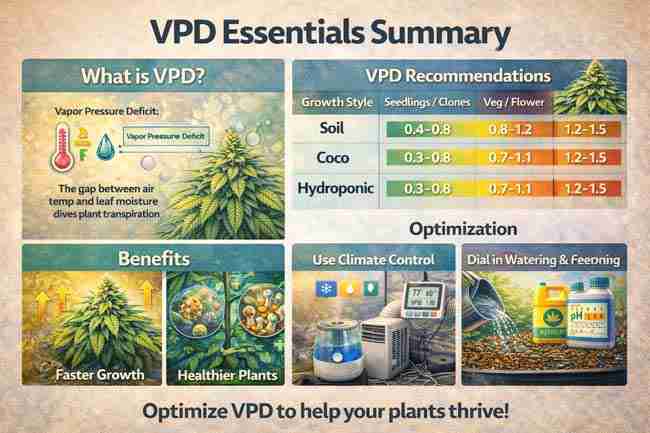
| Seedlings / Clones | 74–80°F (23–27°C) | 65–80% | 0.4–0.8 | Soft, gentle air; prevents drying out |
| Early Veg | 72–80°F (22–27°C) | 55–70% | 0.8–1.1 | Strong growth, steady drinking |
| Late Veg / Pre-Flower | 72–82°F (22–28°C) | 50–65% | 1.0–1.2 | Builds structure; reduces mildew risk |
| Early Flower (Weeks 1–4) | 70–80°F (21–27°C) | 45–60% | 1.1–1.4 | Drives growth while avoiding mold |
| Mid Flower (Weeks 4–7) | 68–78°F (20–26°C) | 40–55% | 1.2–1.5 | Keeps buds safe; strong transpiration |
| Late Flower (Last 2–3 Weeks) | 66–76°F (19–24°C) | 40–50% | 1.0–1.3 | Protects terps/resin; reduces stress |
If you only pick one thing: Aim for the target range and let RH float a bit based on your temperature. That’s the whole “without the math headache” approach.
The “No-Math” Way to Run VPD Cannabis in Real Life
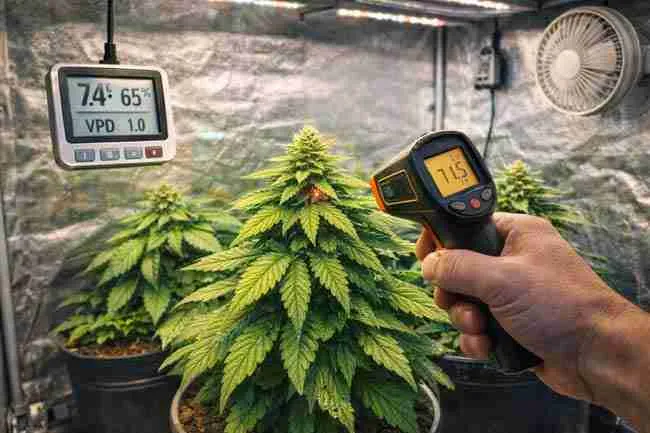
You don’t need to calculate anything if you do these four things.
1) Use a VPD Chart or App (Yes, That’s Allowed)
You’re not cheating. You’re being smart.
Use:
- a VPD chart image you trust
- a grow app that shows VPD
- a controller that calculates it for you
You simply match your stage to the target range.
2) Check Your Leaf Temperature (One Small Upgrade That Changes Everything)
If you want your VPD cannabis setup to feel “dialed,” grab a basic IR thermometer.
You point, click, done.
- If leaf temp is lower than air temp, the plant experiences a higher effective VPD than your room reading suggests.
- If leaf temp is higher, effective VPD is lower.
This explains so many “mystery issues” it’s not even funny.
3) Make One Change at a Time
If you tweak:
- humidity
- temperature
- fan speed
- exhaust timing
…all at once, you’ll have no clue what fixed what.
Change one thing, wait a bit, observe plant posture and drinking rate.
4) Watch the Plant’s “Body Language”
Numbers guide you, but the plant tells the truth.
Healthy VPD cannabis behavior looks like:
- leaves look firm, not stiff
- slight upward “praying” in good light (not taco curling)
- steady daily water use
- new growth looks smooth, not twisted
- no random droop episodes
What VPD Looks Like When It’s Wrong (So You Can Catch It Fast)
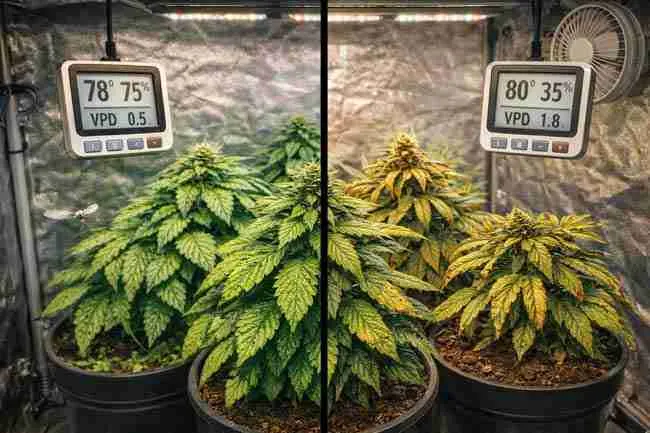
When VPD Is Too Low (Air Too Wet / Not Thirsty Enough)
This is the “swamp room” problem.
You might see:
- slow growth even with good light
- leaves that feel thick or puffy
- weak stems
- algae on soil surface
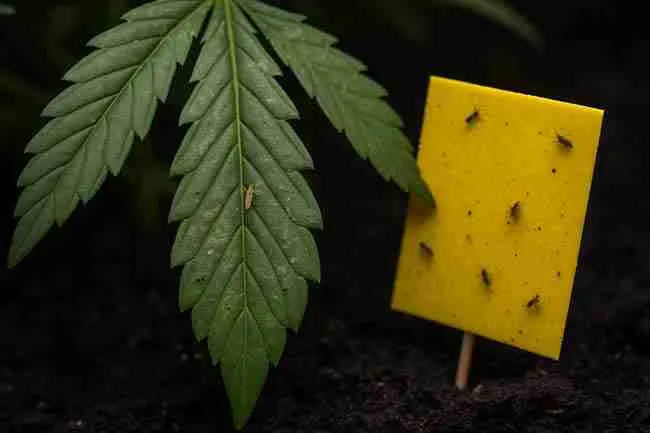
- fungus gnats partying like it’s Friday
- mildew risk climbing
- buds that feel dense but “stale” smelling later
What’s happening: transpiration slows down, nutrient flow gets sloppy, leaf surfaces stay wet longer.
When VPD Is Too High (Air Too Dry / Too Thirsty)
This is the “desert room” problem.
You might see:
- leaf edges crisping
- taco curl (edges folding up)
- droop in bright light even when soil is moist
- rapid drinking, pots drying too fast
- calcium-like issues showing up in new growth
- buds that finish “dry” in aroma
What’s happening: plant dumps water too fast, stress climbs, stomata clamp down, growth can slow.
The Grower’s Cheat Sheet: How to Fix VPD Fast (Without Overthinking)
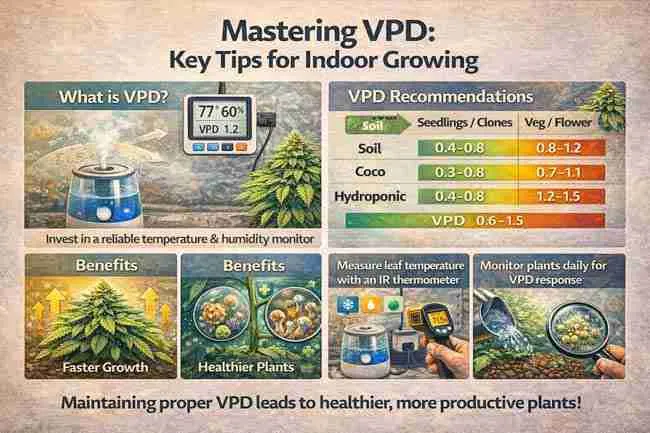
Here’s a simple, practical list you can use like a toolbox.
If VPD Is Too High (Too Dry)
Try these, in this order:
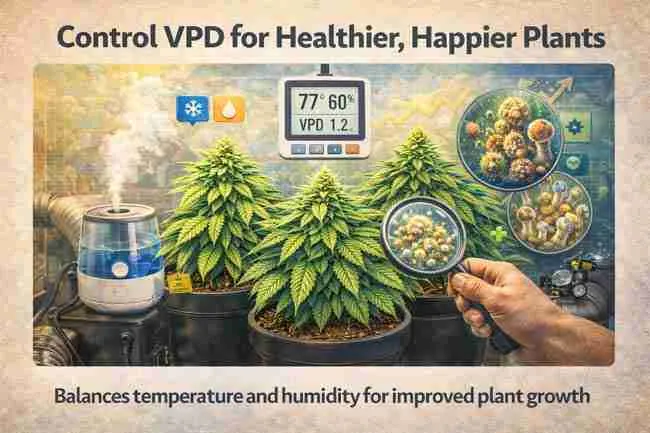
- Raise humidity (humidifier, wet towel near intake, larger water surface—old school but works)
- Lower temperature slightly (AC, lights a bit higher, dim slightly if needed)
- Reduce exhaust aggressiveness (less air dumping out = more humidity stays)
- Add gentle airflow across canopy (not blasting—just moving air)
If VPD Is Too Low (Too Humid)
Try these:
- Increase exhaust or fresh air exchange
- Use a dehumidifier (especially in flower—this one’s a workhorse)
- Raise temperature slightly (warm air holds more moisture, lowering RH)
- Improve airflow through and under the canopy
- Defoliate strategically (not scalping—just improving airflow paths)
And here’s the street-smart truth:
If you run a packed tent with fat colas, you’ll often need a dehumidifier in flower. You can fight it, but you usually won’t win.
VPD Cannabis and Different Grow Styles (Soil, Coco, Hydro)
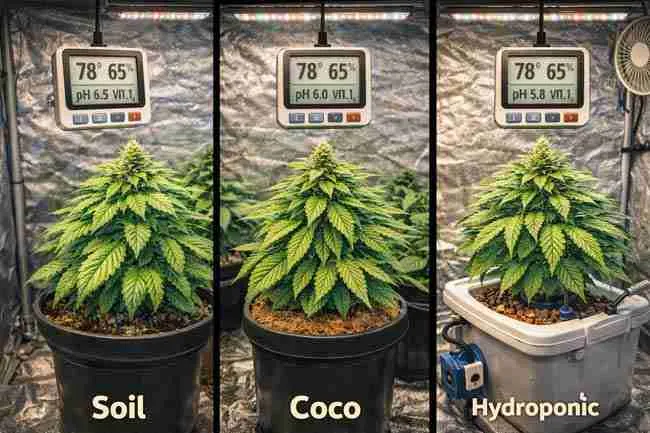
VPD affects every grow style, but each one reacts a bit differently.
Soil Grows
Soil holds water and buffers mistakes better.
- Low VPD can keep soil too wet too long → fungus gnats, slow roots
- High VPD can dry pots fast → you get wet/dry swings that stress roots
Your move: keep VPD steady and avoid dramatic drying cycles.
Coco Coir
Coco feeds fast and drinks fast.
- High VPD makes plants drink harder → EC can rise in the medium if you’re not careful
- Low VPD can slow transpiration → you can overfeed without realizing it
Your move: watch runoff EC and keep irrigation consistent.
Hydro (DWC, RDWC, etc.)
Hydro grows can explode with the right VPD.
- High VPD can push insane uptake, but stress shows quickly if airflow and temps aren’t stable
- Low VPD can make plants “lazy” and reduce oxygen-demand rhythm
Your move: stability matters more than chasing perfection.
Specifications: The Simple Gear Setup That Makes VPD Cannabis Easy

You don’t need a $1,000 controller. But you do need decent readings.
Hygrometer/Thermometer Specs (Minimum You Should Accept)
- Temperature accuracy: ±1°F (±0.5°C) or better
- RH accuracy: ±3–5%
- Fast refresh rate (not laggy junk)
- Ability to place sensor at canopy height
If your sensor is wrong, your VPD cannabis decisions will be wrong. Simple as that.
Sensor Placement (Where Most People Mess Up)
Put your sensor:
- at canopy height
- shaded from direct light (lights heat sensors)
- not directly in front of a fan blast
- not pressed against a tent wall
If you can, run two sensors:
- one at canopy
- one lower near pots
That shows you stratification (hot top, wet bottom), which is super common.
Tools That Make Life Easier
- Small IR thermometer (leaf temp)
- Humidifier (seedling/veg)
- Dehumidifier (flower, especially)
- Controller (optional, but convenient)
- Good airflow fan (oscillating preferred)
Pros and Cons of Running VPD Cannabis On Purpose
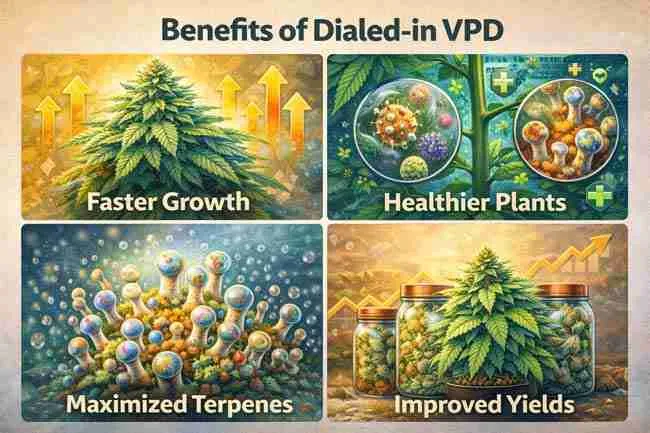
Pros
- Faster, steadier growth in veg
- Fewer calcium “mystery problems”
- Better control of mold risk in flower
- More predictable watering schedule
- Healthier stomata behavior (better CO₂ use)
- Better finish potential when you ease stress late flower
Cons
- You can’t ignore temperature anymore (it matters every day)
- Cheap sensors can sabotage you
- Flowering rooms may require a dehumidifier (extra cost, extra heat)
- You can over-correct and chase numbers if you don’t stay calm
The trick is to use VPD like a steering wheel, not like a panic button.
The Most Common VPD Cannabis Mistakes (And the Fix)
Mistake 1: Copying Someone Else’s Numbers
Their tent isn’t your tent.
Their exhaust isn’t your exhaust.
Their lights might run hotter or cooler.
Their leaf temp may be totally different.
Fix: use targets, then adjust based on plant behavior and your environment.
Mistake 2: High Humidity + Weak Airflow in Flower
That combo grows mold like it’s a hobby.
Fix: airflow through the canopy + dehumidification + reasonable temps.
Mistake 3: Running Too Dry Because You’re Scared of Mold
Yes, mold is real. However, crispy stressed plants don’t yield or taste great either.
Fix: keep early/mid flower VPD reasonable, then ease stress late flower.
Mistake 4: Ignoring Night Conditions
Night temps drop, RH spikes, VPD crashes. That’s when mildew sneaks in.
Fix: manage lights-off humidity with:
- dehumidifier timing
- steady exhaust
- a small heater if needed (warming air lowers RH)
A Real-Life Example: Dialing In Cannabis Humidity Temperature Balance

Let’s say you’re in veg.
You’re sitting at:
- 78°F
- 45% RH
Plants drink fast. Leaf edges start to curl. Pots dry too quick. You think, “Maybe I need more nutrients,” but nah—this smells like VPD cannabis running too high.
So you:
- bump RH up to 60%
- keep temp the same
Now the plant stops acting like it’s in a wind tunnel. Drinking becomes steady. New growth looks smoother. Boom—problem solved without touching your feed.
That’s the power of cannabis humidity temperature balance. You didn’t need math. You needed the right lever.
FAQ: VPD Cannabis Questions Growers Ask All the Time
What’s the best VPD cannabis range for seedlings?
Aim around 0.4–0.8 kPa so the air doesn’t yank moisture out of weak little seedlings. Keep airflow gentle.
Is higher VPD always better for faster growth?
Nope. Too high and the plant stresses, stomata close, and growth can slow. Fast growth comes from balanced vapor pressure deficit cannabis, not extreme dryness.
Why do my plants look overwatered when my pots aren’t that wet?
Low VPD can make plants transpire poorly, so leaves can droop even when you didn’t drown them. Check temperature + RH together.
Do I need to measure leaf temperature for VPD cannabis?
You don’t need it, but it helps a lot. Leaf temp is what the plant actually experiences. An IR thermometer makes this stupid easy.
What VPD should you run in late flower to protect terpenes?
A gentler range often works best: roughly 1.0–1.3 kPa, with good airflow and controlled humidity to avoid mold.
Can VPD fix calcium issues?
It can fix the cause behind many calcium-like problems. If transpiration is weak or chaotic, calcium delivery suffers. Dialing in VPD cannabis often cleans up new growth problems fast.
Why does my humidity spike when lights go off?
Air cools down, and cooler air holds less water. RH rises, VPD drops. That’s why night control matters.
What’s better: controlling RH or controlling VPD?
If you control VPD, you automatically control RH and temperature as a team. RH alone is a half-truth.
Does vapor pressure deficit cannabis matter if you grow in soil?
Yes. VPD affects transpiration and nutrient flow no matter what medium you use.