Cannabis Soils: Mix, Drainage, pH, and What to Buy

Cannabis soils are a mix, not a bag with a mascot. Roots need air, water, a place to hang onto nutrients, and a pH they can actually drink from. The old page on this URL already had those pieces: drainage, water holding, light vs heavy texture, pH, organic amendments, and mixing your own. It also told you to skip perlite unless you had nothing else, and to bake backyard dirt in the oven for indoor pots. Those two lines fight how people actually grow now. Perlite, pumice, or lava rock is how a container stays alive. Yard dirt belongs outside, or it brings the yard indoors.
This rewrite keeps that backbone and teaches what ranks when growers search cannabis soils: bagged potting mix vs peat/perlite vs coco vs living soil, 20–30% aeration, pH around 6.2–6.8, the squeeze test, and a mix you can actually water. You are filling a fabric pot or a bed, not collecting soil trivia. If the handful smears like batter, the plant is already in trouble.
What Makes Cannabis Soil Work

Good cannabis soil does four jobs at once. It holds some water so you are not watering three times a day. It dumps the extra so roots can breathe. It stores nutrients instead of flushing them out the drain hole. It sits in a pH window where those nutrients can move. Miss one job and the plant looks hungry even when you just fed it. Dirt vs living soil: dirt vs living soil. Medium choice if you are still deciding soil vs coco vs hydro: best medium to grow cannabis.
Nutrients and holding them
The old page called this nutrient holding capacity. The lab word is cation exchange capacity. Clay and humus are parking spots for calcium, magnesium, potassium, and ammonium. Sand and perlite have almost none. That is why a bag of 100% perlite cannot “hold” a feed, and why a peat-castings mix can. CEC walkthrough: cannabis and CEC. Outdoors you do not know the parking lot until you test. Indoors you build it: peat or coco for body, compost and worm castings for humus, aeration so it does not turn to mud.
A bag that lists a charge (Ocean Forest, some “hot” organics) is already a feeding program. You bought three to five weeks of food. A light peat/perlite mix is almost empty. You feed from the start. Neither is wrong. Mixing them up is how seedlings burn and how veg plants stall.
Drainage: Perlite, Pumice, and Why Roots Drown
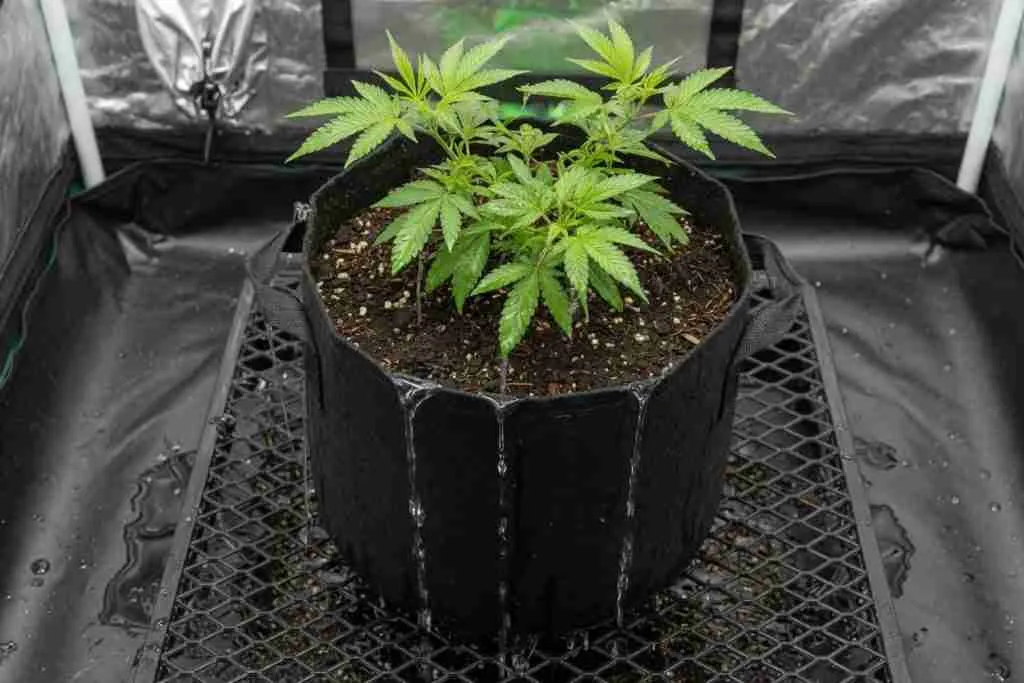
Cannabis roots rot in a swamp. If the pot is still heavy two days after a full water under a real light, the mix is too tight or you are watering a wet pot. Water should run out the bottom on a thorough drink. Then you wait until the pot is light again. Lift it. Do not poke a finger in the top inch and guess. Watering: water cannabis plants. Drowning looks like dying: cannabis plants are dying.
The live page said perlite was a last resort and pushed lava rock, clay pellets, sand, and gravel. Lava rock and pumice are excellent. They do not break down as fast as cheap perlite. Clay pellets are hydro gear; a handful in soil is decoration. Sand and gravel in a small indoor pot make it heavy and can pack. For a home tent, 20–30% perlite or pumice by volume is the ranking answer and the one that actually drains a bagged mix. Most bags already have a token sprinkle. Add more. Target air-filled porosity around 20–25% in a container. That is what high-porosity peat mixes are built to be.
Fabric pots help because the wall breathes. They do not fix a clay batter. A plastic pot with no extra aeration is how you water on a calendar and lose the root zone. Drain holes are not optional. A saucer of standing water is a gnat farm.
A 1.5 cubic foot bag of potting mix is about 11 gallons. To land near 25% aeration, mix that bag with roughly 3.5–4 gallons of perlite, not a coffee cup. Do it in a tub, dry, then wet. If you only stir perlite into the top of a filled pot, the bottom stays a swamp and the top dries out. Roots live in the whole volume. Mix the whole volume.
Water Holding and the Squeeze Test
The other failure is a mix that dries to dust in six hours. That is too much aeration, too small a pot, or a light that is cooking the medium. Peat and coco hold water. Perlite lets it go. You want both. The old “2 to 3 days between waters” is a 5-gallon under a moderate light, not a law. A 2-gallon auto under a 200-watt LED drinks faster. Lift the pot.
Squeeze test after you mix. Dampen a handful. Squeeze. Open. It should hold a shape and crack, not smear like brownie batter, not fall apart like dry sand. Smear: add perlite or pumice. Dust: you never wet the peat, or you went too lean on organics. Peat is hydrophobic when bone dry. Pre-wet it. Coco from a brick needs to be expanded, rinsed if it is salty, and buffered if the bag did not already do that.
Light Mix vs Heavy Mix
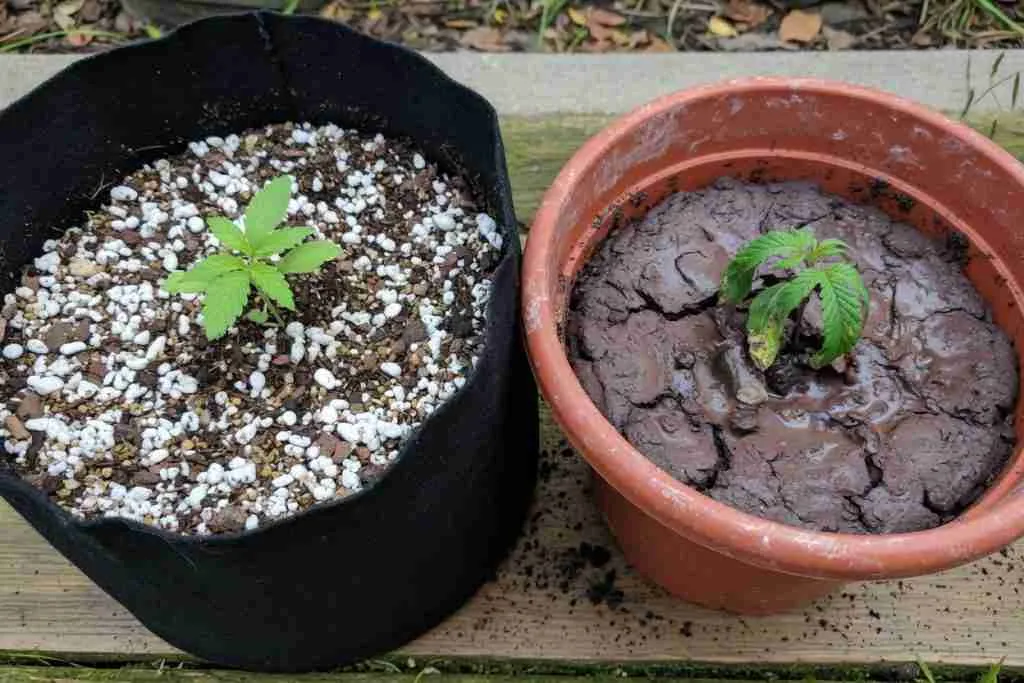
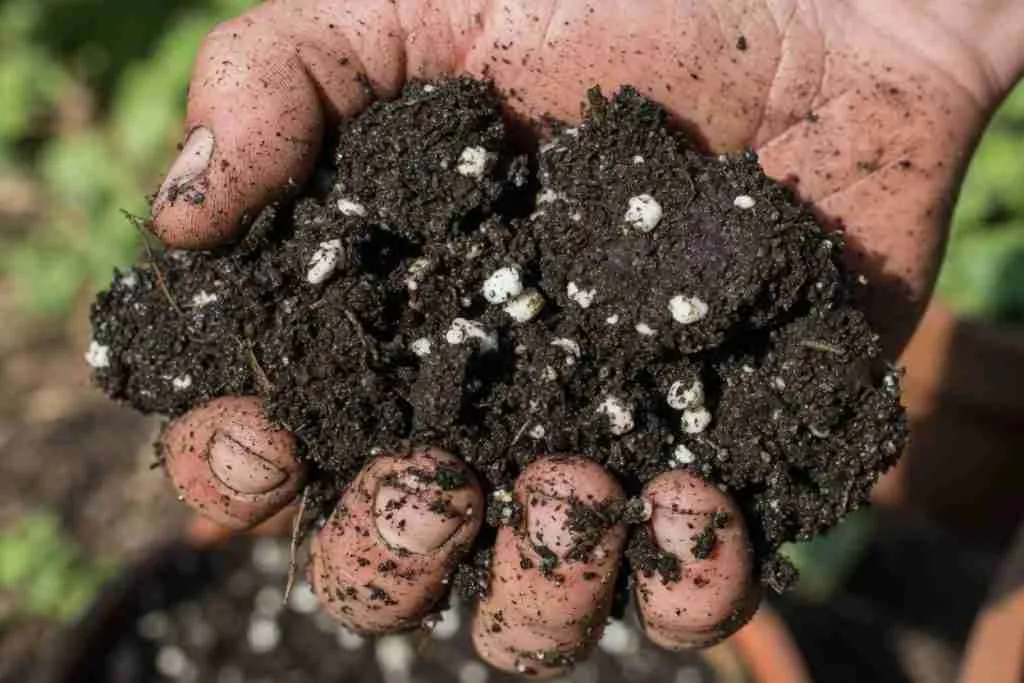
Cannabis wants a light, fluffy mix in a pot. Heavy clay outdoors is a different job. You can fork compost, bark, and aeration into a bed. You cannot shovel that clay into a 5-gallon and call it cannabis soil. The seedling on the right in a cracked mud pie is what “free dirt” looks like after one watering. The left mix is what you are aiming at: dark crumb, visible perlite, air.
Indoor rule: do not bring outdoor soil into the tent. Fungus gnats, slugs, weed seeds, and mystery fungi ride along. The old bake-at-175°F trick kills pests and also kills the biology you wanted. If you need indoor mix, buy a bag or blend peat/coco, aeration, and castings. Outdoor beds can use native soil if you amend it in place: growing cannabis outdoors, cover crops for outdoor soil. Indoor rooms: indoor cannabis growers guide.
Outdoor clay: you are not making a 5-gallon recipe at acre scale. Fork compost and bark into the top 6–8 inches. Add coarse sand only if you already have compost, or you make brick. Raised beds with imported mix are cleaner if the native ground is glue. In-ground plants still want a mound that sheds winter water. Cannabis hates wet feet in April as much as it hates a baked crust in August.
Soil pH for Cannabis
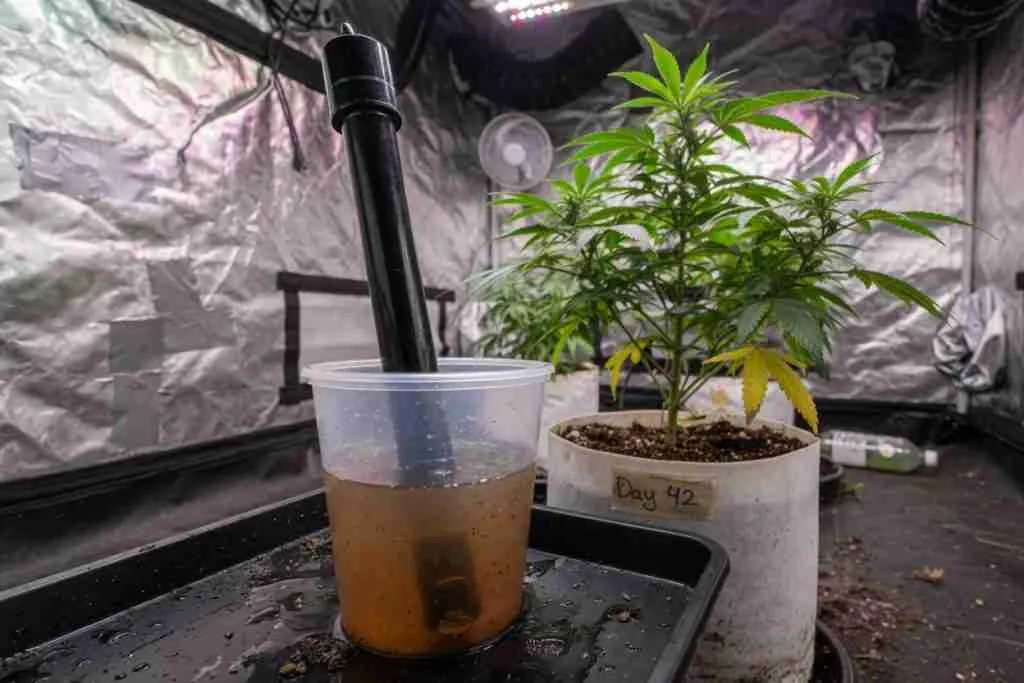
Soil pH is the window, not a religion. Working range is about 6.0–7.0. Most home growers aim 6.2–6.8. The old page said 6.0–6.5. That still works. Do not chase 6.50 every watering in a living mix. Organic soil buffers. Coco is a different window (about 5.8–6.2) and a different article. Full pH guide: pH for growing cannabis.
Peat is acidic. Lime it. Powdered dolomite is the usual indoor add, about a tablespoon per gallon of mix as a starting point, not a cup dumped on a 3-gallon. Too much lime and you lock iron. Coco often needs calcium and magnesium even when pH looks fine. Check runoff if the plant is pale for no reason. Calibrate the pen. A dead meter is how people “fix” a mix that was never the problem.
Hard tap water can sit at 7.5–8.2 and slowly drag a peat mix up. If new growth yellows between the veins, that can be iron lock from high pH, not a nitrogen shortage. Do not answer it with more blood meal. Check the water first. Rain and some RO sit low and need a buffer in soil. Organic mixes forgive more than salt coco, but they are not immune to a well that tastes like limestone.
What to Buy vs What to Mix

Three honest indoor paths. A quality bagged potting soil plus 20–30% perlite: most forgiving, water every few days, feed when the bag’s charge runs out. A peat/perlite base like a high-porosity mix: faster, you feed earlier. Coco/perlite 70/30: fastest, daily water, Cal-Mag from the start. Living or super soil: you load the mix, cook it, then water. Bigger pots. Less steering mid-flower. No-till version: no-till living soil. Reuse primer: organic cannabis soil.
Skip Miracle-Gro-style beads and moisture crystals. The beads are a timed salt bomb. The crystals hold a swamp around the root. Look for peat or coco, perlite or pumice, compost or castings, and a listed pH. “Garden soil” and “topsoil” bags are for the ground, not a tent. Seed starting wants a lighter mix than a 20-gallon living pot: best soil for growing cannabis seeds.
Hot bags burn seedlings and many autos. Start in a light mix, transplant into the richer soil once roots fill the cup. Happy-Frog-style light organic is the usual baby mix. Ocean-Forest-style is the usual veg mix with extra perlite. First crop: planning your first cannabis crop.
Read the bag for time-release fertilizer and wetting crystals. If you see colored beads, that is a timed salt. Fine for a patio tomato if that is what you wanted. For cannabis it fights your bottle and your organic program at the same time. You cannot turn it off. Return it. A boring peat-perlite bag you can amend is worth more than a “moisture control” bag you cannot.
A Simple Cannabis Soil Recipe
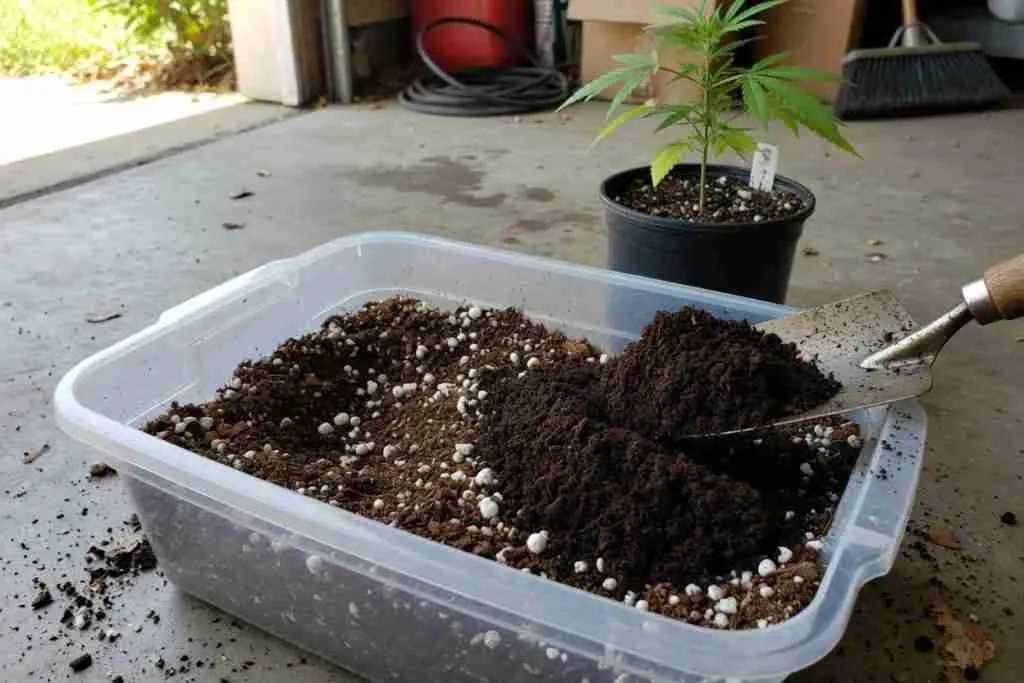
By volume, for indoor fabric pots you will bottle-feed or top-dress:
- 40% peat moss or coco
- 30% perlite or pumice
- 20% worm castings or quality compost
- 10% more aeration if the compost is heavy, or more peat if it dries too fast
- Dolomite lime if you used peat, about 1 tablespoon per gallon of finished mix
Mix dry-ish in a tub, then wet to a wrung sponge. Squeeze test. Fill pots loosely. Do not pack. A 5-gallon fabric pot is a common home size for a photoperiod. Autos often finish in 3–5 gallons of this mix. Seedlings get the same recipe with castings cut to 5% or a plug, then transplant: cannabis seed germination.
Worked volumes. Four 5-gallon pots in a 4×4: about 20 gallons of finished mix. That is roughly 8 gallons peat or coco, 6 gallons perlite, 4 gallons castings, 2 gallons wiggle room. A 2×2 with two 3-gallon pots is about 6 gallons of mix. Buy the perlite first. People always under-buy the white bag and then skip it. A 30-gallon outdoor smart pot can take a slightly richer organic charge because the volume buffers mistakes a 2-gallon cannot.
Reuse last run by screening roots, adding a fresh 10–15% castings, and half the meals if you used them. Water, wait a week if you can. If the old mix smells sour or is full of gnats, compost it. Do not “refresh” a swamp. Details: organic cannabis soil.
Organic Amendments That Earn a Spot

The old list is still the right starter kit. Full menu: organic growing amendments and organic marijuana fertilizer.
- Worm castings — biology and a slow trickle of N. About 10–20% of the mix, not 100%. Guide: worm castings for cannabis.
- Blood meal — slow nitrogen for veg. Easy to overdo. A little goes a long way in a small pot.
- Ground eggshells — slow calcium. They take forever. Fine in a bed. Do not count on them to fix a Cal-Mag crash this week.
- Bat guano — the old page filed it under potassium. Guano varies. High-N guano is veg food. High-P guano is bloom. Read the number on the bag.
- Rock dust — micros on a long clock. Rock dust in cannabis cultivation.
Do not dump a cup of each “for luck” into a 3-gallon. That is a hot mix. Seedlings and autos will claw. If you load meals, you are building super soil. That mix needs time to cook, and a light cap on top so the first roots do not sit in the hottest layer.
Cooking a Mix, and Putting It in the Pot

A light peat-perlite-castings mix can go in the pot the day you blend it. A mix loaded with blood meal, bone, guano, and kelp should sit warm and barely moist for two to six weeks, turned once a week. That is “cooking.” Microbes start breaking the meals down so the first drink is not a salt slap. Four to eight weeks is safer for a hot recipe. Test with a sprout in a cup if you are unsure. If the sprout burns, cap the pot: hot mix in the bottom two-thirds, light mix in the top third where the seedling lives.
Keep the cook pile covered so it stays damp, not sealed so it goes anaerobic. A trash can with the lid cracked, or a tote. If it smells like a dumpster, you went too wet. Turn it, add dry peat or perlite, try again. Worm castings in the mix speed the cook because they bring the crew. That is the old page’s best line, and it is still true.
Mistakes that wreck a mix
- Yard clay in a small indoor pot.
- No extra perlite in a bagged mix, then watering every other day.
- Hot super soil against a seedling stem.
- Moisture crystals and timed-release beads.
- Packing the pot like you are setting a fence post.
- Chasing pH 6.50 every day in a buffered organic mix while the real problem is a wet root zone.
- Feeding an already-hot bag at full bottle strength in week one.
- Letting a fabric pot sit in a puddle so the “breathable” wall is a wick into swamp.
After it is in the pot, the soil is only as good as the room. Light still writes the grams: grow lighting for cannabis. Climate still cooks or stalls roots: best growing environment. Veg and flower still have different drinks: vegetative stage, flowering stage. White roots that smell like soil, not swamp: healthy cannabis roots. Compost leftovers instead of landfilling them: composting for cannabis growers.
FAQ: Cannabis Soils
What is the best soil for cannabis?
The one that drains, holds a drink, sits near pH 6.2–6.8, and matches how often you can water. For most first indoor grows that is a quality potting mix plus 20–30% perlite, or the simple recipe above. Living soil is better at forgiveness, not automatically at yield.
Should I add perlite to bagged soil?
Almost always. Bags are shy. Aim for about a quarter to a third of the final volume as aeration. Pumice if you hate perlite dust. Do not skip aeration because an old paragraph said lava rock only.
Can I use garden soil in pots?
Outdoors in a bed, amended, yes. In an indoor pot, no. It packs, it stays wet, and it imports pests. Buy or mix a potting blend.
What pH should cannabis soil be?
About 6.0–7.0. Aim 6.2–6.8. Lime peat. Do not chase tenths every day in a living mix.
How long should super soil cook?
A gentle castings mix: days to two weeks. A meal-heavy mix: plan on four to eight weeks, moist, warm, turned, then a sprout test.
Coco vs peat in the same recipe: coco dries more evenly and needs Cal-Mag. Peat buffers more and can stay wet in the core of a plastic pot. Either works with 30% aeration. Do not mix half bagged “moisture control” peat with coco and then guess the water schedule. Pick one base. Autos in a hot organic mix stall easier than photoperiods because they cannot wait in veg while you correct a claw. Keep autos on the light recipe. Photoperiods can take the richer pot after they have real roots.
After transplant, water the new mix until you see runoff, then leave it alone until the pot is light. The first week in a fresh organic mix, people overwater because they are nervous. The mix is wet. The plant is small. Wait. A clone or seedling does not drink a 5-gallon on day one. If the mix was cooked and still smells sharp, water once and wait longer. If the plant droops at lights-on and the pot is light, then water. Droop with a heavy pot is oxygen, not thirst.
How often should I water cannabis soil?
When the pot is light, not when the calendar says so. A 5-gallon in a 4×4 under a strong LED might drink every two to four days in late veg. A seedling cup might drink daily. A living 20-gallon might go longer. Lift. If you are watering a heavy pot because the top looks dry, you are drowning the middle.
Is living soil better than bottled nutrients?
Better at hiding small mistakes. Not automatically heavier harvests. Living soil wants volume, time, and a room that does not swing 30°F. Bottles in a peat/perlite mix want a schedule you will actually keep. Pick the routine, not the forum brag. The mix will not outgrow a weak light.
If you are mixing this week, start with 30% aeration, 15% castings, peat or coco for the rest, lime the peat, and water by weight. The plant will tell you if the mix is a swamp or a desert. Seeds that belong in that pot: cannabis seeds store. Questions on a specific bag: contact us.