


Best Growing Environment for Cannabis: Light, Heat, Air, and Humidity

When you grow cannabis, the room is half the crop. Buy the best cannabis seeds on the shelf and still get thin, fox-tailed, mildew-stained flower if the air around those plants is wrong. A grow tent makes the best growing environment easier because you can actually change the numbers. Outdoors you work with weather, wind, and a tape measure of sunlight. Same plant. Different job.
This page is how to build the best growing environment for cannabis on purpose: light, temperature, humidity, air, and reflection. Not a vibe. Numbers you can hang a cheap hygrometer on. You will know what to run in veg, what to drop in the last two weeks of flower, when a fan is helping, and when it is just blasting the leaves off. No fluff. If you only fix one thing after reading, make it the air at the tops of the plants, not a new bottle of bloom booster.
Why the Best Growing Environment Matters

If you want healthy plants and increased yields, the environment is not optional. A poor room lowers yield, invites disease, and gives you airy, harsh flower. Keep the growing environment in check and you get faster growth, greener plants, better pest resistance, stronger smell, and denser buds at harvest.
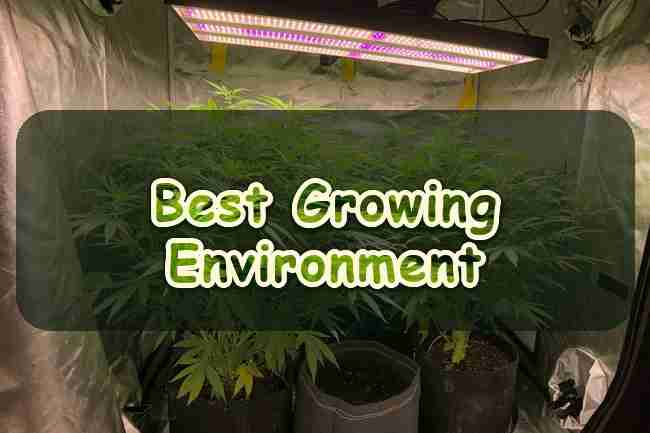
That photo is a real canopy, not a render. Look at how tight the tops sit. That is what happens when light, heat, and air agree with each other. The same genetics in a hot, still closet stretch, claw, and pick up powdery mildew. Happy plants pay you back for years. Stressed plants spend the run trying not to die.
Environment also decides how much of the seed you actually see. A loud terpene profile on the pack does not show up if nights stay too hot and you cook the oil off the flowers. A yield number from a catalog assumes you hit the plant with enough photons and did not stall it at 60°F. Treat the room like part of the recipe, the same way you treat soil and water. More on pots, media, and watering sitting next to climate: environment, media, watering, and pot size.
The Five Factors of a Cannabis Growing Environment
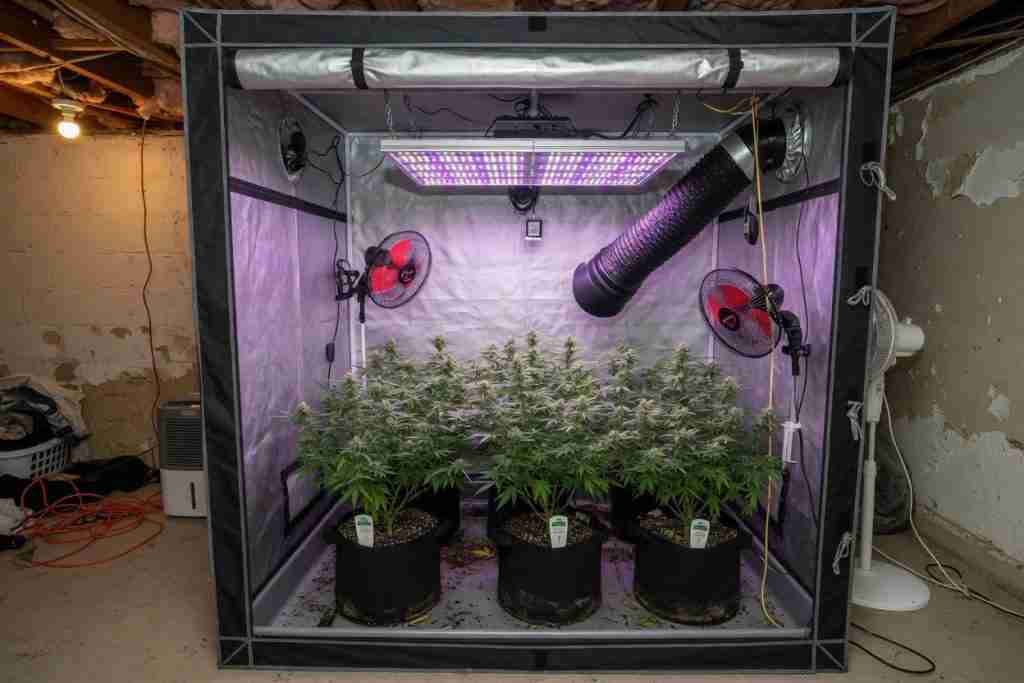
Rank these in this order. Light sets the ceiling. Temperature decides if the plant can use that light. Air keeps leaves working and diseases off the buds. Reflection squeezes more out of the same bulb. Humidity is the fine tuner, quiet until flower, then it will rot a colas in three wet nights.
- Light. Food for buds. Too little and you get stretch and popcorn. Too much and you bleach the tops.
- Temperature. Comfortable for you is close to comfortable for the plant. Veg likes it a bit warmer. Late flower likes it a bit cooler.
- Air. Fresh air in, spent air out, a gentle breeze through the canopy. Still air is how mildew starts.
- Reflection. Bounce wasted wall light back onto leaves. A tent does this for you.
- Humidity. High for clones and seedlings. Mid for veg. Low for late flower so buds stay tight and mold-free.
You do not need a laboratory. You need a tent or a sealed closet, an exhaust that actually pulls, a couple of clip fans, a thermometer/hygrometer at canopy height, and the discipline to look at it twice a day. Building the room from scratch: building a marijuana grow room. Keeping it from turning into a petri dish: protecting a cannabis grow from contaminants.
Grow Environment Lighting

Indoor grow lighting changed. Growers left hot, hungry high-pressure sodium for LEDs that run cooler and put more usable light on the leaf. Lighting in flower is the number-two factor in how large a harvest you take, second only to genetics. Veg does not need the same punch. Flower does. If you cheap out on the lamp and then chase yield with nutrients, you are feeding a plant that cannot eat the light it never got.
A practical ceiling: a modern LED in the 300W class can fill a 2×4 or a tight 3×3. A 4×4 that is supposed to make a pound wants something closer to 400–600W of real wall draw, hung correctly, not a 150W blurple from 2016. That is the same math the ranking grow guides keep repeating, because it is how photons work. Light is the budget. Everything else is how well you spend it.
How much light the plants can actually use
You do not need a lab meter on day one, but you should know the shape of the numbers. Seedlings want a soft 100–300 µmol/m²/s of PPFD. Veg is happy around 400–600. Flower wants 700–1,000 at the tops if the rest of the environment can keep up. Daily light integral in flower should clear about 30 mol/m² if you can get it. That is a 12-hour day at a strong average intensity, not a dim lamp left on forever.
Too much light shows up as tacoing, bleaching, and pale patches on the highest leaves while the lower canopy is still fine. Raise the bar, dim the driver, or both. Common hanging mistakes: growers’ biggest mistakes with grow lights. Seedlings that get cooked on day three: how much light cannabis seeds need. Side and under-canopy bars are a later trick, not a first-tent requirement: under-canopy and side lighting.
Spectrum: veg blue, flower red, without getting weird
If you are picking one light for the whole run, buy a full-spectrum LED made for cannabis and stop there. If you are mixing fixtures, veg likes more blue so plants stay squat and bushy. Flower likes more red and far-red for bulk. UV in small doses can push terpenes. None of that replaces intensity. A pretty spectrum at 200 µmol on a flowering 4×4 still makes light, fluffy buds. Where lighting is heading next: emerging cannabis lighting.
Temperature

Keep temperature in check or the plant slows down, then dies if it gets cold enough. The sweet spot most home grows actually hit is about 70–77°F (21–25°C) at the leaf. That is the range this site has taught for years, and it still works. The wider band plants will take is 65–85°F (18–30°C). Veg likes the warm end. Flower likes the cool end. Under 60°F (16°C) growth crawls. Over about 85°F without extra CO2 the plant starts shutting stomata and stretching fox tails.
Put the sensor at canopy height, not on the floor and not taped to the LED driver. Floor air is colder. The driver is a heater. You are growing the tops, so measure the tops. A $15 meter that you actually look at beats a $200 unit you ignore.
Day versus night
Lights off should drop 5–10°F. That swing helps color, resin, and smell in the second half of flower. A 10°F night drop is how a lot of purple actually shows, assuming the genetics have it. If nights stay as hot as days, buds stay looser and terpenes cook off. If nights crash more than 15°F, you slow the plant and invite condensation on flowers when the lights come back on. That condensation is a mildew starter kit.
Stage chart you can actually run
| Stage | Lights on | Lights off | Humidity |
|---|---|---|---|
| Seedling | 72–80°F | 68–75°F | 65–75% |
| Clones | 72–80°F | 68–75°F | ~70% |
| Veg | 70–85°F | 65–75°F | 45–60% |
| Early flower | 68–80°F | 62–72°F | 40–50% |
| Last two weeks | 64–75°F | 60–68°F | 35–45% |
You can run a bit warmer under strong LEDs if humidity is in range and air is moving. With added CO2 some rooms sit 82–88°F on purpose. That is not a first tent. If you are not enriching CO2, do not chase those numbers. You will just dry the plant out and fox-tail the colas.
Too cold, too hot, and fox tails
Cold rooms look dark green, slow, and sometimes purple in a sad way, not a bag-appeal way. Roots sit wet because the plant is not drinking. That is when fungus gnats move in. Hot rooms taco the leaves, stretch internodes, and push foxtailing on flowering plants. Foxtails are those little turrets stacking off the bud. Heat and too much light are the usual pair. Dense buds want a cool-enough flower room. Temperature is the second-most important factor after light for tight flowers. If you also want bulk, keep training honest: lollipopping.
Humidity by Stage

Humidity is quieter than light and heat until it is not. A veg plant will forgive 40% or 65% for a week. A week-7 cola will not forgive 60% with no air. The plant wants different moisture in the air at each stage because the leaf and the root are not the same size, and because dense flowers are a mold trap.
A useful way to think about it, without a physics class: VPD is just “is the air dry enough that the leaf can push water out?” Too wet and the plant barely drinks, calcium sits in the pot, and new growth twists. Too dry and it drinks itself into a wilt even though the soil is wet. You do not have to live on a VPD chart. Hit the humidity bands below at a sane temperature and you are in the pocket.
Clones and seedlings
Clones want around 70% humidity. They have no roots yet. They drink through the leaf. A dome or a propagator is the honest tool. Seedlings are close, but they already have a taproot, so 65–75% is plenty. Do not park seedlings at 85% for two weeks. That is how damping-off and stretched, glassy stems happen. Day-by-day seedling look: cannabis seedlings day by day. Whole seedling stage: seedling stage of growth. If they yellow in that wet cup, it is often water and light, not a missing bottle: seedling yellowing.
Vegetative growth
Veg wants 45–60%. That is wide on purpose. 50–55% at 75°F is a boring, excellent target. Higher humidity in veg can speed growth a little because the leaf is not fighting the air. Stay under 60% if you can. Over that, and you start growing fungus and slow, soft stems. A humidifier in a dry winter basement is normal. A humidifier in a sealed 2×2 in July is how you get gnats.
Flower and the last two weeks

First weeks of flower: 40–50%. Last two weeks: 35–45%. This is the humidity that actually makes or breaks a crop. Fat flowers packed together hold water. If the room stays wet, bud rot starts inside the cola where you cannot see it until the bud turns brown and smells like a basement. Powdery mildew loves still, humid air on the leaf. If you are already in flower and you see it, read harvesting with powdery mildew before you panic-spray.
If humidity will not drop, get a dehumidifier sized for the room, not a closet unit for a whole basement. Exhaust more air. Defoliate the interior so air can move through the plant. Do not just point a louder fan at a wet cola and hope. That dries the surface and leaves the core wet. Late-flower nutrient drama is a different page: flowering stage nutrient deficiencies.
Air Flow and Ventilation
You always want ventilation. Hot room, cool room, LED, leftover HPS, does not matter. Cannabis transpires. It dumps warm, wet air and it uses up CO2. If you do not pull that spent air out, the tent becomes a damp box of yesterday’s breath. A good rule: exchange the air about every one to five minutes. Five minutes is the slowest I would accept on a sealed tent. Faster is better if you can do it without turning the space into a wind tunnel.
Intake low. Exhaust high. Heat and humidity rise. A carbon filter on the exhaust is how you keep the hallway from smelling like week six. The filter goes inside the tent, then the fan pulls through it and out a duct. Negative pressure — tent walls sucking in a little — means smell stays in. If the walls are ballooning out, you are pushing stink into the house.
Clean air is how you stay off the pest and disease list: bud rot, mold, fungus gnats, thrips, mites. A still, wet corner is a farm. More on the pest side of a bad room: thrips on cannabis plants. A longer cultivation dump lives on the cultivation blog.
A gentle breeze over the plants
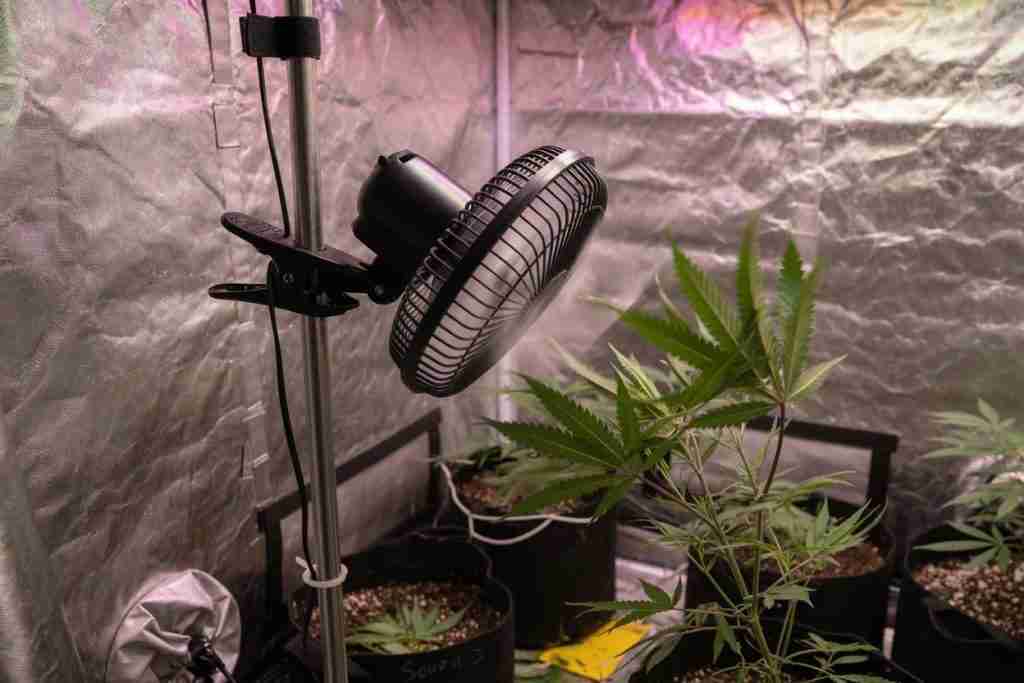
Do not blow the leaves half off the plant. You want a gentle breeze. Leaves should nod, not flag. Oscillating clip fans, two of them in a 4×4, one aimed across the tops and one stirring the stems, will do more than one floor fan on high. Pointing a shop fan at a plant is how you get leaf curl and claw that looks like overfeeding. Windburn is real. Still air is also real. Live in the middle.
Air under the canopy matters as much as air over it. If you lollipop and still have a jungle of wet fans in the dark, that is a mildew room. Strip the interior in flower so the breeze you already paid for can actually reach the buds.
Using ventilation to keep the heat down

The other job of exhaust is heat. HPS and metal halide made this obvious because they were space heaters with a bulb attached. LEDs still dump heat. The diodes are cooler than a 600W HPS, but a 480W LED in a closet will cook a 2×2 if you do not vent it. If the tent sits over 85–87°F (30°C) with the exhaust already on, you need air conditioning or a cooler intake, not a motivational quote. Even with LED, air exchange is not optional.
Worked example. 4×4 tent, 480W LED, basement in July at 78°F. Lights on, tent hits 88°F in twenty minutes with a 4-inch fan. That fan cannot move the heat. Step up to a 6-inch exhaust, open a second intake, and if it still hangs at 86°F, a small portable AC on a thermostat is the adult move. Do not dim the light to 40% for eight weeks and then wonder why the harvest is light. Fix the air so the light can stay on.
Reflective Walls and Making the Most of the Light

Cannabis is a light-loving plant. Light that hits a dark wall is light your buds never see. A grow tent already has highly reflective walls. If you are building a closet or a spare room, you have to add that yourself. Flat white paint is the cheap, honest option and reflects most of what hits it. Diamond-type tent material or white poly sheeting stapled smooth is the next step. Wrinkled mylar looks shiny and still throws hot spots and shadows. Smooth beats crinkled.

Anything that stops the walls from eating light helps the harvest. Do not use household aluminum foil. It reflects badly, makes harsh spots, and looks like a cry for help. Do not use emergency blankets that sag into the canopy. Hang the material, keep it clean, wipe the dust. Dusty walls are just beige again.
Indoor, Outdoor, and Greenhouse

Indoors you buy the environment. Outdoors you pick a site and then you manage what you cannot buy. Outdoors wants 6–8+ hours of direct sun, air that actually moves, water you can reach with a hose, and a spot that does not sit in a damp hollow after rain. Warm days around 75–85°F and cooler nights are the outdoor version of that flower chart. You cannot drop humidity to 40% in a wet September. You can pick a cultivar that finishes before the fog, prune for airflow, and keep water off the flowers at dusk.
Greenhouses sit in the middle. You get free sun and some control. You also get heat spikes at noon and humidity spikes at night. Vents, shade cloth, and a fan are not extras in a greenhouse. They are the environment. Hydro in a sealed room is the other extreme: you control everything, and everything will punish you if you nap. A DWC walkthrough: DWC hydroponics and the longer hydroponic cannabis grower’s guide.
Soil outdoors is more forgiving than a tent because the planet is a big buffer. A tent is a small box. That is why tents need meters. Outdoors you still watch for heat wilt at 2 p.m. and for bud rot after a three-day rain. The plant does not care that the sun was free if the cola is brown.
A Real 4×4 Tent, Run as a System

Here is one setup that actually matches the chart instead of a shopping list fantasy. 4×4 tent. 480W full-spectrum LED. 6-inch exhaust through a carbon filter, ducted out a window. Two clip fans. One cheap meter at the tops. Fabric pots. Soil or coco, your call. Watering is its own skill: how to water cannabis plants. Feed is its own skill: organic marijuana fertilizer.
Veg, lights 18/6. Aim 75–78°F lights on, 68–72°F off, 50–55% RH. Hang the light so the tops sit in that 400–600 PPFD band. If the newest leaves taco, raise it. If internodes stretch like a giraffe, lower it or add hours, do not just dump nitrogen.
Flip to 12/12. First three weeks of flower, drop humidity toward 45% and keep days under 80°F. Last two weeks, 70–75°F days, 40% RH or a hair under. Exhaust stays on. If the meter says 58% at lights off, the dehumidifier runs on a humidistat, not on your memory. That is how you keep trichomes on the flower instead of in a trash bag of rot.
Daily check, two minutes. Look at the meter. Feel the pot. Look at the tops for bleach. Look at the undersides of fans for mites. Listen to the exhaust. If the fan sounds like it is dying, it is dying, and the room will cook while you sleep. Environment is not a set-and-forget poster. It is a habit.
If you can hold light, heat, air, reflection, and humidity in the ranges on this page, you will take the harvest those seeds were capable of. That is the whole trick. Master the room and the plant does the rest. If you still need seeds for a new space, start in the cannabis seed shop.
