Advanced Nutrient Management for Cannabis Plants

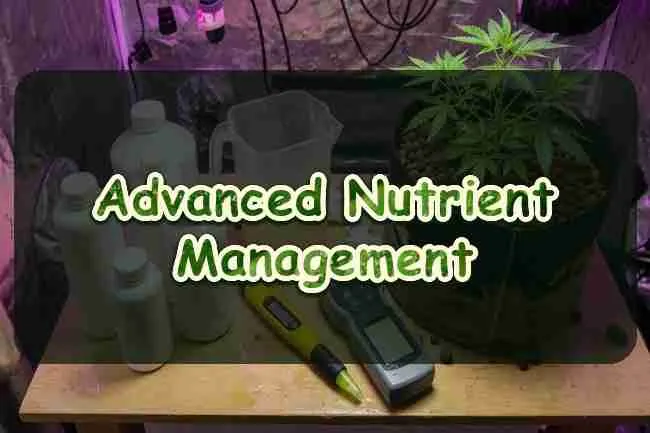
Advanced nutrient management is steering. You mix a jug. You read what came out of the pot. You watch the new leaf. Then you change one thing. The chart on the bottle is a first guess. The plant and the runoff are the job.
Stage food lives on cannabis nutrition across all stages. Phase numbers live on dialing EC by phase. Leaf color as a map lives on cannabis nutrient deficiency. You are here because the jug is already mixed and you need a way to steer it without stacking every bottle on the shelf.
Start from named cannabis seeds. A 5-pack is the default order. Named packs sit around four dollars CAD a seed. Mix packs sit around a dollar. Genetics still set the ceiling. Advanced nutrient management decides whether those roots get a recipe you can correct on Tuesday, or a salt pile you fight all month.
Advanced nutrient management is steering, not a chart

A beginner follows millilitres. An advanced room follows a loop. Mix. Pour. Catch runoff. Read pH and EC on the way in and on the way out. Look at the newest leaf tomorrow. Change strength, or change the ratio, or change nothing. Write it down. That loop is the whole skill.
Catch runoff in a clean cup, not the saucer soup from yesterday. In a fabric pot, tilt after the drink and take the first decent pour. In a drain-to-waste coco bag, the first 10 to 20 percent that leaves the bottom is the sample. Recirculating hydro has no runoff cup. You sample the reservoir after it has mixed, and you dump when the recipe has drifted. Same loop. Different sample.
You still need a complete base. Nitrogen, phosphorus, potassium, calcium, magnesium, sulfur, and the micros. The plant takes ions. Brand names do not change that. Bottled salts: synthetic cannabis fertilizers. Soil food: organic marijuana fertilizer. Pick one language for a crop. Mixing a three-part salt with a hot top-dress in the same week is two jobs in one pot.
Write the pantry on a card and tape it to the tent. Base bottles, water source, target pH band for this medium, last input EC, last runoff EC. That card is advanced nutrient management in one glance. Hardware can look identical from crop to crop. The card cannot, because the tap and the dimmer change.
One change at a time
If the leaf is pale and runoff EC is low, raise strength a little. If the leaf is pale and runoff EC is high, the gate is pH, water, or a crowded ion, and more bottle makes it worse. If tips burn, drop strength. If only the ratio looks wrong, keep the same EC and shift N versus K, or add a fish-safe calcium source, and wait a few days. Two bottles on the same Tuesday hide which one did the work.
The label is a starting guess

Feed charts assume a heavy eater, a bright room, and water with almost no minerals. Your tap may already carry calcium. Your tent may run 400 PPFD while the chart was written for 900. Start a new bottle at half the printed millilitres. Hold that for several drinks. Raise toward three-quarters only if the plant is hungry and runoff is not climbing. Full label is a ceiling some rooms never need.
Additives are how charts go hot. A base, a Cal-Mag, a silica, a PK, a bloom stim, an enzyme, a carbohydrate. Each one adds salt or changes pH. If you cannot name what the last bottle is for, it stays on the shelf this crop. Silica goes in first in many salt programs, before the base, because it hates acid. PK goes in only when the base is already boring. A carbohydrate syrup is extra sugar in a root zone that may already have a biofilm you wanted to keep. Count bottles on the bench. If you need two hands to hold them, you are stacking.
A 5-pack of named seed still matters more than a sixth additive. A dead neighborhood on a good seed is a wasted pack. Autos finish while you are still ramping. Photoperiods let you veg until the log is boring: photoperiod vs autoflower. Seedling cups want a gentle start: seedling stage.
Mix, then set pH
Put every bottle in the jug first. Then set pH. Acid first, then a calcium product, is how you get snow in the jug. Hard water already brings carbonate and calcium; that changes the starting EC: water hardness and cannabis. Soft water and RO leave the jug empty, so calcium and magnesium have to come from you. Stir until it is clear. Clouds that will not settle are a precipitate. Dump that jug and mix again in the right order.
Input versus runoff is the real log

Write four numbers: input pH, input EC, runoff pH, runoff EC. In coco and a drain-to-waste peat mix, aim for a little runoff each feed so the pot does not become a salt trap. If runoff EC walks well above input for a few drinks, the medium is holding more than the plant is eating. Feed lighter, or give a drink of pH’d water, then go back to a milder jug. If runoff EC sits below input and the plant is pale, it is eating. You can raise a little.
A practical steer: if runoff EC is 0.3 to 0.5 above input and the plant looks fed, hold. If it is a full point above and climbing, you are stacking. If it is below input for days and new leaves are lime, the plant is mining the pot. Give a slightly stronger drink, still under the printed chart. Do not chase a forum EC trophy. The phase bands live on the EC page. Your four numbers tell you which side of the band you are on.
Soil with a real buffer lags. You will not see the same tight runoff story. Lift the pot. Watch the new leaf. A slurry test tells you more than a cup from the saucer. Soil pH as a gate: optimum soil pH. Three-medium pH bands: pH for growing cannabis. Watering as a habit: how to water cannabis plants.
pH is the gate. EC is the size of the meal.
A perfect EC at the wrong pH is a closed door. Iron and manganese drop off as you climb. Calcium and magnesium get harder at the acid end. Lockout when the number is the gate: nutrient lockout. Calibrate the pen in fresh sachets. Store the probe wet if the manual says so. A cheap meter that drifted 0.4 will send you chasing bottles that were never the problem.
Change strength or change the ratio
Strength is how much salt is in the drink. Ratio is who is in the drink. Veg wants more nitrogen relative to phosphorus and potassium. Flower still wants nitrogen through stretch, then a leaner N and a steadier K as colas pack. Phosphorus has a ceiling. One hydro flowering trial peaked yield at a modest P level; extra P after that did not buy more flower. That story in full: phosphorus nutrition in cannabis. Potassium as a single ion: what potassium is for. A PK booster on top of a bloom base is often just more salt: bloom boosters.
If tips burn and the plant is dark, drop EC. Keep the same bottles. If the plant is a good color and stretching into flower, keep EC and shift the ratio toward bloom. If new leaves bleach while old leaves look fed, think iron or pH, not a bigger jug. Yellow from the bottom with pale new growth is a different letter: seedling yellowing early, nitrogen later. Veg as a stage: vegetative stage. Flower as a stage: flowering stage.
Wait three to five drinks after a change before you make another one. A nitrogen correction on an old leaf takes a week to show. Iron on a new leaf can turn around faster if pH was the gate. If you change the jug every time you walk in the tent, you will never know which mix worked. Advanced nutrient management is slow on purpose.
Keep some nitrogen through stretch
The first two to three weeks of 12/12 are still a growth job. Cut nitrogen to zero on flip day and you get a yellow stretch and weak laterals. Ease N down after the stretch, once pistils are everywhere and internodes have stopped racing. Outdoor bloom has its own sun clock: best fertilizer for outdoor cannabis grow bloom.
Ions crowd each other

Potassium in excess crowds magnesium and calcium. Phosphorus in excess ties up zinc and iron. Ammonium in a cold wet pot burns roots and shoves calcium aside. That is antagonism. The leaf looks hungry. The pot is already full. Adding the missing ion without dropping the bully is how you get a salt crust and a worse leaf.
Growers talk Ca:Mg around 2:1 to 3:1 in the jug, and K:Mg that does not run away with potassium in bloom. You do not need a lab to use that. If you added a PK booster and the next week the leaf shows interveinal yellow on old fans, drop the booster and keep magnesium in the base. If new growth is rusty and twisted after a calcium dump, you may have shoved magnesium out. The fix is a milder, more even jug, not a third bottle.
LED rooms run a high calcium and magnesium bill because the plant is working harder under that spectrum. RO and coco make it obvious. Tap that already tests hard may need little extra. Magnesium as its own page: magnesium for growing cannabis. A Cal-Mag bottle is a tool for empty water and coco. It is not a weekly vitamin on living soil that already has dolomite in it.
Read the newest leaf, then the runoff
Mobile ions (N, P, K, Mg) show on old leaves first. Immobile ones (Ca, Fe, S) show on new growth. If the new leaf is twisted and the runoff pH is off, fix the gate before you buy a calcium bottle. If old leaves fade in late flower and runoff is quiet, that can be a finish, not a crisis. Flush as housekeeping, not as a THC trick: flushing cannabis.
Light and water write the appetite
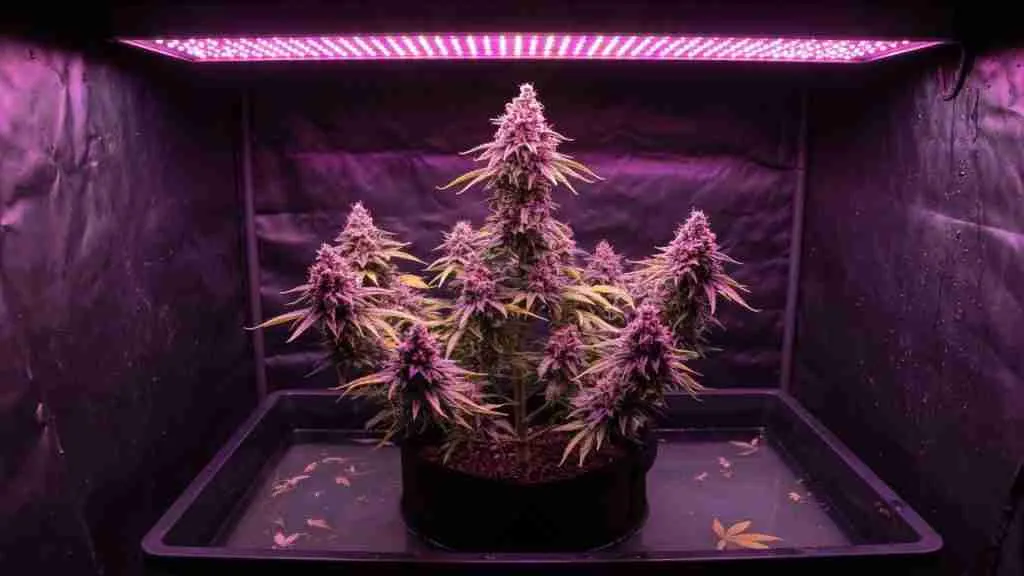
A plant under a weak light eats like a seedling even in week five of flower. A plant under a strong LED with moving air drinks and eats. Raise EC only after the canopy is actually using the light. Drop EC if you dim the bar or if nights get cold and the pot stays wet. Room, pots, and drink as a physical system: environment, media, watering, and pot sizes.
Transpiration is the pump. Dry air and moving air pull water through the plant and pull ions with it. A sealed tent with wet leaves and still air drinks little, then sits in a hot pot. The leaf will look overfed because the roots never got a dry-back. Open the intake. Aim the fan at the stems, not at a thrashing canopy. Then read runoff again. The jug may have been fine the whole time.
Overwatering looks like a nutrient problem because oxygen is gone and ions sit. Dry-back in coco is part of the feed. A swamp in soil is a lockout you will try to bottle-fix. The job list in order: most important things growing cannabis.
Soil, coco, and hydro lag on different clocks
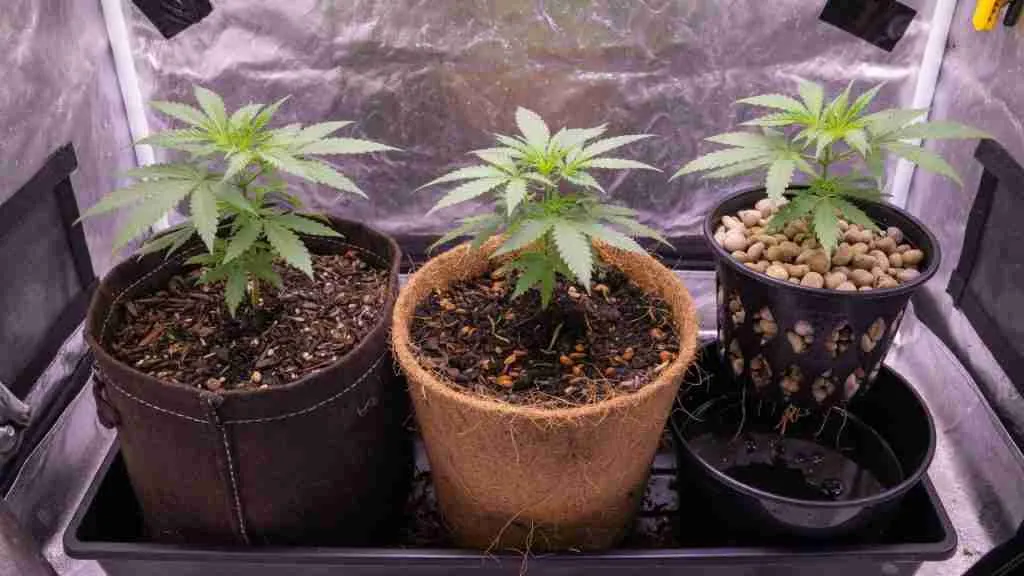
Soil holds a pantry. You feed less often. Mistakes show late. Coco is a daily conversation. Hydro is an IV. Buffer versus drip: soil vs hydroponic cannabis. Coco as a medium: growing cannabis in coco coir. A reservoir: hydroponic cannabis growers guide. Medium shopping: best medium to grow cannabis.
Living biology in a pot changes the lag again. Microbes hold and release. Peroxide and a salt dump wipe that crew: the cannabis microbiome. Amendments that belong in soil: organic growing amendments. A coco EC chart in a living mix is the wrong clock. Give soil a week after a top-dress before you decide it failed. Give coco two or three drinks. Give hydro a day.
A four-plant program you can actually run
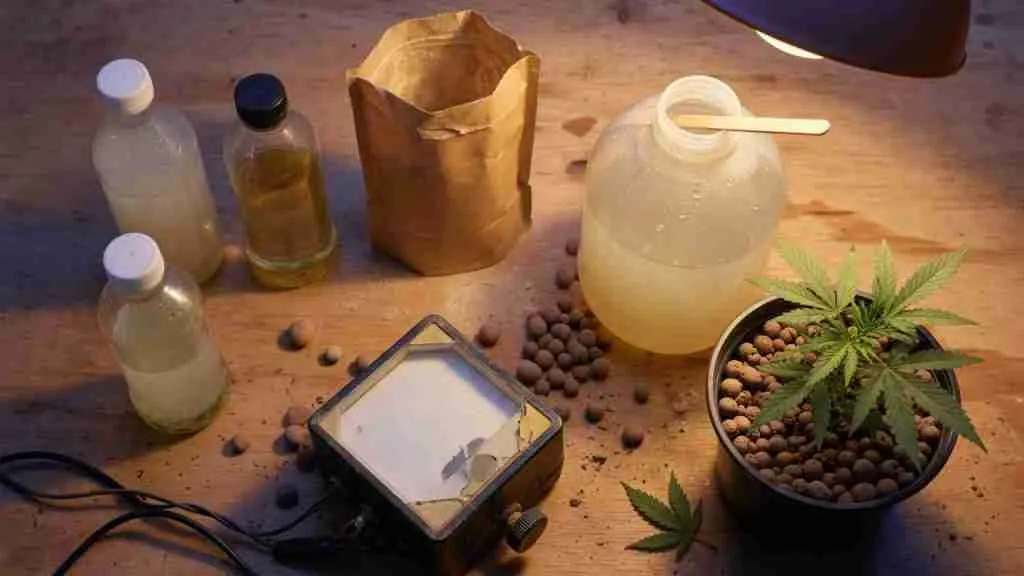
Canada’s Cannabis Act, section 12, caps recreational home cultivation at four plants per household. Quebec prohibits recreational cultivation. Manitoba has been indoor-only since 1 May 2025. Four plants is a small room. It is still enough to overfeed if you chase a commercial chart. A 4×4 with four plants in 5-gallon coco is a daily runoff job. The same four in 20-gallon living soil is a weekly lift. Match the program to the pots you actually own.
If you run bottled salts
One complete two- or three-part. Calcium and magnesium if the water is empty. pH pen. EC pen. Start at half label. Log input and runoff. Raise in small steps. Keep some N through stretch. Skip a PK spike until the base is boring and the plant is still hungry. Dump a hydro reservoir when the recipe walks away from you.
If you run organic soil
Build the pantry once. Water. Top-dress on a slow clock. Runoff EC is a weak story in a living mix, because the pantry is the soil, not the last jug. If the leaf goes wrong, check water and pH first. A tea is a nudge. Give it a week before you top-dress again. The soil is still working while you sleep.
The notebook that makes it advanced
Date. What you mixed. Input pH and EC. Runoff pH and EC. What the newest leaf did. Light dimmer position. That page is worth more than a sixth bottle. After one crop you will know whether your tap is a Cal-Mag room, whether your cut is a light eater, and whether your 4×4 actually uses the EC you thought it did.
A sample week in coco, four plants, one jug. Monday: mix at the same EC as last week, pH 5.9, 15 percent runoff, write the four numbers. Wednesday: pots are light, same jug, runoff EC up 0.4, hold. Friday: new leaves a touch lime, runoff back near input, raise the jug a little. You changed one variable. That is the program. Soil skips Wednesday. Hydro samples the rez each day and dumps on a schedule you already learned on the hydro page.
Advanced nutrient management questions that keep coming up
What is advanced nutrient management for cannabis plants?
Steering a complete feed by input, runoff, light, and the newest leaf. You change strength or you change ratio. You wait. You write it down. Marijuana yield still follows light, genetics, and a white root.
Should you follow the bottle chart?
Use it as a ceiling. Start at half. Many weed rooms never need the full printed dose. The chart does not know your tap or your dimmer.
Do you need Cal-Mag?
If you run RO, distilled, or coco, usually yes, in the base, not as a panic spray. If your tap is already hard, measure first. Extra calcium on a full pot crowds magnesium.
When do you switch to bloom food?
Ease the ratio after the flip, keep nitrogen through stretch, then lean N as colas pack. A hard cut on day one of 12/12 is a yellow week you did not need.
Is a PK booster advanced?
Only if the base is already dialed and the plant is still hungry at the same EC. Stacking PK on a hot jug is how tips burn and Ca/Mg disappear.
How often should you feed?
Coco: often, with runoff, every time the pot is light. Soil: when the pot is light, and not every watering has to carry salt. Hydro: the reservoir is the meal, dump when it drifts. Match the clock to the medium.
What EC should you run?
A band, not a trophy number. Seedlings stay gentle. Veg climbs as the plant can take it. Flower peaks only if light and roots can use it. The phase table lives on the EC page. Your log decides where you sit inside that band.
Should you foliar feed?
A foliar can nudge a mobile shortage while roots catch up. It will not fix a locked pot. Spray lights-off, skip late flower, and keep it dilute. If you need a foliar every other day, the jug is the problem.
Do you need a tissue test?
A lab leaf test is useful when four plants still look wrong after pH, runoff, and light are boring. For a home tent, the newest leaf plus the four numbers will get you through a crop. Save the lab for a cut you will run again.
When do you stop feeding?
When the plant is finishing and runoff is already mild. A crash two weeks out is an early stop. A dark, salty pot in week seven of flower is a late one. Plain water is housekeeping. It does not raise THC.